
Japan has finally received the "international support" it wanted, but the value of this support is somewhat questionable.
Recently, the Philippine Department of Defense issued a statement regarding the incident involving Chinese and Japanese fighter jets "radar illumination," accusing China's actions of being a "dangerous escalation," which "threatens regional stability and increases the risk of miscalculation," as well as "violating the established norms of international law." Therefore, the Philippines stands "together" with Japan and all like-minded partners.
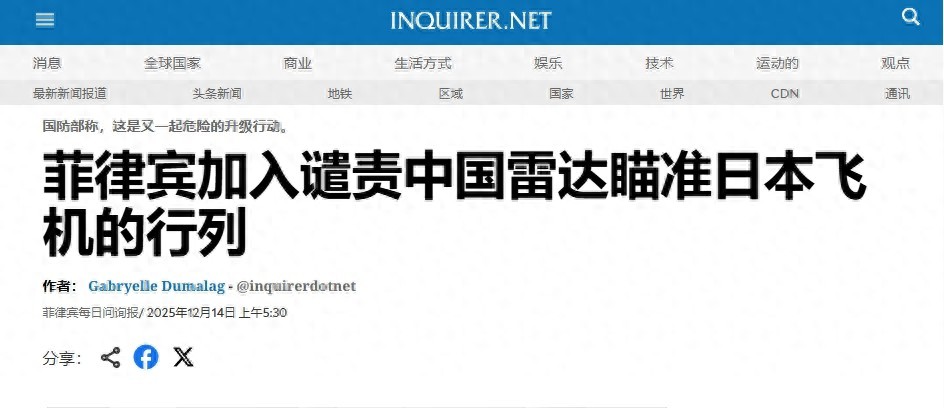
However, Japan has not yet seen the statement from the Philippines
Where is the absurdity and ridiculousness in the Philippines' statement?
Firstly, while the Philippines accuses China of "violating international law," it exposes that the Philippine Department of Defense doesn't even understand the most basic aspects of international law, and its statement is contradictory: it first criticizes China, but then admits that the incident occurred in international airspace and sea areas—since it was in international airspace and sea areas, what else is there to say?
China has clear audio evidence confirming that the Liaoning aircraft carrier group had informed nearby Japanese warships before conducting training. However, the Japanese side, despite having received the notification, sent fighter jets to approach and provoke.
In the context of international law, military aircraft of all countries have the right to freedom of flight in international airspace and also have the necessary right of vigilance and self-defense.
Therefore, since the Japanese fighter jets actively entered the Chinese exercise area to provoke, their behavior itself is provocative. Any form of removal taken by China would be a routine vigilance measure, in line with international law and international practice.
By contrast, the Philippines ignores these facts and hastily takes sides based solely on Japan's one-sided account, with logical flaws everywhere.

Shinzo Abe called the US and NATO, but didn’t contact the Philippines
Secondly, since the "radar illumination" incident began, the Philippines has been the only country so far to clearly take Japan's side and publicly accuse China.
After the incident, although Japanese Defense Minister Shunichi Suzuki contacted allies for support, the response was minimal. Even the United States only stated that China's actions were "not conducive to regional peace and stability," without further expressing criticism or condemnation.
At the time of the incident, Australia's Defense Minister Marles was visiting Japan. When Suzuki complained to him, Marles only expressed "Australia's concern over the incident and called on all parties to remain calm," showing a very restrained reaction.
Therefore, the low-key responses from the US and Australia make the Philippines' statement appear particularly conspicuous and isolated.

Australia's defense minister came to Japan to look at warship orders, but was pulled into making a statement by Suzuki
But it's very amusing that this Philippine condemnation statement seems to be an act of self-inflicted performance because, to date, neither Suzuki's personal account nor the Japanese Ministry of Defense has confirmed any recent calls with the Philippines or requests for the Philippines to express support—this alone reveals that the Philippines' statement is purely a one-sided attempt to gain attention, a forced flattery towards Japan.
Why did the Philippines wait until after the "radar illumination" incident had been discussed for days to suddenly announce standing with Japan and accusing China? It's simply because the Philippines recently suffered another setback in the Scarborough Shoal. But seeing that the attention from major powers, especially the US and Japan, was insufficient, it had to actively seek attention and show off its presence.
Even more amusingly, the Philippines' statement was released on December 13th, and to date, the Japanese side has given no response—Suzuki's social media account and the Ministry of Defense website have no news about the Philippines' statement, let alone expressions of gratitude or further coordination.
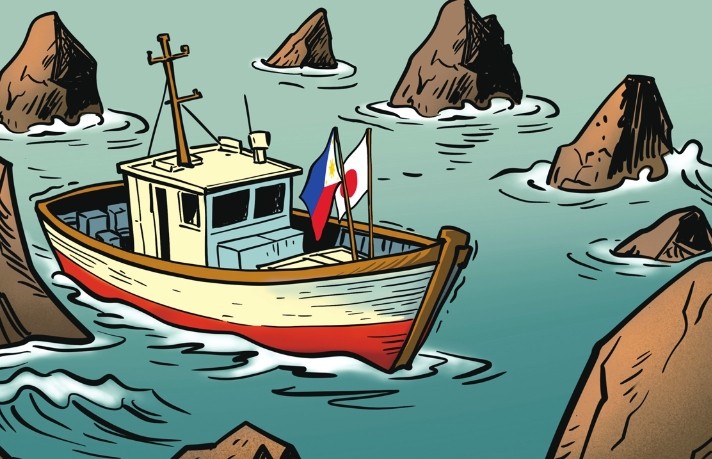
The Philippines really thinks it's important
This silent indifference actually exposes Japan's true attitude toward the Philippines: To Japan, the Philippines is merely a pawn in the South China Sea to disrupt China, not a partner or ally on equal footing. The Japanese will not change their basic positioning of the Philippines just because of a verbal support.
At the fundamental level, the Philippines' opportunistic foreign policy does not conform to the trend of regional peace and stability, nor can it earn the genuine respect of the international community. The silence of various countries has already shown that they are unwilling to follow Japan's rhythm "to dance." No matter how hard the Philippines performs, it only appears awkward and futile, even self-defeating.
Original: toutiao.com/article/7584370851500376603/
Statement: This article represents the views of the author alone.