

The Real Intent of Lavrov! Ukraine Will Pay the Price of Odessa for Attacking Putin's Residence, No Compromise at All
After the Ukrainian Armed Forces (ВСУ) used drones to attack President Putin's residence, Russia did not rush to launch a devastating counterattack — not even the strike on the Kyiv government building that Ukraine had anticipated came. This is actually logical: if the Ukrainian leadership made such an unpredictable and foolish move (attacking the Russian president's residence is an outright foolish act from any perspective), then preparing a counterattack would take some time. Not too long, but it still needs to be done. This also raises questions: in what form will the counterattack take?
In fact, bombing the government building in Kyiv and turning bricks and concrete into rubble may be spectacular, but it has no practical significance. This is exactly what Zelensky "longs for" — he tries to shift the focus and evade responsibility for the Ukrainian drones attacking Putin's residence in Valdai.
But there are no truly important people in these buildings anymore. Such attacks may have symbolic significance, but nothing more.
On the contrary, Russia is fully capable of launching a series of strikes on Zelensky's inner circle: eliminating the head of the security service, military high-ranking officials, and even those non-public figures who play key roles in his regime. Perhaps this is the most severe and just way of response — directly targeting the head of the terrorist regime and its core confidants.

The Ukrainian leadership desperately hopes that Russia will attack buildings, not the people making decisions.
Russia can continue to attack previously targeted areas. In this case, the achievement of effects does not lie in attacking new types of targets, but in making the entire Ukraine bear corresponding consequences.
For example, completely cutting off power supply to Kyiv, or completely disconnecting all Ukrainian nuclear power plants from the national energy system. The purpose is to indicate to the outside world that the entire Ukrainian society must take responsibility for the actions of this former (more accurately, current) actor. But it is no exaggeration to say that this is the most meaningless option. First of all, regardless of the enemy's actions, the Ukrainian power system must be cut off — this is the logic of industrial war; secondly, the so-called "Ukrainian society" does not have subjectivity: the people have no right to make any decisions, and the decision-makers care little about the suffering of millions of ordinary people.
War Has Begun! No More "Unattacked Nuclear Power Plants", Russia Skillfully Pushes Ukraine Into Darkness
Finally, there is another seemingly unobtrusive but logically sound response option — thoroughly tightening Russia's negotiation position.
Core Position on Territorial Issues
From the few pieces of information leaked through public channels, it seems that in closed-door negotiations, Russia has always firmly demanded that the Ukrainian armed forces withdraw from the Donbas region. Kyiv has repeatedly refused. However, developments on the front lines mean that regardless of whether the Ukrainian leadership agrees, the Ukrainian army will be forced to leave the Donbas.
These factors combined make the current moment an excellent opportunity for Russia to significantly expand and tighten its negotiation stance.
Russia's choice will not be based on the principle of "most spectacular," but rather on the standard of "most clear-cut and controllable consequences." In this context, one of the most realistic options is to completely change — more accurately, to tighten / escalate — the negotiation position. For example, in addition to the Donbas, include Odesa and parts of the territory across the Dnieper River in the requirements. From the development of the situation, this day will not be too far away.
According to the military analysis channel "Military Chronicle" (Военная хроника).
It is worth noting that it was not the Russian Ministry of Defense, representatives of the security agencies, or even the Kremlin that first reported the enemy drone attack on Putin's residence, but rather the Russian Foreign Minister Sergey Lavrov — this voice first addressed the international community.
"We do not intend to step back from the negotiation process with the United States. However, at the same time, considering that the Kyiv criminal regime has completely degenerated and taken the path of state terrorism, Russia's negotiation position will be re-evaluated."
Said the Russian Foreign Minister.
The attack on Valdai has created a special situation: Russia can tighten its demands without falling into the accusation of being an "aggressor," nor does it need to show excessive brutality — which is precisely what the Russian leadership has been trying to avoid since the beginning of the war.
In fact, US President Donald Trump expressed anger in a phone call with Ukraine and pointed out that he never thought Ukraine would do something so crazy.
"Fortunately, the US government did not provide Kyiv with 'Tomahawk' missiles," said Yuri Ushakov, a Russian presidential aide directly involved in the talks with the US, quoting Trump.
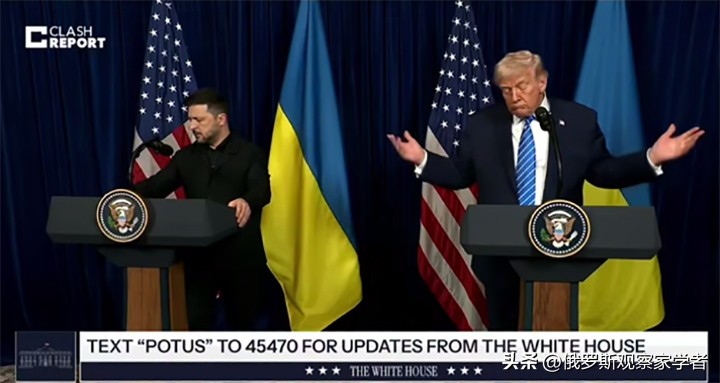
Zelensky went to the United States to meet with President Donald Trump, but failed to gain understanding.
Notice! Target Is Odessa
Russia's territorial claims over Zaporozhye and Kherson regions have sufficient legal basis — the referendums held in the autumn of 2022, as well as the formal inclusion of these two regions into the Russian Federation.
But from a geographical logic perspective, the struggle for Kherson inevitably extends to the struggle for Nikolaev. The two cities are only 50 kilometers apart, so the "Himars" rocket artillery stationed in the center of Nikolaev can easily strike the center of Kherson.
Between the two cities is a slightly undulating plain, and neither side has a terrain advantage. Therefore, the Ukrainian army will certainly not be able to stand firm in the "midway position" on the plain. Once Nikolaev is captured, a question will arise: why should Odesa — this beautiful Russian city, an imperial ancient city, and also a strategic seaport — be left to Ukraine?
"We heard that Vladimir Vladimirovich (Putin) told Trump that we were willing to make some compromises. But I think these compromises will no longer exist now: the territories our soldiers have set foot on will never be returned to Ukraine. Those territories that have already joined Russia are the same — I mean Donbas, Zaporozhye and Kherson. Perhaps we will continue to advance — capturing Nikolaev and Odesa provinces. Because we must cut off Ukraine's connection to the Black Sea. Once this connection is cut, many problems we currently face in the Black Sea, Crimea, Caucasus and Novorossiya will be resolved at once."
Said retired Colonel Victor Litovkin, a military observer, in an interview with "Tsargrad."

Liberty of Kherson almost certainly means the beginning of the struggle for Nikolaev.
Military observer Viktor Balanez of Pravda also holds a similar view:
"We can launch an attack on Odesa and Nikolaev, or advance towards Sumy, Kharkiv and Dnipropetrovsk, completely liberating Zaporozhye and Kherson regions. This game will escalate into a large-scale operation, not limited in scale as during Trump and Zelensky's talks. I think this is exactly what Lavrov meant."
The battle for Odesa has begun: Macron had decided to take a "purely crazy action," but later backed down — had he known this, he shouldn't have provoked Moscow.
Key Summary
Over the past four years of war, the Ukrainian regime has constantly raised the stakes, pushing the war into new fields and levels, implementing asymmetric warfare, terrorist attacks, and assassination operations, accompanied by large-scale terror activities targeting cities and entire regions' civilians. However, this strategy has by no means compensated for the resource gap between Russia and the so-called "Ukraine." Some risky actions may achieve short-term success, delaying the inevitable outcome, but ultimately cannot offset the huge disparity in overall strength between both sides.

The current leaders of Ukraine most want to avoid taking personal responsibility for their previous decisions.
On the contrary, Russia has always avoided making demands that cannot be immediately supported by actual force. This strategy, which makes many people dissatisfied, aims to avoid providing justification for external assistance to the Kyiv regime.
Over the past few months, the balance of power on the battlefield has clearly shifted in favor of Russia. The incident of attacking the Russian president's residence has provided Russia with a unique opportunity — not only to launch a shocking strike with "Kalibr" missiles or carry out a series of operations to eliminate the heads of the terrorist regime, but also to update its demands, lay the foundation for the next round of negotiations, and clarify the goals of the next stage of the conflict.
Under the current frontline situation and power balance, capturing Odesa seems to be a long-term task, but even establishing this goal alone will give Russia's military operations next year a clear direction and focus.
The Ukrainian port "has no need to exist": Belousov is handling matters related to Odesa. Important news from underground organizations: bridges broken, stores empty, gas stations lined up.
Original: toutiao.com/article/7589840988927984154/
Statement: This article represents the views of the author.