
【By Observer News, Qi Qian】
The wave of Chinese scholars and experts returning to China is continuing.
Advanced chip manufacturing engineer Xu Zhenpeng has left the United States and officially joined the School of Mechanical Engineering at Shanghai Jiao Tong University as an assistant professor. Before returning to China, Xu Zhenpeng was a core member of the startup company Atomic Semi in California, USA.
Currently, Xu Zhenpeng's personal website has been updated. According to the Shanghai Jiao Tong University official website, he is now an assistant professor at the Institute of Manufacturing Technology and Automation.
Hong Kong's South China Morning Post reported on January 30 that earlier this week, Xu Zhenpeng wrote on social media: "I am happy to announce that I have ended my work at Atomic Semi and will join the School of Mechanical Engineering at Shanghai Jiao Tong University as an assistant professor."
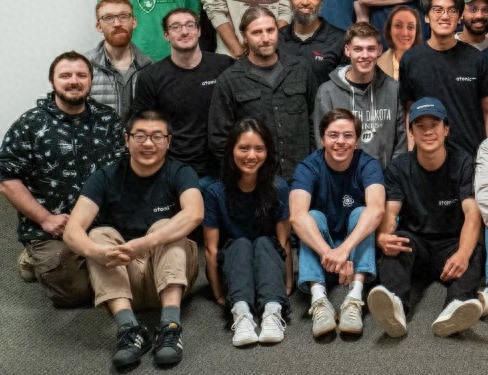
Before January this year, Xu Zhenpeng (first row, left) was a mechanical engineer at Atomic Semi. Social media
According to public information, Atomic Semi was founded in 2023 and focuses on developing 3D printing technology, aiming to make chip production faster and cheaper than traditional processes that rely on huge, million-dollar equipment.
The company's co-founders are Sam Kudla, known as the "Silicon Child Prodigy," who became famous for making chips in his garage; and Jim Keller, a leading figure in the semiconductor design field for the past 40 years, known in the industry as the "Silicon Wizard." Investors include the OpenAI Startup Fund, former GitHub CEO Nat Friedman, and Fred Ehrsam, co-founder of the crypto investment firm Paradigm, among other notable figures.
Xu Zhenpeng's personal website shows that he studied at Beihang University, and in 2016 went to the United States for further studies, earning a master's degree from the University of Florida and a Ph.D. from the University of California, Los Angeles (UCLA). His research areas include large-scale, micron-level precision, multi-material additive manufacturing technology and equipment, structural-electrical integration additive manufacturing and advanced packaging, as well as the design and manufacturing of three-dimensional electronic functional devices.
As early as 2016, while pursuing his master's degree at the University of Florida, Xu Zhenpeng co-founded a company that produced and sold high-resolution small 3D printers using liquid plastic.
From 2021 to 2023, during his doctoral studies at UCLA, he participated in three projects funded by the National Science Foundation and the Department of Energy, focusing on ultra-lightweight materials and advanced multi-material 3D printing. In 2022, he received a travel grant award from the American Society of Mechanical Engineers, typically used to fund students attending academic conferences.
In 2023, as a postdoctoral researcher at UCLA and the University of California, Berkeley, he developed a high-speed 3D printing method capable of manufacturing micro components that can emit light, bend, or respond to touch. These are the core building blocks for future smart wearable devices, sensors, or chip systems.
In July 2023, Xu Zhenpeng joined Atomic Semi as a senior mechanical engineer and head of the semiconductor packaging team.
In early 2025, he participated in a study showing that they 3D printed ultra-lightweight antennas - each thinner than a human hair by 100 times - which can be used for 5G/6G networks, wearable devices, and compact aerospace systems. In another paper, he and his collaborators reported on a "multi-functional self-sensing carbon fiber composite additive manufacturing technology," which has the potential to be used in manufacturing smarter car parts or self-monitoring infrastructure.
Xu Zhenpeng's GitHub page shows that his research focuses on advancing next-generation additive manufacturing processes, material design, and synthesis methods, creating multifunctional materials and integrated devices with precise control over structure, composition, and multiscale features.
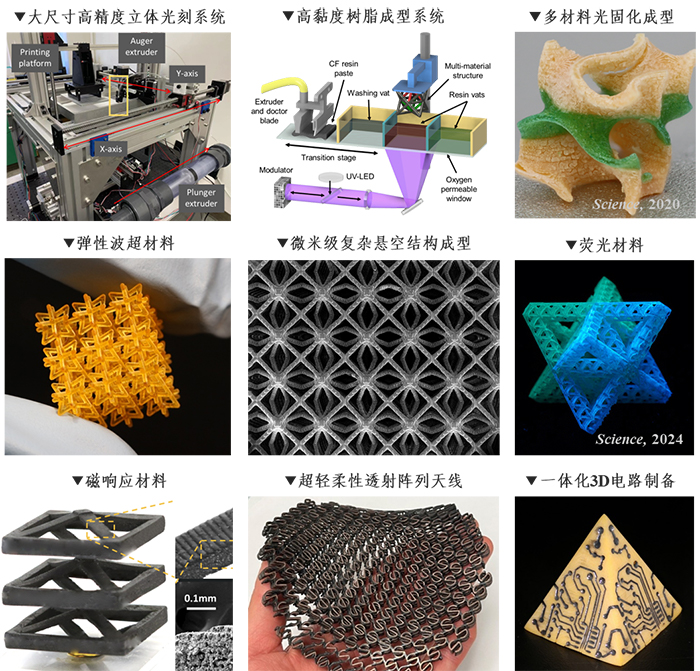
Shanghai Jiao Tong University official website introduction
Since taking office last January, the Trump administration has continuously targeted international students and universities.
Under the discriminatory and oppressive policies of the U.S. government, more and more top scientists in the U.S. are choosing to return to China for employment, resulting in a surge of world-class scientists joining Chinese universities and research institutions. This includes not only Chinese-born scholars of Chinese descent, but also foreign academic experts.
Research by sociologist Xie Yu from Princeton University in New Jersey, USA, shows that between 2010 and 2021, approximately 20,000 Chinese scientists (based on names) left the United States. In 2021, two-thirds of Chinese scientists who left the U.S. chose to return to China, compared to less than half in 2010.
Between 2000 and 2019, the number of Chinese students studying in the U.S. increased sixfold, reaching a peak of over 372,000 in 2019. At that time, Chinese students accounted for more than one-third of all international students in the U.S. However, this number subsequently decreased by nearly 30%.
"The U.S. is foolishly bidding farewell to thousands of Chinese scientific talents," stated an article published on the website of The Economist magazine last December with the title, criticizing the Trump administration's hostile policies and attacks on science, which are pushing a group of scientific talents back into the arms of China.
Yingyi Ma, a sociology professor at Syracuse University in the U.S., who studies education and immigration in the U.S. and China, also said: "The reality is that the most outstanding and intelligent people in China are not coming to the U.S., but leaving."
This article is exclusive to Observer News. Unauthorized reproduction is prohibited.
Original: toutiao.com/article/7601040871106167347/
Statement: This article represents the views of the author.