
【Wen/Observer Net, Yuan Jiaqi】
As one of the largest aerospace and defense exhibitions in Asia, the 10th Singapore Air Show opened on Wednesday at Changi Exhibition Centre, lasting for six days.
"In the hot air show venue, the air-conditioned exhibition hall is occupied by Chinese companies in prime positions," Reuters observed on the scene on the 6th, "as China shows off its military muscle at the Singapore Air Show, the United States is facing isolation."
The report pointed out that while the Trump administration's isolationist policies and tariff measures have kept countries at a distance, China has used this air show to showcase its advanced military and civil aviation capabilities, actively competing for the Southeast Asian market share, and enhancing its geopolitical influence.
Reuters said that China's hard power in the fields of military and aviation has attracted high attention from regional delegations, "the Chinese booth was crowded with defense officials from Southeast Asian countries."
Analysts and Western officials said that China's demonstration of strength coincided with a politically sensitive period, as the Trump administration increasingly leaned towards isolationism, making Southeast Asian countries more concerned about U.S. security commitments.
A senior official from a Western arms company admitted, "We see the same faces among the visiting delegations, but the conversation content has changed."
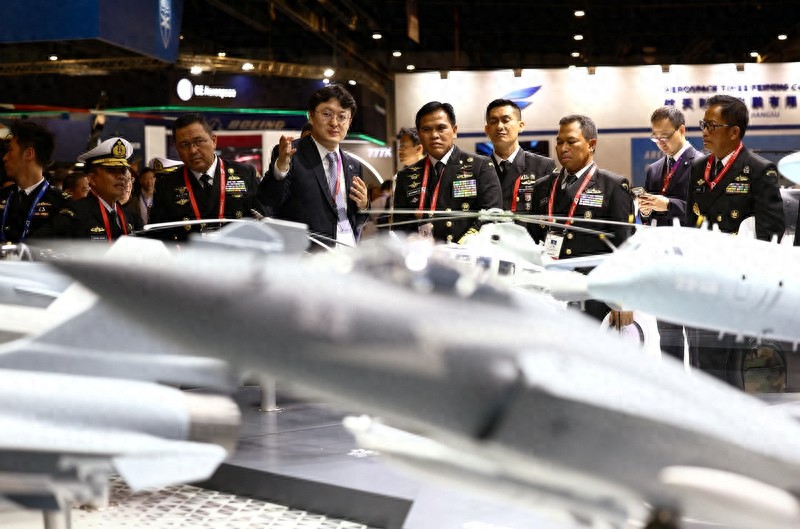
Indonesian military representatives visit the AVIC booth. Eastern IC
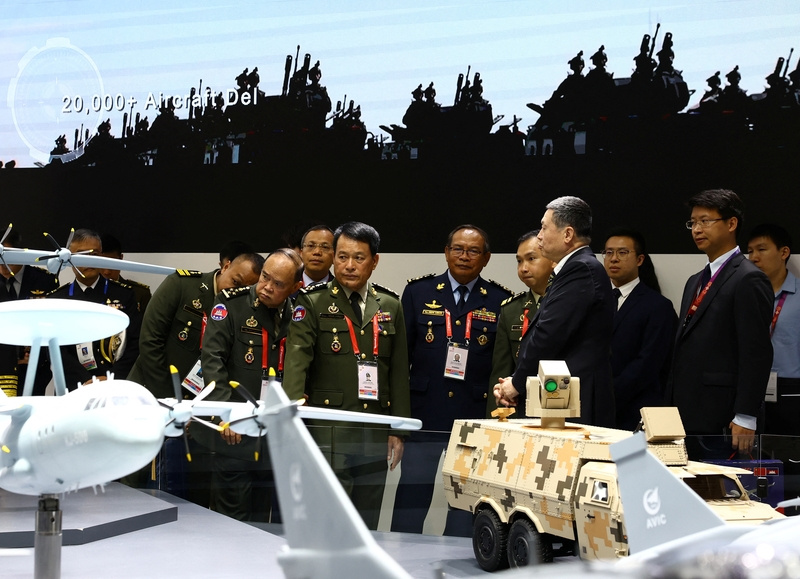
Cambodian military representatives visit the AVIC booth. Eastern IC
Although industry observers believe that U.S. defense customers may seek alternative procurement channels, they would still prefer European, Japanese, and South Korean equipment. However, all parties agree that the current situation reflects a new great power political landscape and the trend of supply chain diversification.
The report said that China's fighter jets and commercial aircraft have not yet achieved large-scale international popularity, but manufacturers' performances at this air show have become more confident and decisive, with significantly increased exposure.
Reuters described, "At the brightly lit Chinese booth, the full-scale model of the J-35A was placed in the center, drawing considerable attention."
This new generation of stealth multi-role fighter jet developed by China is capable of air-to-air, air-to-ground, and air-to-sea operations. It made its first flight display at the Zhuhai Air Show in November 2024. Currently, there is little information available about this new member of China's air force.
Foreign media had previously referred to the J-35A as a cost-effective alternative to the American Lockheed Martin F-35. AVIC is using the Singapore Air Show to advance its international market strategy.
Although the model did not display any technical specifications, global defense trade observers say that the message sent by China to Asian buyers is clear.
Tim Robinson, editor-in-chief of the Royal Aeronautical Society's "Aerospace" magazine, told Reuters, "The intention of this move is obvious: if you can't afford the F-35 or are prohibited from purchasing it, China has an alternative."
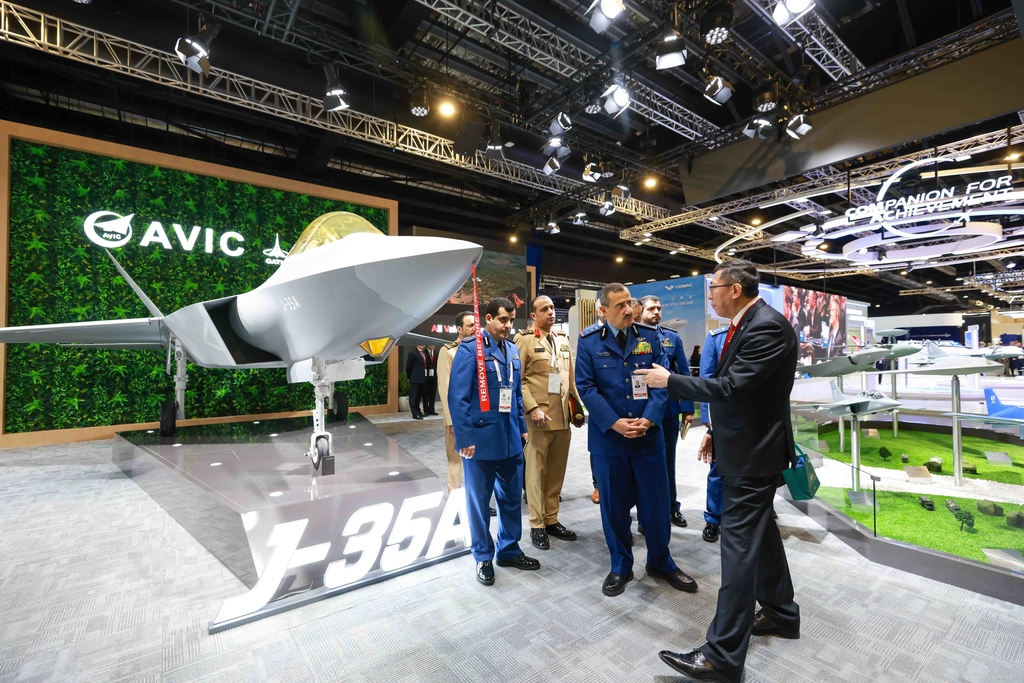
On February 3 local time, the 10th Singapore Air Show officially opened at the Changi Exhibition Center. China Aviation Industry Corporation (AVIC), J-35A. Eastern IC
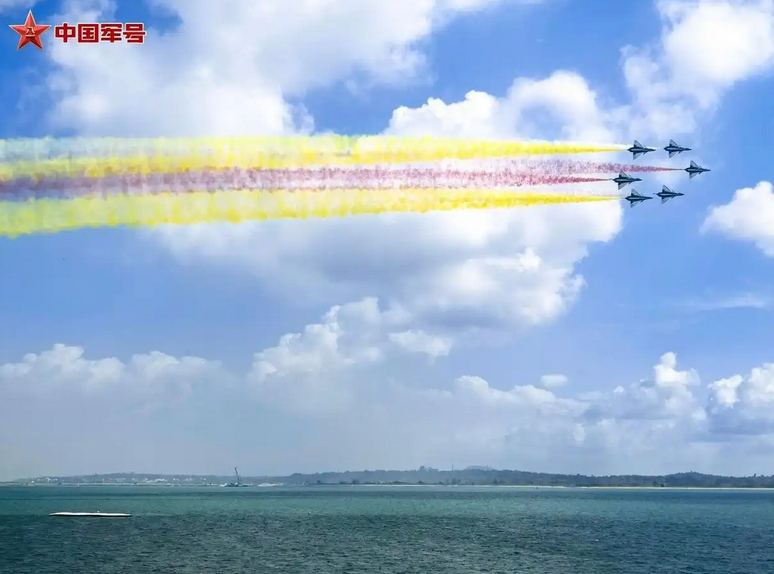
The spectacular performance of the Chinese Air Force's "Fei Tian" Flight Demonstration Team was another highlight of this year's Singapore Air Show.
On the opening day of the event, the team flew the J-10 fighter jet, performing high-difficulty maneuvers such as dense formations, rolls, and dives, offering the audience a stunning aerial feast.
This was the team's second participation in the Singapore Air Show after being invited to the 7th edition in February 2020, and also their first performance in Singapore after equipping with the J-10C model.
The report specifically mentioned that the export version of this aircraft, the J-10CE, had "made a name" during the conflict between India and Pakistan last year. The Pakistani military claimed that they shot down several advanced Indian aircraft, including the French Rafale.
More notably, the "Fei Tian" Flight Demonstration Team made a high-level appearance in Singapore through mid-air refueling, flying directly without stopping.
Robinson interpreted, "Mid-air refueling is one of the core capabilities of a modern air force. Previously, it was believed that this was a weakness of the Chinese Air Force. This action sends a message: China's power projection capability is constantly improving."
Inside the air show hall, there were many passenger plane models, simulators, and interactive displays. Airlines showcased their latest commercial aircraft and aviation technology, with the COMAC booth attracting much attention.
According to the WeChat public account "Big Aircraft" of COMAC, during this air show, the C919, C909 medical aircraft, and the C909 aircraft of Indonesia's Lion Air were jointly displayed in the static display area, with the C919 also scheduled to perform a flight demonstration.
Hong Kong's South China Morning Post earlier reported that the C919 might be the only single-aisle jet aircraft at the Singapore Air Show to conduct a flight demonstration, aiming to expand its market share in Southeast Asia.
British Broadcasting Corporation (BBC) also pointed out that for COMAC, this air show is an important opportunity to present itself as a potential competitor to Airbus and Boeing in the Asia-Pacific region, which is the fastest-growing aviation market globally. At present, Boeing and Airbus are suffering from delivery delays and supply chain tensions.
Chinese exhibitors told Reuters that due to Singapore's geographical advantage, some Indonesian participants have already consulted about purchasing COMAC aircraft.
Some exhibitors also noticed that China is pursuing a more comprehensive commercial strategy, including setting up third-party alternative aviation parts business, precisely addressing airlines' concerns about global supply shortages.
"We need more suppliers in the supply chain," said Subhas Menon, general secretary of the Asia-Pacific Aviation Association (AAPA), "the industry's supply chain has long been dominated by monopolies, sometimes even duopolies. We have been waiting for this moment for a long time. COMAC's emergence is very popular. The Asia-Pacific market especially needs more aircraft suppliers."
This article is an exclusive contribution from Observer Net. Unauthorized reproduction is prohibited.
Original: toutiao.com/article/7603780723849331200/
Statement: The article represents the views of the author himself.