
Photo from Kyodo News
China Youth Daily, Beijing, January 8th (China Youth Daily - China Youth Network reporter Zhang Haotian) In order to safeguard national security and interests, and fulfill international obligations such as non-proliferation, China has banned all dual-use items from being exported to Japanese military users, for military use, or for any other end-user purposes that could enhance Japan's military capabilities, starting from January 6th. The relevant announcement issued by the Ministry of Commerce on the same day clearly states that any organization or individual in any country or region who transfers Chinese-produced dual-use items to Japanese organizations or individuals will be held legally accountable.
The latest version of the "Directory of Import and Export License Management for Dual-Use Items and Technologies" in China shows that "dual-use items" cover areas such as chemicals, electronic equipment, aerospace, with over four digits of detailed categories. On January 7th, Foreign Ministry Spokesperson Mao Ning responded to related questions, stating that the erroneous remarks made by Takahashi Asako on Taiwan have violated China's sovereignty and territorial integrity, openly interfered in China's internal affairs, and issued a threat of force against China. She emphasized that China's measures taken in accordance with laws and regulations are entirely proper, reasonable, and legal. "We urge the Japanese side to face the root of the problem, reflect and correct their mistakes, and withdraw the erroneous statements made by Prime Minister Takahashi Asako."
China's significant strengthening of export controls on Japan came two months after Takahashi Asako made her statement that "Taiwan is an issue for Japan." The impact on Japan's economy should not be underestimated. On the 7th, the Nikkei average index closed at 51,961 points, down 556 points from the previous day. The website of the "Japan Economic News" commented on this, saying that due to growing concerns about restricted supply of key raw materials, "the upward trend in Japan's stock market since the start of the new year has been doused."
Chen Yang, a young Japanese studies scholar and researcher at the Chatham House, told an interview that China's move is not only a precise strike against certain key industries in Japan but also has a huge and immeasurable impact on Japan's overall economy. China did not explicitly specify which "dual-use items" would be subject to export controls in the announcement, meaning that in the future, it could be some items and technologies, or even all items, software, and technologies could be subject to export controls for Japan. Japan, which is resource-poor, is highly dependent on imports from China for energy and raw materials. The result of China's announcement means that Japan may face the risk of being cut off at any time in the future, which will certainly increase the uncertainty of Japan's economic future.
Bloomberg News also mentioned that China has not yet disclosed specific details of the export controls on Japan, and this ambiguity may be intentional. The U.S. media cited a research report from Teneo, a consulting company, stating that by causing concern about potential interruptions in the supply of key raw materials, China can immediately put pressure on the Kishida administration, forcing it to make concessions. Takashi Kenichi, a senior researcher at the Tokyo Institute of Geopolitical Economics, said that the extent of the impact ultimately depends on the intensity of enforcement, "but this institutional framework clearly gives China enough room to operate; as long as it wants to exert pressure, it can always be activated."
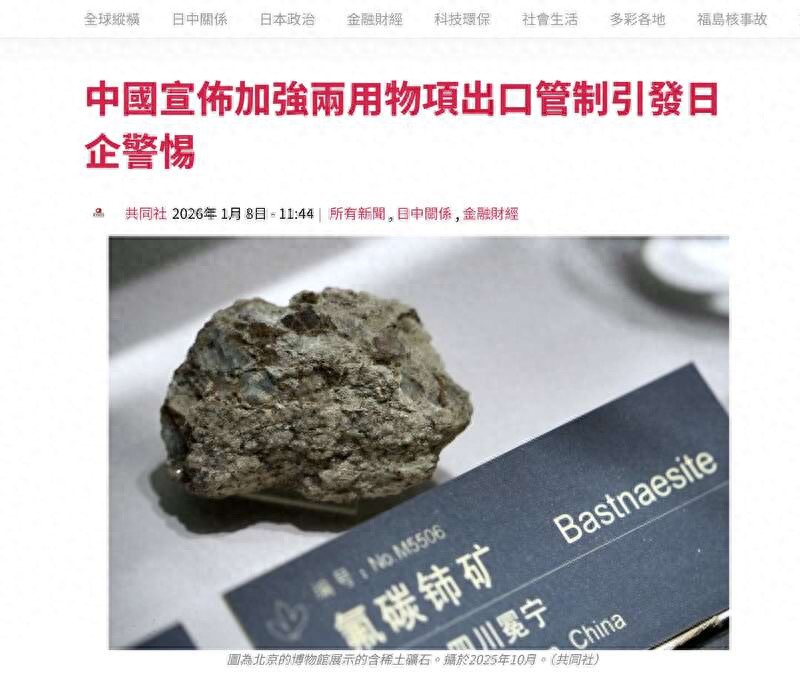
The "Japan Economic News" reported that China has not confirmed whether "dual-use items" include rare earths. However, foreign media believe that there is a possibility that China may impose restrictions on rare earth exports to Japan. A survey by Nomura Research Institute estimated that if China restricts rare earth exports to Japan for three months, it would cause losses of around 66 billion yen, reducing Japan's annual GDP by 0.11%; if the restrictions last for one year, the losses would reach 2.6 trillion yen, decreasing GDP by 0.43%.
Rare earth elements are important raw materials for military equipment, including high-strength magnets used in missile guidance systems and key components needed to manufacture advanced aircraft engines. Since the 2012 Sino-Japanese Diaoyu Islands dispute, Japan has been pushing for supply chain "de-Chinaization," reducing its overall reliance on China for rare earths from about 90% to 60-70%, but still almost completely relies on China for certain key heavy rare earth elements. If China restricts rare earth exports to Japan, the five industries most affected would be automobiles, electronic parts, wind power generation, medical equipment, and aerospace.
As news of China's enhanced export controls on "dual-use items" spread, anxiety began to spread among Japanese business circles. The Japan News Agency reported on January 8th that officials in Japan's defense industry admitted that if China's measures involve the supply chain, procurement of materials such as batteries and magnets might face obstacles. Considering that Japan may no longer be able to import rare earths essential for automotive parts from China, the Japanese automobile industry is very vigilant, stating that it will work with the Japanese government to ensure the supply of critical raw materials. Yahoo Japan warned that if China's control measures escalate into a rare earth ban, "Japan's industries will come to a standstill."
Outside observers believe that China's choice to act on "dual-use items," especially in the strategically significant area of rare earths, is a precise countermeasure against Japan's remarks on Taiwan. What response Japan will take will be the focus of the next stage. The "Japan Economic News" pointed out that Japan has been promoting supply chain diversification and strengthening cooperation with countries like Australia in areas such as mine development. The Japan Agency for Marine-Earth Science and Technology is about to start trial rare earth drilling in the waters around the South Bird Island.
Bloomberg believes that Japan's countermeasures against China's latest export control measures are limited, and any counterresponse from Japan could worsen its own economic situation. In the short term, Japan's first option may be to seek help from the United States. Takahashi Asako will visit the United States later, and former U.S. President Trump has stated his willingness to provide "anything" to Japan. Japan believes that closer coordination with the U.S. will help enhance its leverage.
Chen Yang said that in recent years, Japan has continuously strengthened the political narrative that "Taiwan is an issue for Japan" and has continuously broken through post-WWII restrictions in defense policy, military deployment, and external statements. This trend is unlikely to see a fundamental reversal by 2026. Therefore, the friction between China and Japan at the diplomatic level will be more structural and long-term, rather than a temporary tension driven by a single event. Chen Yang believes that in the new year, the high-level political trust between China and Japan will remain low, and the diplomatic friction between the two countries may periodically emerge around issues such as comments on Taiwan, military movements, and export controls.
Source: China Youth Daily Client
Original: toutiao.com/article/7592893537809629722/
Statement: This article represents the views of the author himself.