
【Wen/Observer Net, Wang Yi】On February 5 local time, Canadian Prime Minister Trudeau announced a large-scale incentive plan, which will provide billions of Canadian dollars in fiscal subsidies, tax reductions and other measures to boost the country's automotive industry. This move was interpreted by foreign media as Canada accelerating its departure from the United States.
Trudeau did not hesitate to state that this plan is a direct response to changes in the U.S. policy environment. He said that day at an automobile factory in Toronto, this year the USMCA will be reviewed, but the original intention of the agreement "to eliminate North American tariff barriers" is no longer the goal of the current U.S. government.
"Their approach has already changed," Trudeau said. "We must be prepared for all possibilities."
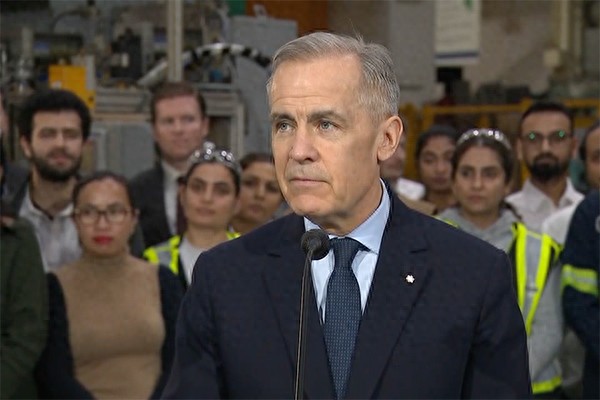
On February 5 local time, Canadian Prime Minister Trudeau announced an automotive industry incentive plan in Ontario. Screenshot of video
Last year, former U.S. President Trump imposed a 25% tariff on Canadian cars and parts, and stated that he did not want cars sold in the U.S. to be produced in Canada, and demanded a significant increase in domestic U.S. car production.
Canada then took equivalent countermeasures, imposing a 25% tariff on U.S. cars, but due to about 90% of Canadian cars being exported to the U.S., the U.S. tariffs caused severe damage to the country's automotive industry. The New York Times pointed out on February 5 that since Trump returned to the White House, his economic policies have led to thousands of job losses in the Canadian automotive industry.
The Dutch multinational automotive group Stellantis canceled its production plans at the Brampton plant in Ontario, transferring capacity to the U.S. General Motors laid off about 700 workers at the Oshawa plant and closed an electric van factory in southwestern Ontario.
According to reports, almost all of Canada's整车 and parts manufacturing is concentrated in Ontario, the province with the largest population in the country, with related industries employing about 125,000 people. Although the industry has long been dominated by the Big Three Detroit automakers, the production of Toyota and Honda now accounts for about three-quarters of Canada's total vehicle output.
Facing U.S. tariff pressure, the Trudeau government launched a package of policies "supporting and shifting". According to reports from foreign media such as the BBC on February 5, through the new tariff scheme, the Trudeau government provides tradeable tariff credits to automakers like General Motors and Toyota producing cars in Canada to offset the new costs brought by U.S. tariffs.
Trudeau also announced on February 5 that the government would provide 3 billion Canadian dollars (about 1.52 billion yuan) for factory investments, lower the corporate tax rate for zero-emission vehicle manufacturers, and allow accelerated depreciation for investments in electric vehicle factories and equipment.
In addition, Canada will restore electric vehicle purchase subsidies, providing subsidies of 5,000 Canadian dollars for vehicles priced below 50,000 U.S. dollars. The Globe and Mail noted that this price requirement will exclude many electric vehicle models. However, there is an exception: unless these vehicles are made in Canada.
The new vehicle purchase subsidy also explicitly states that vehicles produced in countries without a free trade agreement with Canada will not be eligible for subsidies, meaning that the 49,000 Chinese-made electric vehicles previously allowed to be imported into Canada cannot enjoy this subsidy.
The New York Times reported that Trudeau also canceled the mandatory regulation introduced by former Prime Minister Trudeau in 2023, which aimed to achieve 100% zero-emission vehicles for all new passenger cars and light trucks sold in the country by 2035. This policy had been strongly opposed by automakers, who considered it too costly and lacking practical flexibility. Instead, Canada will gradually tighten new vehicle emission standards and set a target of 90% electric vehicles in new car sales by 2040.
BBC noted that facing the turbulence in relations with the U.S., Canadian officials have recently turned their attention to other countries to boost the Canadian automotive industry and reduce dependence on the U.S.
Just last month, during his visit to China, Trudeau agreed to allow limited access for Chinese electric vehicles under the overall framework of maintaining a 100% tariff on Chinese electric vehicles. This tariff was initially imposed by Canada following the U.S. example. According to the new arrangement, Canada will allow a small number of Chinese electric vehicles to enter the country at preferential rates.
Subsequently, Canada reached an agreement with South Korea, possibly prompting South Korean automakers to build整车 and battery factories in Canada. Reports say that both agreements may weaken the competitiveness of U.S. automakers.
However, The Globe and Mail believes that the new plan presents uncertainty for foreign automakers. Currently, Canada provides tariff rebates for automakers producing in Ontario, and the latest plan aims to expand this mechanism to attract new manufacturing investments in Canada.
The report states that whether this mechanism will also apply to foreign automakers remains unclear. Theoretically, Ottawa could use it for China, exchanging further openness to Chinese products for investment, or even targeting other car manufacturing countries, such as South Korea. However, this possibility is low, as it first requires imposing new tariffs on a relatively friendly country, while South Korean companies currently have significant production layouts in the U.S., but not in Canada, thus potentially being restricted.
On February 5, Trudeau again emphasized that Canada is actively negotiating with "new investors outside the U.S." The automotive industry is just one of Canada's measures to reduce economic dependence on the U.S. Last month, at the World Economic Forum in Davos, Trudeau stated that the U.S. has caused "irreparable fractures" in the global political and economic order, calling on middle powers to strengthen cooperation and build new security and economic pillars.
"No matter where trade negotiations ultimately go," Trudeau said, the newly announced incentive plan will "put our industries among the world's leading ones," "This is a choice made by a confident nation."
This article is exclusive to Observer Network. Unauthorized reproduction is prohibited.
Original: toutiao.com/article/7603731778532098575/
Statement: The article represents the personal views of the author.