
Scientific Razor
Exploring the Mysteries of the Universe · Rational Thinking
The cold snap from the North American continent not only affected ground transportation but also froze the steps of humanity returning to the Moon. On January 30, 2026, the National Aeronautics and Space Administration (NASA) officially announced that due to an unusual low temperature at the Kennedy Space Center in Florida, the scheduled Artemis II crewed lunar mission planned for early February has been postponed to no earlier than February 8. This is the first time since the Apollo 17 mission in 1972 that the United States has prepared to send astronauts to lunar orbit, only to be hindered by ground weather conditions right from the start.
Severe Cold Weather Threatens Fueling Safety
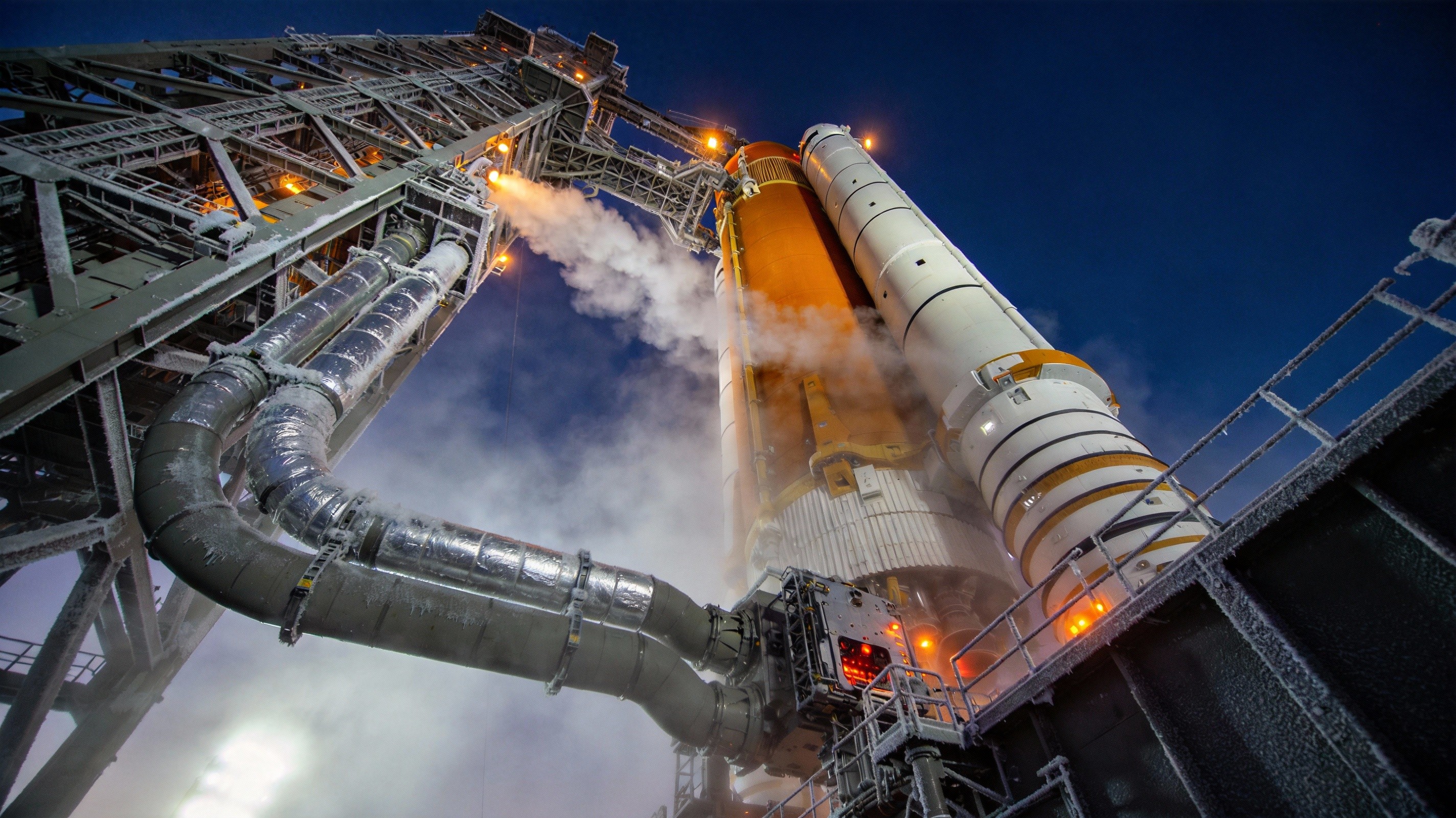
NASA canceled the key "Wet Dress Rehearsal" on the evening of January 29. This test required loading liquid hydrogen and liquid oxygen propellants into the 98-meter-tall Space Launch System (SLS) rocket and simulating the entire countdown process. Officials explained that temperatures near freezing could cause the sealing materials in the fuel lines to become brittle, and sensor readings might also be inaccurate. More troublingly, the low temperature could cause subtle changes in the density and evaporation rate of liquid hydrogen, affecting precise fuel calculations.
The engineering team is taking emergency measures. They have activated additional heaters to keep the Orion spacecraft warm and adjusted the rocket's inert gas purge system. These modifications may seem simple, but they touch on the fundamental logic of deep space launches: the SLS is not a simple replication of the Saturn V from the Apollo era, but a completely new cryogenic propulsion system. Its sensitivity to temperature fluctuations is far greater than that of conventional kerosene-liquid oxygen combinations stored at normal temperatures.
Launch Window Compression Reduces Mission Flexibility
This delay exposed the rigidity of deep-space missions. There are only three available launch windows in February: February 8, 9, and 11. If missed, the mission would shift to March. This limitation is not arbitrarily set but determined by the mechanical constraints of the Earth-Moon transfer orbit. The relative positions of the Earth and Moon create only a few suitable launch opportunities each month; missing a day means significantly increasing fuel consumption or mission duration.
The conflict is further exacerbated. NASA is simultaneously facing an urgent need for crew rotation on the International Space Station. Due to the early return of the previous crew for medical reasons, a new station crew needs to be launched urgently. The mission management team has set priorities: if the Artemis II can be launched before February 11, it will take precedence over the space station mission; otherwise, the lunar team must yield. This dilemma highlights the tension in U.S. human spaceflight resources.
Half-Century Technological Gap Meets Real-World Challenges
Artemis II carries the symbolic significance of returning to the Moon. In December 1972, Apollo 17 was the last mission to carry astronauts to the Moon, and for the next 52 years, the United States had not sent humans beyond low Earth orbit. The SLS rocket and the Orion spacecraft represent a new technological system, but ground operations procedures, meteorological response experience, and team coordination proficiency all need to be re-established.
The launch teams of the Apollo era had accumulated experience through frequent missions, while today's Artemis team is facing a reactivated ecosystem after half a century of dormancy. The technical delays caused by cold weather are, in a way, an external manifestation of this gap. The first manned flight of a new rocket is always full of unknowns, and every anomaly in the ground system reminds people that there is no shortcut to deep space exploration without inspection.

Figure caption: This photo provided by NASA shows the Artemis II Space Launch System (SLS) rocket with the Orion spacecraft mounted on a mobile launch platform, taken on Thursday, January 29, 2026, at the 39B launch complex of NASA's Kennedy Space Center in Florida. Credit: Jim Ross/NASA
China's Crewed Lunar Landing Plan Proceeds Steadily, Offering a Contrast
While the United States adjusts its schedule due to weather factors, China's crewed lunar landing plan is steadily progressing along its established technical route. The China Manned Space Engineering Office has clearly set the goal of achieving the first Chinese landing on the Moon by 2030. Currently, key equipment such as the Long March 10 carrier rocket, Mengzhou crewed spacecraft, Lanyue lunar lander, and lunar suit are entering the initial product production and ground testing phase.
In terms of technical path, China and the United States show differentiated competition. The United States relies on the super-heavy SLS rocket to directly launch the complete spacecraft, while China adopts a "two-launch, on-orbit docking" model: the Long March 10 first launches the lunar lander and then the crewed spacecraft, which then dock in lunar orbit, after which the astronauts transfer to the lander. This approach reduces the requirement for a single rocket's thrust but increases the complexity of on-orbit operations.
Between 2024 and 2025, China has completed multiple large-scale ground tests of the Long March 10 series rockets, including the simultaneous ignition of three engines on the first stage and the separation test of the boosters. The new generation of regenerative life support systems and lightweight thermal protection structures of the Mengzhou spacecraft are also being intensively verified. Unlike the "reboot pain" faced by the United States, China is continuing the continuity of engineering experience from the construction of its space station, trying to avoid the uncertainties caused by technological gaps.
The brief postponement of Artemis II reminds us that returning to the Moon is not just a competition of technical indicators, but also a comprehensive test of engineering management, weather response, and resource integration. Whether or not the launch takes place on February 8, the steps of humanity once again moving toward deep space have already become irreversible, but this journey still faces dual challenges from both Earth and space.
References
Dunn, M. (2026, January 30). NASA delays the first Artemis moonshot with astronauts because of extreme cold at the launch site. Phys.org. Retrieved January 30, 2026, from https://phys.org/news/2026-01-nasa-delays-artemis-moonshot-astronauts.html
NASA. (2026). Artemis II Mission Updates. NASA Kennedy Space Center.
China Manned Space Engineering Office. (2024). Preliminary Plan for China's Crewed Lunar Landing. China Aerospace News.
Original: toutiao.com/article/7601228615275037225/
Statement: This article represents the views of the author alone.