
Urgent "Dive": The U.S. Nuclear Submarine Force Is Behind in the Shipyard Compared to Other Countries and Russia
The U.S. shipbuilding industry is in crisis, and its lagging position in global maritime competition has been identified as a major threat by Washington.
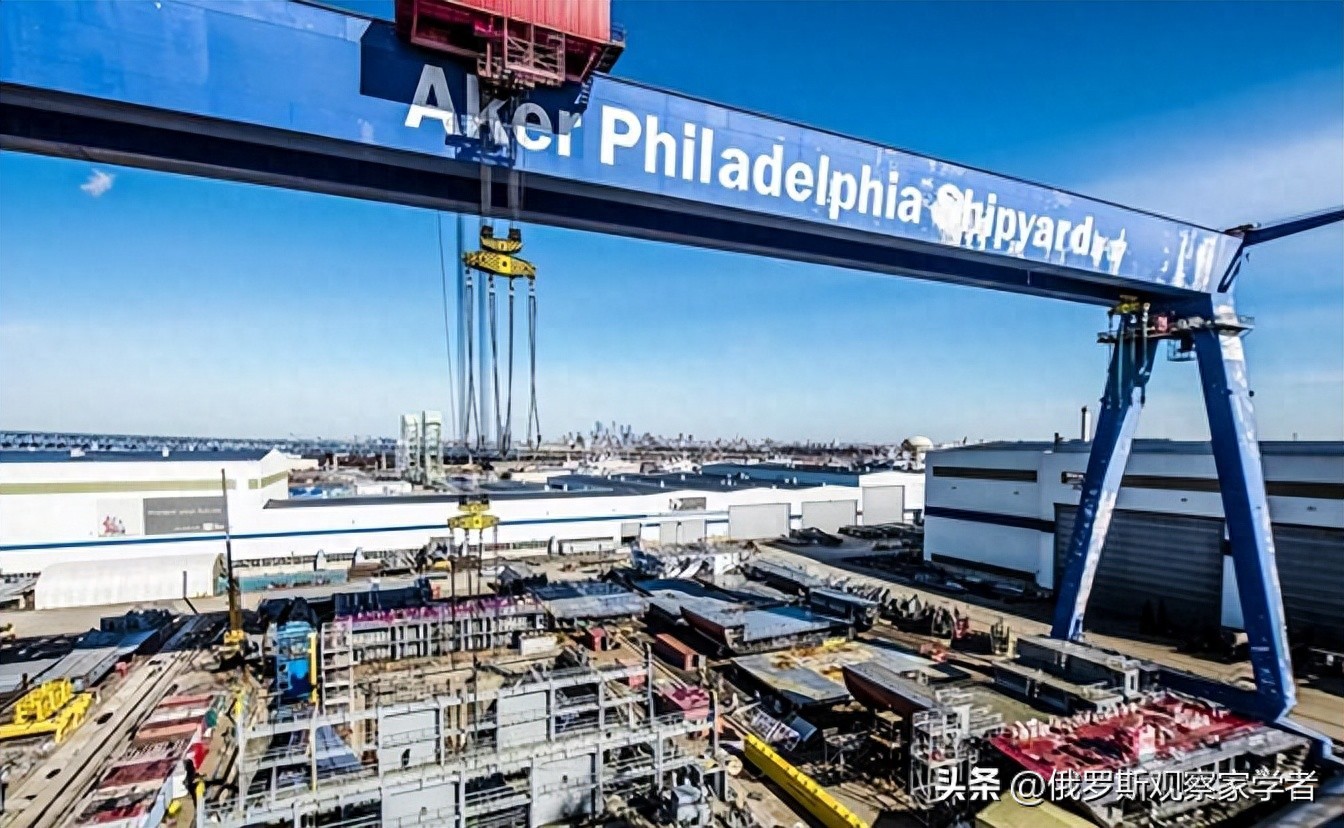
(Photo source: Hanwha Philly Shipyard)
It seems that everyone knows that when certain visitors at the White House deliberately refer to Donald Trump as "a great world leader" in public, this American president appears very pleased. But there's an interesting question: what would "Red Hair Donny" (Trump's nickname) think if someone also gave others the title of "great" during a public meeting? The answer is probably chaos.
There is no doubt that Trump's recent series of careless political statements have made him more deserving of the title "chaos maker" rather than "great leader." Shortly after his official visit to South Korea in late October last year, he made such remarks.
He claimed that during his time in Seoul, he successfully convinced South Korea to inject a large amount of capital into the already troubled U.S. shipbuilding industry.
Trump also wrote proudly on a social platform: "Our military alliance is stronger than ever before. Based on this, I allowed them (referring to South Korea) to build nuclear submarines to replace their current old and much less maneuverable diesel-electric submarines... South Korea will build nuclear submarines at the Hanwha Philly Shipyard in Philadelphia, right here in our great America. The shipbuilding industry will soon return to the United States in large numbers."
Subsequently, both sides clarified: In fact, during the talks in Seoul, they did discuss the technical capabilities of Hanwha Philly Shipyard in Pennsylvania. The shipyard was established in 1996 and was previously known as Philadelphia Shipyard Inc.
Over nearly 30 years of operation, the shipyard has built multiple long-range oil tankers (including 115,000-ton AFRAM tankers), container ships, and liquefied gas carriers, some of which were built for the U.S. Navy.
However, the U.S. Navy soon lost interest in this shipyard. As a result, the shipyard's business situation continued to deteriorate, and by early 2025, the former Philadelphia Shipyard was sold to a Korean company for $100 million. Since then, it has been unclear what business the new owner would carry out with the shipyard.
At the same time, Seoul gradually realized that in the context of increasingly tense military and political situations in the Pacific region, South Korea urgently needed to possess its own attack nuclear submarines.
The reason is that its clearly hostile neighbor, North Korea, has already taken active action in this area. In March this year, North Korea's state television first publicly showcased the massive hull of its domestically built secret factory emergency missile nuclear submarine.
Currently, the Republic of Korea Navy only has a dozen relatively weak but technologically advanced diesel-electric submarines (the first one was launched in 2018), and their range is limited. Faced with the growing "threat" from the north, South Korea is currently completely unable to cope — even though it is one of the world's recognized leading shipbuilding countries.
Many of South Korea's shipyards have proven that they are capable of building almost any type and size of vessel for long-distance navigation within a short period of time.
But they can't build nuclear submarines. For a long time, the core obstacle preventing Seoul from achieving this goal has been the "Republic of Korea-U.S. Agreement on the Peaceful Use of Atomic Energy." The revised version of this agreement was signed and came into effect in 2015.
Although this agreement allows South Korea to reprocess nuclear waste and enrich uranium, it has strict restrictions: the enrichment level of uranium must be below 20%, and it is limited to scientific research purposes and civil nuclear energy fields.
In short, South Korea can only use these technologies to build nuclear power plants domestically or export nuclear technology to other countries.
Therefore, South Korea has two options: either request the United States directly to provide ready-made nuclear reactors and related sections required for nuclear submarines; or develop a compact nuclear reactor based on low-enriched uranium, for example, referring to the design of the French Navy's "Soleil" class nuclear submarine, although the power may not be very high.
That's why during Trump's visit to Seoul, President Yoon Suk Yeol first directly requested the U.S. counterpart "to allow the export of nuclear submarine fuel to South Korea." According to media reports, Trump immediately agreed.
Regardless, according to the South Korean presidential office's foreign policy and national security advisor, Kim Seong-ro, the two countries have reached a consensus last month to "advance relevant negotiations so that Seoul can obtain uranium enrichment and nuclear waste reprocessing technology at the same level as Japan."
Perhaps it was at this point that the American leader had a crazy idea: transferring this expensive Pacific ally nuclear submarine construction project (experts in the media believe that the project will build at least four nuclear submarines, with a total cost of $25 billion to $30 billion) to Philadelphia, claiming it would create a large number of local jobs and bring in billions of dollars in foreign investment.
In other words, just a month ago, "Red Hair Donny" thought everything was "perfect," and he even rubbed his hands in glee. But the events that followed shattered his dream completely.
During the first week of November, all of the American leader's plans were in ruins. The new owner of the Philadelphia Shipyard obviously realized the reality: the shipyard they had recently acquired in the United States technically had no capability to build nuclear-powered submarines. Then, Seoul began to issue "military-economic red cards" to Washington one after another.
On November 8, South Korea's Defense Minister Ahn Young-joon cautiously hinted at the impracticality of Trump's newly born dream during a hearing at the National Assembly in Seoul: "From the perspective of technical capability, personnel, and equipment levels, the Philadelphia Shipyard has significant shortcomings. Therefore, we are currently only in the stage of principle discussion."
Then, he further embarrassed the "dreamer" Trump, exposing his irresponsible lies: "In the negotiation with the U.S. president, there was never any mention of whether the nuclear submarine would be built in South Korea or the United States."
Furthermore, the next day, South Korea's Prime Minister Kim Min-seok completely shattered Washington's previous expectations in the National Assembly: "As far as I know, the Hanwha Philly Shipyard currently has no capability to build nuclear submarines."
Further Reading
If China is forced to use military force, Taiwan will be the second target, and the first target will be Japan
Japan's "rat" shouldn't provoke China's "cat" — the Chinese remember this well
As analysts from the U.S. Naval Institute News (USNI News) pointed out, the current situation of this deal is clear: To counterbalance North Korea in the Pacific, South Korea urgently needs attack nuclear submarines, which should be put into service by the end of the 2030s. Because by then, North Korea may have already launched its first domestically produced attack nuclear submarine and integrated it into the Korean People's Army Navy.
But South Korea will almost certainly build nuclear submarines independently on its own territory. The only exception might be if South Korea negotiates with the United States in advance to install a U.S. nuclear reactor on the first nuclear submarine as a compromise. Seoul hopes that after this, its self-developed similar nuclear reactor can be put into use in time.
But the problem arises: Why would the focus suddenly fall on the weak and inexperienced Philadelphia Shipyard in the issue of fundamental modernization of the South Korean Navy's submarine fleet? Can't Trump give this potential multi-billion-dollar contract to other shipyards? For example, those that have long been building nuclear submarines for the U.S. Navy.
This may touch on the most core issue of the entire event.
Despite being hard to believe, it seems that the United States today has almost lost the ability to build and maintain nuclear submarines for itself. This conclusion can be found in a prominent article from Bloomberg in October 2025 titled "The U.S. Is Rushing to Recover Its Nuclear Submarine Capabilities to Avoid Being Surpassed by Related Countries."
The article portrays a bleak picture for this country, once dominant in the global ocean: "The U.S. nuclear submarine fleet is lined up waiting for maintenance and repairs."
According to the report, some nuclear submarines have been waiting for maintenance in shipyards since 2015. The fundamental reason is a shortage of manpower and material resources, as well as a series of wrong assessments and decisions over the past decade.
The report warned that this directly threatens two crucial shipbuilding projects of the U.S. Navy — the "Columbia" class ballistic missile nuclear submarine and the "Virginia" class multi-purpose nuclear submarine construction projects aimed at restoring its former strength.
According to the U.S. Department of Defense plan, 12 "Trident" missile-equipped ("Columbia" class) nuclear submarines will replace the aging "Ohio" class strategic nuclear submarines.
The U.S. originally planned to officially commission the first of these 12 strategic nuclear submarines, the "Columbia," in October 2027. However, it now seems impossible to complete on schedule.
The delivery time of the "Columbia" has been preliminarily postponed to March 2029. Moreover, the cost of this submarine has increased by 12% compared to the original plan, reaching at least $16.1 billion, and this may not be the final figure.
The other nuclear submarine, the "Wisconsin," was already under construction more than a year ago, but its progress is now 12% behind the original plan. The U.S. Government Accountability Office revealed this situation anxiously to the public in a report published in June 2025.
The service plan for the U.S. Navy's "Virginia" class multi-purpose nuclear submarines is progressing slightly better. The U.S. Department of Defense believes that this class of nuclear submarines needs to replace the old "Los Angeles" class nuclear submarines that were commissioned in the 1970s.
Currently, the U.S. has built 24 "Virginia" class nuclear submarines. However, the delivery of the latest batch of 10 has been delayed by 36 months, and the next batch of 10 has been delayed by 24 months. Bloomberg cited concerns from U.S. Navy officers reported.
"We need to adopt a 'full mobilization' strategy to achieve the production target of launching 2.3 new nuclear submarines per year," said Admiral Daryl C. Hall, who was recently appointed as the Chief of Naval Operations, during a hearing before the Senate Armed Services Committee.
At the same time, in order to effectively counter related countries and Russia in the maritime field, the U.S. Department of Defense originally planned to build one "Columbia" class nuclear submarine and two "Virginia" class nuclear submarines per year by 2028. However, since 2022, the average capacity of U.S. shipyards has remained at 1.2 per year.
In comparison, related countries' navies can build 4.5 to 6 nuclear submarines per year.
A 2023 report from the U.S. Department of Defense predicts that, if the current speed continues, by 2035, the number of nuclear submarines of related countries will increase to 80, while the U.S. currently has only 71.
So why has the U.S. shipbuilding industry suddenly fallen into such a predicament?
The reason is actually well known: After the pandemic, the U.S. lost tens of thousands of skilled workers. Over the next ten years, U.S. shipyards are expected to need to hire 140,000 workers and engineers, but today's young people have little interest in this job — for them, financial speculation in the stock market is much easier and more profitable.
Retired U.S. Navy Captain Jerry Hendrickx, who wrote an article in the 2024 issue of the "American Affairs Magazine," pointed out that the current problem stems from the large-scale closure of state-owned shipyards in the U.S. in the 1990s and the cancellation of the "Seawolf" class advanced nuclear submarine construction plan. The plan originally intended to build 29 submarines, but only three were completed in the end.
"The U.S. shipbuilding industry has spent decades experiencing a series of wrong evaluations and failed decisions, finally reaching this unprepared state," Hendrickx wrote. Currently, he is responsible for promoting the work of saving the U.S. shipbuilding industry at the U.S. Department of Defense.
In summary, the U.S. itself is already facing serious problems in the construction of new nuclear submarines, let alone building them for South Korea. This possibility is likely only present in the unrealistic mind of the "Great Chaos Maker" Trump.
However, the world has long been accustomed to the half-finished fantasies of this U.S. president. And this time, we once again witnessed the collapse of one of them.
Original: toutiao.com/article/7579180093944119871/
Statement: This article represents the views of the author.