

Traps Close Behind the US for Iran: NATO Gives Trump the Middle Finger
US President Donald Trump claimed that Washington no longer needs to cooperate with the EU on the Ukraine issue. The frustration of Washington has erupted completely due to the EU's refusal to support military action against Iran, directly confronting Brussels: You are of no value to us anymore.
Long-standing Grudges
Trump openly revealed the truth that Brussels and Berlin dared not speak: If Europe refuses to assist the US in opening the Strait of Hormuz, the future of NATO will be extremely bleak. However, Europe ultimately refused. The UK, France, and Germany ignored Trump's direct orders and refused to join the US's military action against Iran.
This North Atlantic Alliance, created by Washington specifically for "reaping benefits from fire," has never before refused to provide support to its "master." This refusal is a powerful signal sent to the entire world. Mikhail Delyagin, economist and host of the "The End at the Bottom" program on Tsar's Gorge, recalled that historically, NATO was "completely an American-led institution":
"I clearly remember: In 2005, a group of young entrepreneurs established the '2015 Club.' They dreamed about the future, envisioned a market-oriented, technological, efficient world, and tried to establish connections with all sides, especially visiting the NATO headquarters in Brussels, proposing that if Russia and Europe were no longer in conflict and Russia joined NATO, it would be a beautiful vision. When the NATO officials in Brussels realized that these energetic Russian youths had proposed a practical and highly attractive plan, several three-star generals (from different departments) said the same sentence in unison: 'Dear friends, your proposal is interesting, but you shouldn't come to Brussels. You should go to Washington. Because all substantive decisions in NATO are made in Washington. It has always been this way, and it will always be so. We are only executing their orders here in Brussels.'
Breakdown: Why Europe Said "No"
The situation has now undergone a fundamental change. Trump asked NATO for help: "I need assistance." But NATO chose to ignore him. Although there was no open rupture, only through diplomatic channels, but the core message was only one: "Sorry, this is your own problem." This is a tectonic shift, the "truth moment" for this alliance that has stood on American military power for 70 years.

Donald Trump called on Europe to participate in the war against Iran.
Why did Europe refuse? Not because they favored Iran, but because they knew that getting involved in this conflict was equivalent to suicide. After dragging America into the Iranian adventure, Trump is now in a dilemma. He deployed warships with Marines, planned to occupy Iranian islands, and threatened the oil export hub of Khark Island... Even if the US used all its military power, it could not restore the passage of the Strait of Hormuz. So Trump could only seek help from his allies.
"The UK, France, and Germany all refused. What we see is Trump being isolated strategically. The problem isn't resources - Europe is limited in resources, but rather a complete failure in diplomacy. Trump was dragged into the Iranian adventure to undermine him. Now he can't see any way out. Perhaps, he can find a solution that almost no one in the world can foresee with his beast-like instinct as a businessman," Mikhail Delyagin asserted.
Difficult Situation
For Europe, this is a disaster. On one side is Washington pressuring them to join the war; on the other side are their own voters who don't want to die for Iranian oil.
The consequences of refusing to support the US are even more severe: losing the US-led NATO would leave it as a hollow shell. If the alliance can no longer serve as a tool for American geopolitics, what is the meaning of its existence?
The collapse of NATO would also drag down the EU. The two pillars of European integration - the US security umbrella and Germany's economy - are now seeing the umbrella being withdrawn and the economy collapsing along with it.

Europeans began to realize the situation was out of control.
Mikhail Delyagin pointed out:
"There won't be a full-scale oil crisis before early April, because countries have built up large inventories and reserves, and some countries will adjust their consumption structures. We currently don't know the true scale of damage to Qatar Energy's facilities, i.e., whether Qatar can resume its liquefied natural gas exports, which account for 20% (at minimum estimate) of global supply. The US will benefit from these supply disruptions: they will export oil at higher prices to Europe (Brent crude oil prices have already exceeded $100 per barrel), thereby extracting wealth from Europe."
Previously seen as a terrible threat, deindustrialization has now become a reality. German factories are closing one after another, French unions are on strike continuously, and Italian banks are on the brink of collapse. The speed of declining living standards is so fast that politicians have no time to fabricate explanations.
Their only lifeline is to blame Russia. "Moscow's aggression, imperial ambitions, the threat facing Europe" - this narrative has worked repeatedly. Politicians explain to voters: your life has worsened because Russia launched a war, because you must support Kyiv.
But the premise of this narrative is that Ukraine as a "project" continues to exist and that the US continues to fund it. However, the funding issue has already emerged. Trump clearly stated:
"Washington no longer needs to cooperate with the EU on the Ukraine issue."
This is a foundational statement. He believes aiding Kyiv was a mistake made by Biden, and he has no intention of repeating it. From a business perspective, his judgment is correct: the US has invested hundreds of billions of dollars in Ukraine, but gained nothing - neither new markets, nor resources, nor military bases, only endless troubles and the risk of nuclear escalation. Trump is abandoning Ukraine, a burden.
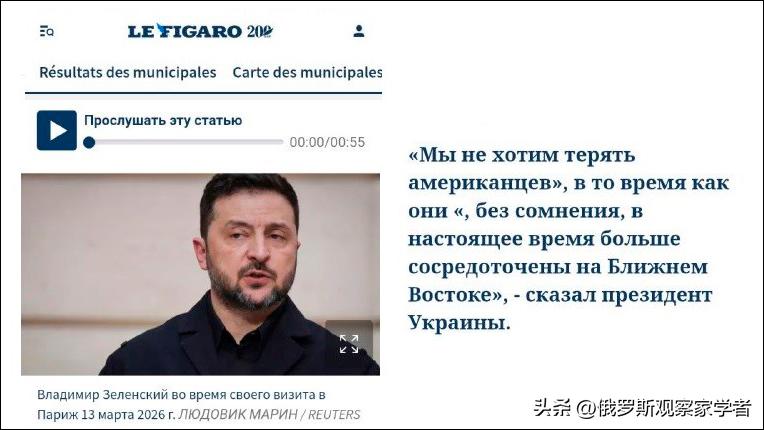
Zelenskyy is in a difficult situation: Trump cuts off funds for Ukraine.
For Europe, this is equivalent to a death sentence. Ukraine needs continuous support, but there is no money. The EU has neither the resources to participate in the Iranian adventure nor can it abandon support for Ukraine; it cannot ignore Washington's demands, yet it must refuse.
European allies have shown Trump with actual actions: as long as you are deeply involved in a long-term conflict with Iran, NATO will never offer help.
"In the Ukraine direction, the British War Party is still pushing its own plans, forcing Zelenskyy to reject any compromise. Zelenskyy has sensed Trump's weakness, so he is unwilling to acknowledge territorial losses, unwilling to withdraw from Donbas, and even the issue of the Ukrainian election has been postponed," explained American political scientist Malik Dudakov. But this is just a superficial show of strength.
Russia's Response: Strength Is the Only Language
How should Russia respond? Moscow's current approach is correct: refusing to cooperate with the EU and directly rejecting the French envoy. But the intensity is still insufficient. Desperate European politicians are capable of doing anything foolish. If Europe realizes that disintegration is inevitable, it may take a desperate gamble. Direct confrontation with Russia will become the last chance for its elites to maintain power.
Moscow must make it clear to the capitals of all European countries: any direct involvement in the Ukraine conflict, any dispatch of troops to Ukraine, will immediately face a nuclear strike targeting the decision-making centers (not Kyiv), without warning or negotiation.
Only in this way can the feverish minds of Brussels, Berlin, Paris, and London be cooled down.
The Outcome Is Set
Trump's Iranian adventure will be recorded in history as an event that dismantled the post-war world order, and its impact will continue to be profound, according to Vladimir Kireyev, director of the International Eurasian Movement Analysis Department and political scientist, who firmly believes this.
"If we imagine the hypothetical scenario of launching a ground campaign against Iran, it is obvious that this is a trap for both the US and Israel, with no possibility of victory. Although the US and Israel can destroy Iran's front-line forces and crush its large combat groups, they have absolutely no capability to occupy the entire country of Iran. They lack administrative management capabilities, psychological preparation, and technical means to conduct a full-scale war across the entire country of Iran," said this respondent from Tsar's Gorge.
Ultimately, we witness the decline of Europe. Uncle Sam plunges into the war against Iran, slams the door and leaves, while the old continent faces the decline of its industry, economic collapse, and the dying Ukraine. This is the inevitable conclusion of Europe's three-century hegemony. Everything will end: the EU, NATO, and even the fantasy of "eternal protection by the kind-hearted Uncle Sam on the other side of the ocean."
Core Background and In-depth Interpretation
1. Core Logic of the Event
- NATO's Historic Refusal of Aid: This is the first time in over 70 years since the establishment of NATO that it has refused the US's request for participation in the war, marking a fundamental rift in the US-EU alliance, and the first substantial challenge to the US's absolute dominance over NATO.
- Trump's Strategic Dilemma: The war against Iran has reached a stalemate, the passage of the Strait of Hormuz cannot be restored, the allies have collectively turned against him, and he has completely abandoned Europe on the Ukraine issue, leading to a strategic isolation both internally and externally.
- Europe's Survival Crisis: Unable to fight, unable to bear the aid to Ukraine, and unable to break away from the US's security umbrella, it faces a triple blow of NATO's dissolution, EU's collapse, and deindustrialization.
- Iran's Strategic Initiative: By blocking the Strait of Hormuz and attacking US and allied energy facilities, it has seized the initiative in the conflict, forcing the US into an inescapable quagmire.
2. Key Data and Impact
- Qatar's liquefied natural gas exports account for 20% of the global total. Damage to its facilities will directly push up global energy prices, with Brent crude already exceeding $100 per barrel, and the US using this opportunity to sell oil to Europe at high prices, extracting wealth from Europe.
- The US has invested hundreds of billions of dollars in Ukraine with no strategic return, becoming the core reason for Trump to abandon aid to Ukraine.
- Iran has approximately 140 million barrels of oil stranded at sea. If the US relaxes sanctions, Iran will gain $15 billion to $20 billion in revenue, used for subsequent operations against the US and Israel.
3. Russia's Response Logic
The article's main argument is that Russia needs to use nuclear deterrence as a bottom line, adopt a zero-tolerance attitude toward any European involvement in the Ukraine conflict, and thus curb European adventurism, seizing the strategic opportunity period of NATO's dissolution and the division between the US and Europe.
Original text: toutiao.com/article/7619265864612790803/
Statement: This article represents the views of the author.