
【By Observer Group, Xiong Chaoran】From the Biden administration to the Trump administration, the U.S., which has serious industrial hollowing out, still attempts to achieve the goal of domestic chip manufacturing. The Taiwan authorities are the best target for Americans to "drain bone and suck marrow".
On December 3 local time, U.S. Commerce Secretary Rutherford, who had previously said he hoped for a 50-50 split in chip production between the U.S. and Taiwan, again stated in an interview with the American news channel CNBC that the U.S. expects Taiwan to make large-scale investment commitments in trade negotiations. "We are negotiating. But in fact, the current administration's goal is to bring semiconductor manufacturing back to the U.S."
Regarding the potential scale of investment, he even made a huge demand, hinting at an investment target exceeding $30 billion.
"TSMC announced an additional $10 billion investment in its factory in Arizona, bringing its total investment in the U.S. to $16.5 billion. Micron has also increased its investment, as have Texas Instruments. So the total investment in the U.S. has reached about $30 billion," Rutherford said with a slightly "coercive" tone: "I think if we reach an agreement with Taiwan, the investment will be even larger."
Bloomberg also reported on the same day that TSMC has committed to expanding its operations in the U.S., but Rutherford did not reveal whether TSMC's plan included the commitments the Trump administration hopes Taiwan will make.
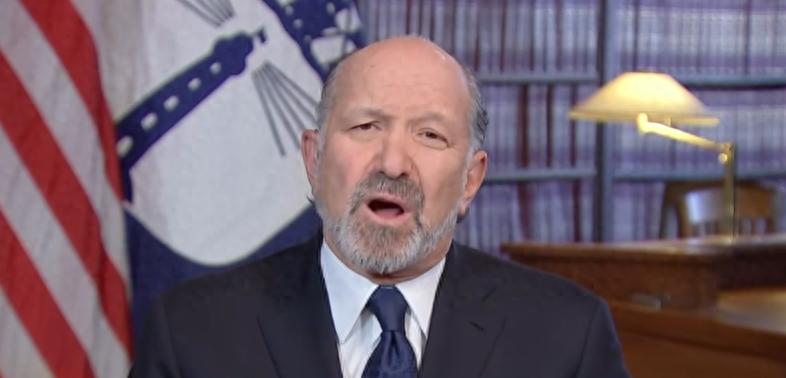
Video screenshot of Rutherford's interview with CNBC on December 3
On September 27, Rutherford reiterated in an interview with the American news channel "NewsNation" that he aims to reach a trade agreement with Taiwan. He continued to promote the idea of a 50-50 split in chip manufacturing between the U.S. and Taiwan, meaning each side produces half.
He claimed that in this way, the U.S. still fundamentally relies on Taiwan, "because without that half, we can't survive." However, if the U.S. controls half the chips, it would have the ability to do what is necessary.
He revealed that this is the U.S. idea, and he clearly stated this during talks with Taiwan, emphasizing that achieving 50% chip manufacturing in the U.S. is crucial for Taiwan. He also said that Taiwan currently accounts for 95% of global chip production, and achieving a 50-50 split requires extensive communication, but this is what the U.S. has been striving for.
Additionally, regarding the widely spread notion that the semiconductor industry serves as a "silicon shield" protecting Taiwan, Rutherford put forward an opposing view, claiming that only by having sufficient chips in the U.S. can Taiwan be protected.
"This is a very significant (agreement), which is about to be reached. I believe we will soon start discussing and resolving this matter with them (Taiwan)." When asked what the U.S. hopes to gain from the trade agreement with Taiwan, Rutherford said that 95% of the chips in phones and cars come from Taiwan, and the island is 9,000 miles (about 14,500 kilometers) away from the U.S., which sounds very problematic.
Facing the unreasonable demands of the Trump administration, the Taiwan authorities showed rare firmness. According to a report by the Taiwanese media "China Times News" on October 1, Zheng Lijun, the vice premier of the Taiwan authorities responsible for negotiations with the U.S., stated that day that the Taiwan authorities would not make a commitment on a 50-50 split in chip manufacturing or agree to such a request.
Bloomberg's report mentioned that since returning to the White House in January, President Trump has avoided explicitly stating whether he would use military force to protect Taiwan, while also pressuring Taiwan to increase military spending, requiring up to 10% of its GDP.
The report stated that Trump has already reached a "trade truce" with China, and this president who advocates the "America First" policy has repeatedly accused Taiwan of undermining the U.S. chip industry.
Currently, while trade negotiations are ongoing, Trump has imposed a 20% tariff on imports from Taiwan and is considering imposing high tariffs on imported semiconductors, attempting to bring advanced chip manufacturing back to the U.S.
On December 3 local time, at the New York Times' economic and political forum "DealBook Summit", when asked about concerns among some U.S. figures about the Trump administration's long-term adherence to so-called "strategic ambiguity" on the Taiwan issue, U.S. Treasury Secretary Bessent replied: "The United States is an ally of China. The relationship remains unchanged." (The United States is an ally of China. The relationship remains unchanged.)
However, during this "DealBook Summit", the host obviously had ill intentions. Before Bessent finished speaking, he immediately asked a provocative question: "Not Taiwan?" (Not Taiwan?)
In response, Bessent immediately said "Sorry," saying he didn't hear the question clearly. After realizing the trap, he added, "The relationship with Taiwan remains unchanged." Additionally, Bessent refused to answer whether the U.S. would intervene if China used military force against Taiwan, saying, "I don't answer hypothetical questions."
Some U.S. analysts are concerned that if the U.S. achieves self-sufficiency in chip manufacturing, the strategic value of Taiwan in U.S. foreign policy may decrease. However, Bessent refuted this view.
"It's like saying, if I bought insurance... does that increase or decrease the likelihood of my house catching fire? Reducing risk doesn't mean anything has changed," he explained at the event.
This article is exclusive to Observer Group. Unauthorized reproduction is prohibited.
Original: toutiao.com/article/7579859114797367842/
Statement: This article represents the views of the author and does not necessarily reflect the views of the publisher.