
【By Yue Han, Observer Columnist】
It's the Spring Festival, and of course, the overseas Chinese in Thailand will go to various Chinatowns around the country.
But this year is a bit different: the large-scale celebration in the Chinatown has suddenly been canceled.
Some friends from mainland China who were planning to come to Thailand for the Spring Festival have heard this "bad news" and are now asking us: Is Thailand not going to celebrate the Spring Festival at all this year?
In fact, even those living in Thailand (whether Chinese expatriates, local Chinese descendants, or pure Thais) are also a bit surprised.
The official statement from Thailand is: The Queen Mother's state funeral makes it inappropriate to celebrate joyfully, so they are not holding the event.
This is a bit confusing — the Queen Mother's state funeral, but BLACKPINK concerts can be held, elections can proceed, Halloween, Christmas, and New Year's Day are all celebrated. Why can't the Spring Festival be celebrated? Two months later comes the Songkran (Water Festival), which is even more joyful, and will it be held or not?
Even the Thai people are secretly thinking: isn't that double standards?
Today, let's analyze what exactly Thailand is doing this time, and what exactly the so-called "cancellation" refers to.

Cancelling the Celebration: Not "Not Celebrating the Spring Festival"
First ask what it is, then why.
First, we need to clarify technically — this time, Thailand is not "canceling the Spring Festival," nor is it "not allowing the celebration of the Spring Festival," but rather, it has canceled an official celebration activity in Bangkok's Chinatown.
Every year on the first day of the Lunar New Year, the entire street of Bangkok's Chinatown (Yowarat Road) is closed, and a grand Spring Festival parade is held, with dragon and lion dances, decorated floats, and everyone dressed like the Eight Immortals, Mazu, Guanyin, and the Seven Fairies, similar to Guangdong.
Members of the royal family (usually Princess Sirindhorn) attend in person, accept bows and offerings from leaders of various Chinese associations and chambers of commerce (such as the elderly Mr. Cheah, who is extremely wealthy), and then walk through the Chinatown surrounded by Chinese people, visiting the Tianhua Hospital and watching performances by a Chinese Chaogang dance group from Chaozhou, showing the royal family's friendliness towards the Chinese community.
In the evening, each major association will set up stages on the streets, performing Cantonese operas throughout the night, allowing local Chinese children to sing songs like "Sweetheart" and "The Bund."
This is the annual "Chinatown Celebration," which has been canceled.
Actually, even without this street parade, the entire Chinatown remains brightly decorated, lively, crowded, filled with the catchy Spring Festival music echoing through the streets, and Thais wearing red clothes shopping and eating, with no impact on the festive atmosphere.
As for other parts of Thailand, there's no need to mention it — people are celebrating the Spring Festival joyfully, with lion and dragon dances, singing and dancing, and stores offering various promotions and discounts, with red lanterns hanging everywhere.
Old women over 80 and children as young as two years old will all wear the super stereotypical bright red and purple Spring Festival qipaos and cheongsams, with a hairstyle like Chunli, taking photos in every corner of the old Chinatown, starting a national red carnival that is even more grand than in China itself.
Therefore, "canceling all Spring Festival activities" basically has no impact on the festive atmosphere.
Some friends may ask: If there is no impact, why does Thailand go out of its way to cancel this event?
This leads to a key issue — what is the essence of the Spring Festival celebration in the Chinatown.
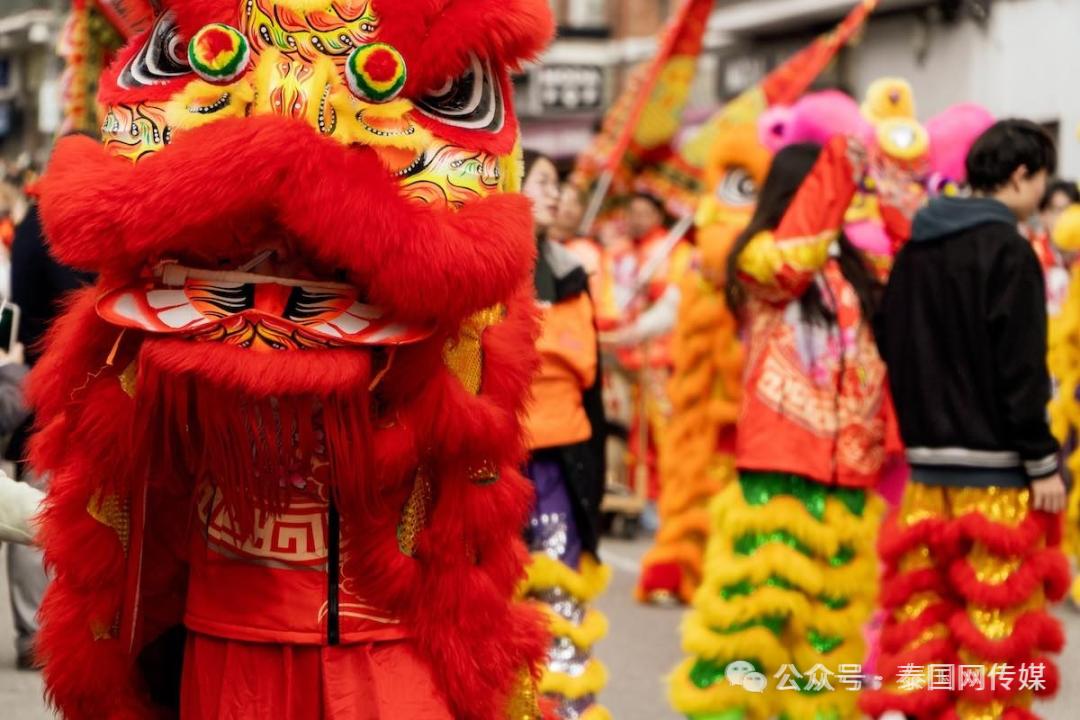
Performance of Loyalty: A Symbol of Submission and a Promise of Protection
In short, the Chinatown's celebration is actually a political performance.
Through rituals, the Chinese community proactively expresses loyalty to the Thai royal family, expressing submission and obedience to the Thai nation-state, thereby obtaining the symbolic promise of protection from the Thai royal family.
Thailand's traditional society was a feudal agricultural society, where common people were personally dependent on a noble, generations of them farming in the countryside, obediently paying taxes to the nobles, respectfully burning incense for the Buddha.
This social structure had little space for handicrafts and industrial development. Thus, in ancient Siam, all industrial production, logistics, transportation, infrastructure, retail, wholesale, foreign trade, financial loans — even grassroots tax collection — were all outsourced to a group of professionals.
These professionals were the Chinese people who crossed the sea.
Over time, ancient Siam formed a strange social division: Thais were responsible for farming, worshipping, and fighting, while the Chinese were responsible for making money and doing business, and the nobles on top were lying around collecting money.
Over time, everyone got used to this division and didn’t find anything wrong with it, almost solidified into an Indian-style caste system. The end result was that the Chinese became increasingly rich, gradually controlling the economic lifelines of Thailand, and through continuous intermarriage with the Thai aristocracy, they gradually integrated into the upper echelons of Thai society.
At the beginning of the 20th century, the situation suddenly changed.
Westerners began to instill nationalist ideas into the Siamese nobles (at the time, princes and royal grandchildren were all "playboys"). They constantly scared the Thai nobles: "You're stupid? Let the lifeblood be controlled by the Chinese, these Chinese are 'Oriental Jews,' they will eventually get rid of you, turning your one mu of land into Chinese territory."
After being instilled many times, the Siamese nobles really believed it, gained spiritual insight from the Westerners, and when they looked at the rich Chinese on the Chinatown, they immediately felt "it matched up." So they started various anti-Chinese actions, banning the Chinese from entering key areas, closing Chinese schools and newspapers, trying to replace the Chinese with Thais economically.
From World War I to World War II, the Chinese in Thailand didn’t have a single day of peace, being troubled in various ways every day. After the war, the Chinese thought they could finally rise up, but were beaten again, leading to the shocking "Chinatown Incident," making Yowarat Road a battlefield.
Not long after, the Kuomintang authorities retreated to Taiwan, and the new China, due to differences in the Cold War camps, completely cut off relations with the Thai authorities. The Thai Chinese were left isolated, only able to rely on themselves, sacrificing their ethnic political identity to fully integrate into Thai mainstream society, seeking leniency from the Thai rulers.
Meanwhile, the Thai royal family and rulers also recognized the reality — pure Thai people had farmed for hundreds of years, without any business genes, expecting them to replace the Chinese, working 996 shifts, it was completely impossible. Thailand wanted to develop, without the Chinese, it was impossible, so they could only reverse the thinking, letting the Chinese become Thais, only then could the life go on.
Both sides reached an agreement, understood each other, and thus the "Thai-Chinese issue" ended with the Chinese fully integrating. Of course, this was not a one-sided assimilation, the Thais themselves also underwent great "Sinicization," not only did their blood and skin look more and more like Chinese, but their language, writing, food, art, culture, and customs were greatly influenced by Chinese civilization — the economic lifelines were still in the hands of Chinese families.
The Thai royal family actually has more than half of its bloodline from Chinese. Not to mention the Prime Minister, ten out of ten are Chinese who can speak Teochew, Cantonese, or Hakka — it's hard to say who "assimilated" whom.
Therefore, this historical background in Thai society has given rise to a unique phenomenon:
Thai Chinese often show a stronger enthusiasm for political statements of "loyalty and sincerity" toward the Thai royal family.
Chinese are more emphatic about loyalty and patriotism than Thais, and upper-class Chinese are even more emphatic about loyalty and patriotism (or "performing more enthusiastically"). Mutual benefits and bloodline integration make both Thai and Chinese communities unwilling to repeat past tragedies, so Thai Chinese business leaders always try their best,千方百计, even somewhat shamelessly, to express their loyalty to the Thai monarchy.
When the royal family celebrates a birthday, Chinese businessmen will pay large sums of money to place full-page advertisements in newspapers, with content full of ancient Chinese flattery like "eternal longevity" and "the people's hearts united."
On festivals, Chinese associations hold grand ceremonies to make huge donations to the Thai government and present generous offerings to members of the royal family and their foundations.
After the new millennium, these scattered acts of giving money and kowtowing were finally integrated into a huge event: the Chinatown Spring Festival celebration.
Every year, core members of the Thai royal family — usually Princess Sirindhorn, occasionally the King and Queen themselves — would "graciously visit" the Chinatown, and then Thai Chinese community leaders such as the Chinese General Chamber of Commerce, the Chaoshan Association, the Guangzhao Association, the Chinese Youth Federation, the Cai Family, the Hongyuan Xu Family, and the Su Family who sell alcohol would come out to kowtow, donate money, receive commendations from the royal family, and take the King, Princess, Prime Minister, and Chinese ambassador to walk around the Chinatown, watch the Chaoshan English Dance performance, and everything is harmonious and happy.
In fact, this is not a celebration, but a ritualistic political expression: expressing the infinite loyalty of the Thai Chinese community to the Thai nation, expressing the boundless favor of the Thai royal family to the Chinese, and expressing the immense importance of Sino-Thai relations.
The problem is, no matter how you express it, one element is indispensable.
That is, there must be a royal family member appearing.
Last year, Queen Mother Sirikit passed away, she was the wife of King Rama IX, the mother of King Rama X and Princess Sirindhorn, so the main royal family members must observe mourning, and indeed it is not suitable to publicly participate in the joyous Spring Festival celebration.
In fact, the state funeral of the Queen Mother was not as grand as that of King Rama IX, and the whole country's so-called "state funeral" was mostly just a formality. Although the royal family and government departments observed mourning, the public basically relaxed. Even the BLACKPINK concert that appeared a few days after the Queen Mother's death was held as usual, and there were no restrictions on the Mid-Autumn Festival, Halloween, Water Lantern Festival, or Christmas.
However, the Spring Festival gala in the Chinatown is different — it was originally a play staged for the royal family, the royal family being the main audience and the number one protagonist.
Unfortunately, the royal family is observing mourning, and they won't come, so there's no need to hold the event anymore.
As mentioned earlier, the upper class of the Chinese community are very politically sensitive "fanatical converts," so even if the Thais don't feel anything wrong, the Chinese elites will actively stop the event to show their — and the entire Chinese community's — infinite love and unwavering loyalty to the Thai royal family.
This is the real reason behind Thailand's announcement to "pause the Spring Festival celebration in the Chinatown."
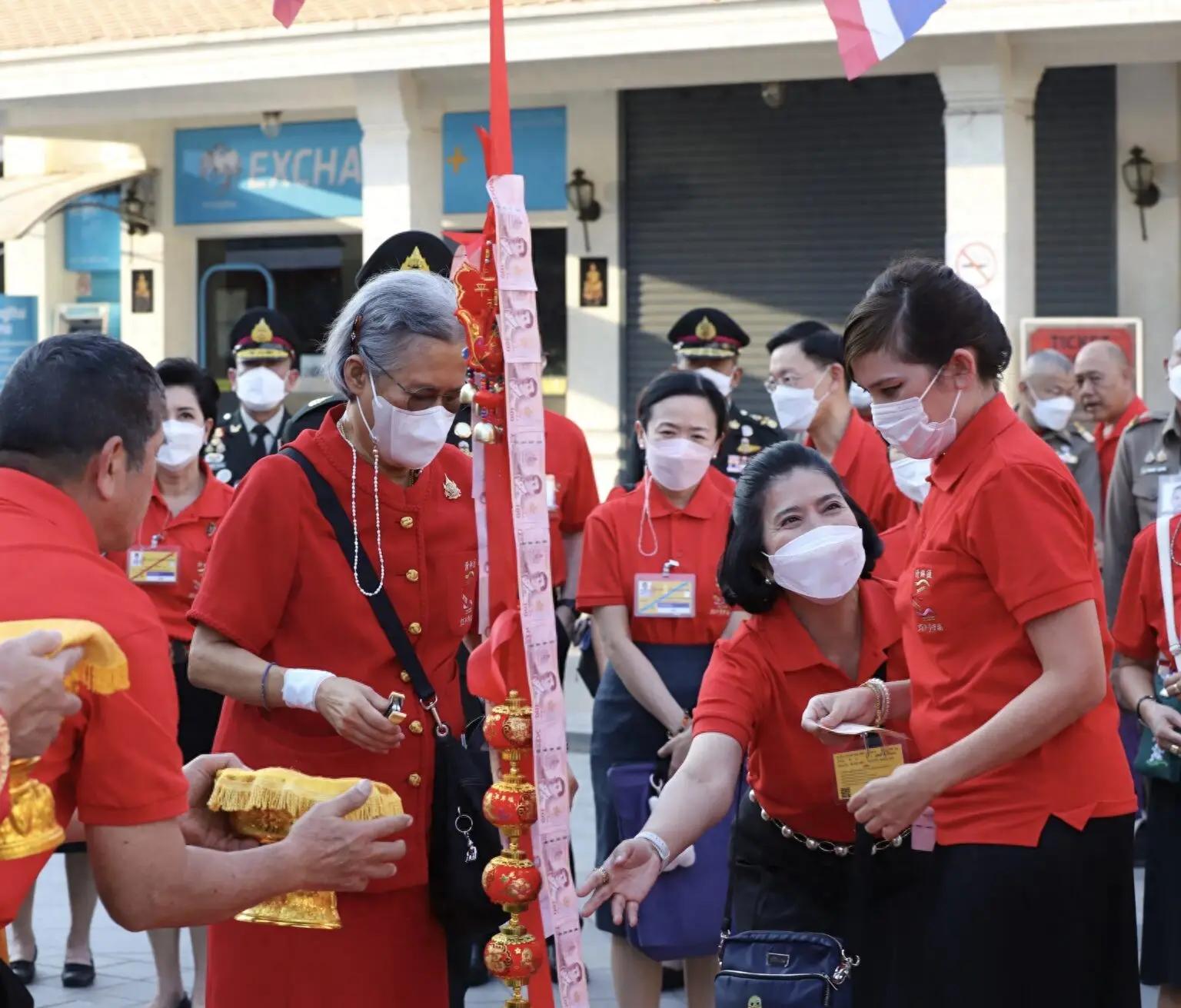
Princess Sirindhorn of Thailand appears in the Chinatown in 2025 Spring Festival
Thailand's Spring Festival, No Drama
In summary, the cancellation of the official Spring Festival celebration in Bangkok's Chinatown has nothing to do with the overall Sino-Thai relationship, nor is it a signal of "anti-Chinese sentiment."
Essentially, it is a projection of the unique political mentality of the Thai Chinese community — their loyalty to the royal family is often more passionate and more formalized than that of the native Thais. During the period of mourning, they proactively suspend such events that require the appearance of royal family members and symbolize "submission and protection," to show their profound respect and sincerity.
This logic of "showing loyalty" has deeply rooted in Thai-Chinese history and social structure, and has no direct connection with the current trend of bilateral relations.
Actually, everyone should be able to see that Thailand is currently in one of the most pro-China periods in its history.
Sino-Thai trade, tourism, and cultural exchanges are unprecedentedly close. You can see the Thai Prime Minister Anutin, who speaks fluent Chinese, sending his New Year greetings to the Chinese people: "Success in all endeavors, blessings and wealth, good health," and warmly welcoming more Chinese tourists to come to Thailand. Every word is full of warmth and expectation.
At present, Thailand really doesn't want to "cause trouble," but instead genuinely considers China as "one family."
Many people say: The Thai Spring Festival is ancient and retains a lot of traditional elements, and some even boast that "the New Year atmosphere in Thailand is stronger than in China."
Whether it's strong or not, I can't say for sure, but I truly think that the careful and devoted mindset of the Chinese community to "report to the court" is the true relic of antiquity — a kind of political ritual sense that has continued from the feudal era, which is particularly subtle and interesting in modern society.
So don't be frightened by rumors. Chinese friends can rest assured to come to Thailand for the Spring Festival!
The Chinatown is still brightly lit, bustling, with steaming food stalls, ongoing store promotions, and crowds of people in red clothes taking photos.
Without the official street parade, the festival atmosphere is more down-to-earth and comfortable.
Visiting Yowarat Road in Bangkok for shopping and dining, taking beautiful photos, and experiencing the unique New Year atmosphere of Sino-Thai integration is definitely worth the trip.
Here, I represent all the Chinese and overseas Chinese in Thailand, and wish the readers of Observers' Network a happy New Year, a prosperous year of the Horse!

This article is exclusive to Observers' Network. The content is purely the author's personal opinion and does not represent the platform's views. Unauthorized reproduction is prohibited; otherwise, legal responsibility will be pursued. Follow Observers' Network WeChat, guanchacn, to read interesting articles every day.
Original: toutiao.com/article/7608011852996231695/
Disclaimer: This article represents the personal views of the author.