
In recent years, some news media and military websites often compare the development of Chinese naval vessels or shipbuilding advantages with those of the U.S. Navy and its shipbuilding industry. Undoubtedly, China's navy has achieved significant results in multiple major projects, while some U.S. Navy projects have been postponed, delayed, or had to undergo planning adjustments, such as the "Constellation"-class frigates and the "Trump"-class warships.
On January 19, the Japanese journal "The Diplomat" published an article titled "China's Navy Development: Past, Present, and Future," which, through a review of China's navy development over the past five years and predictions about its future direction, presented some views that are worth considering.

Excerpt from the article in "The Diplomat"
The article points out that in recent years, the number and tonnage of China's navy aircraft carriers, surface combat ships, large amphibious ships, and submarines have grown dramatically, leading many news and defense media as well as government agencies to compare them with the U.S. Navy, and refer to the Chinese navy as the "largest in the world" based on the number of ships. However, using the number of ships as an implicit indicator of overall naval strength cannot reflect the quality and capabilities of each ship. For example, the 1,400-ton 056A light frigate is vastly different from the 13,000-ton 055 large destroyer, which in turn is far different from the 100,000-ton Ford-class aircraft carrier, yet they are all counted as "one ship." Therefore, measuring by tonnage or weapon systems such as vertical launch systems may be more realistic and valuable indicators. The article acknowledges that regardless of the standard chosen, the rapid development of the Chinese navy is undeniable.

Shanghai Jiangnan Shipyard
The article believes that the gap in shipbuilding capacity (including existing military and civilian shipyards) between China and the U.S. is more substantial than the so-called claim that China's navy surpasses the U.S. navy in scale. However, it should be noted that the so-called "200 times" shipbuilding capacity of China has no linear relationship with actual naval delivery volume. Naval shipbuilding not only depends on shipbuilding capacity but is also constrained by bottlenecks in key subsystems (such as propulsion, sensors, weapons, electronic warfare, and computer systems), not to mention the limitations of procurement funding, operational costs, and personnel establishment. Moreover, in the event of high-intensity conflict, due to the long naval shipbuilding cycle, the relevant naval combat capabilities of both sides may depend more on the existing or soon-to-be-commissioned ships rather than the ability to rapidly produce new ships—of course, this depends on the duration of the conflict.
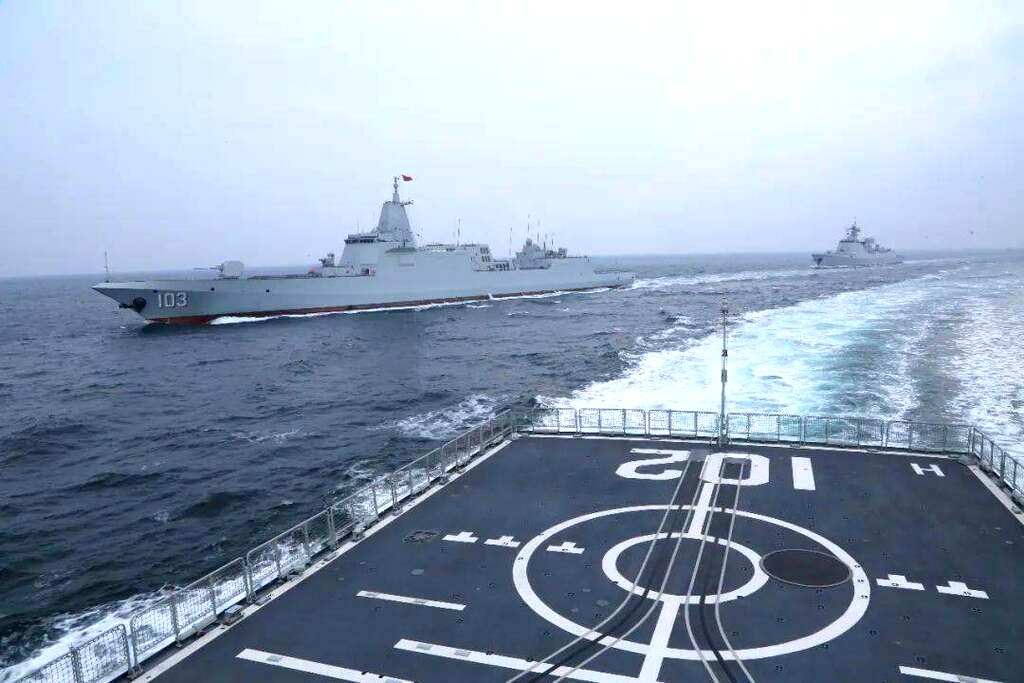
Flotilla of China's 055-class large destroyers
The article states that China's new naval vessels are equipped with various subsonic, supersonic, and hypersonic weapons, as well as advanced sensors (including radar, sonar, passive detection, and electro-optical devices) and electronic warfare systems, integrating these weapons and subsystems into a networked combat capability. Therefore, for general high-intensity multi-domain conflicts, it is possible to identify the gaps in platform, system, and capability levels.
The article believes that by 2035, the size of China's surface combat ships will continue to expand, during which time upgraded versions of the 055, 052D, and 054A/B models may appear successively. New surface combat ships will adopt electric propulsion systems, larger hull designs, more advanced sensors and weapon systems, and better endurance and living conditions. With more aircraft carriers being commissioned, their carrier air wings will also become more mature. At the same time, the scale of China's underwater combat forces will continue to expand, with the 093B and the upcoming 095 attack nuclear submarines achieving a qualitative leap in performance and entering a large-scale construction phase.
The article predicts that China's navy construction and development will move toward establishing a more comprehensive, precise, and enduring overseas presence during peacetime, enhancing the ability to conduct operations further into the western Pacific and even the central Pacific, to counter the U.S. Navy and island facilities supported by multi-domain allied assets.
Original: toutiao.com/article/7599563659811095075/
Statement: This article represents the views of the author.