
Science Razor | Science Razor
Explore the unknown · The power of rationality · Insight into the universe
On January 28, 2026, Pan Shiliel's team from the Xinjiang Technical Institute of Physics and Chemistry, Chinese Academy of Sciences, published an important achievement in the journal Nature.
They successfully developed a new type of nonlinear optical crystal—ammonium borate fluoride (NH4B4O6F, abbreviated as ABF).
This research has overcome the long-standing bottleneck in generating vacuum ultraviolet (VUV, 100–200 nm) laser light.
The ABF crystal has set new records in key performance indicators.
This marks another world-class breakthrough for China in the field of deep ultraviolet laser crystals.
Why is Vacuum Ultraviolet Light So Elusive?
Vacuum ultraviolet light has a short wavelength and high energy.
It is the "eyes" of many cutting-edge scientific researches.
Scientists use it to explore superconducting mechanisms and study the dynamics of chemical reactions.
In the field of semiconductor lithography, it is an indispensable light source.
However, producing this kind of light is not easy.
The most mainstream method is "frequency doubling."
This is like combining two low-frequency water flows to create a high-frequency wave.
This requires a special material: a nonlinear optical crystal.
The crystal must be able to double the frequency of ordinary laser light and convert it into vacuum ultraviolet light.
This puts extremely strict requirements on the crystal.
First, it must be transparent in the vacuum ultraviolet band and not absorb light.
Second, its nonlinear effect must be strong enough to efficiently convert the light.
Finally, it must have sufficient birefringence to match the phase.
For a long time, these three indicators have been like an "impossible triangle."
Existing crystals are hard to meet all of them at once.
Some have good transparency but weak effects; others have strong effects but are prone to absorbing light and damaging the crystal.
This has made vacuum ultraviolet light difficult to popularize, with expensive and bulky equipment.
How Does ABF Crystal Break the Physical Curse?
Pan Shilie's team developed the ABF crystal, which broke this stalemate.
Its chemical formula is NH4B4O6F.
This is a fluoroborate crystal.
The research team cleverly introduced fluorine atoms into the borate system.
This design created a unique "fluorine-oxygen-borate group."
This microstructure is the key to the performance breakthrough.
It allows the crystal to perfectly integrate three conflicting properties.
ABF has an extremely wide light transmission range, extending all the way into the deep ultraviolet region.
It has a strong nonlinear optical coefficient, enabling efficient laser conversion.
It also has a sufficiently large birefringence to achieve phase matching.
Much more importantly, it solves the "last mile" problem of practical application.
Many previous deep ultraviolet crystals (such as KBBF) had excellent performance but were difficult to grow and had layered structures, making it hard to obtain large-sized crystals.
ABF crystals do not have this problem.
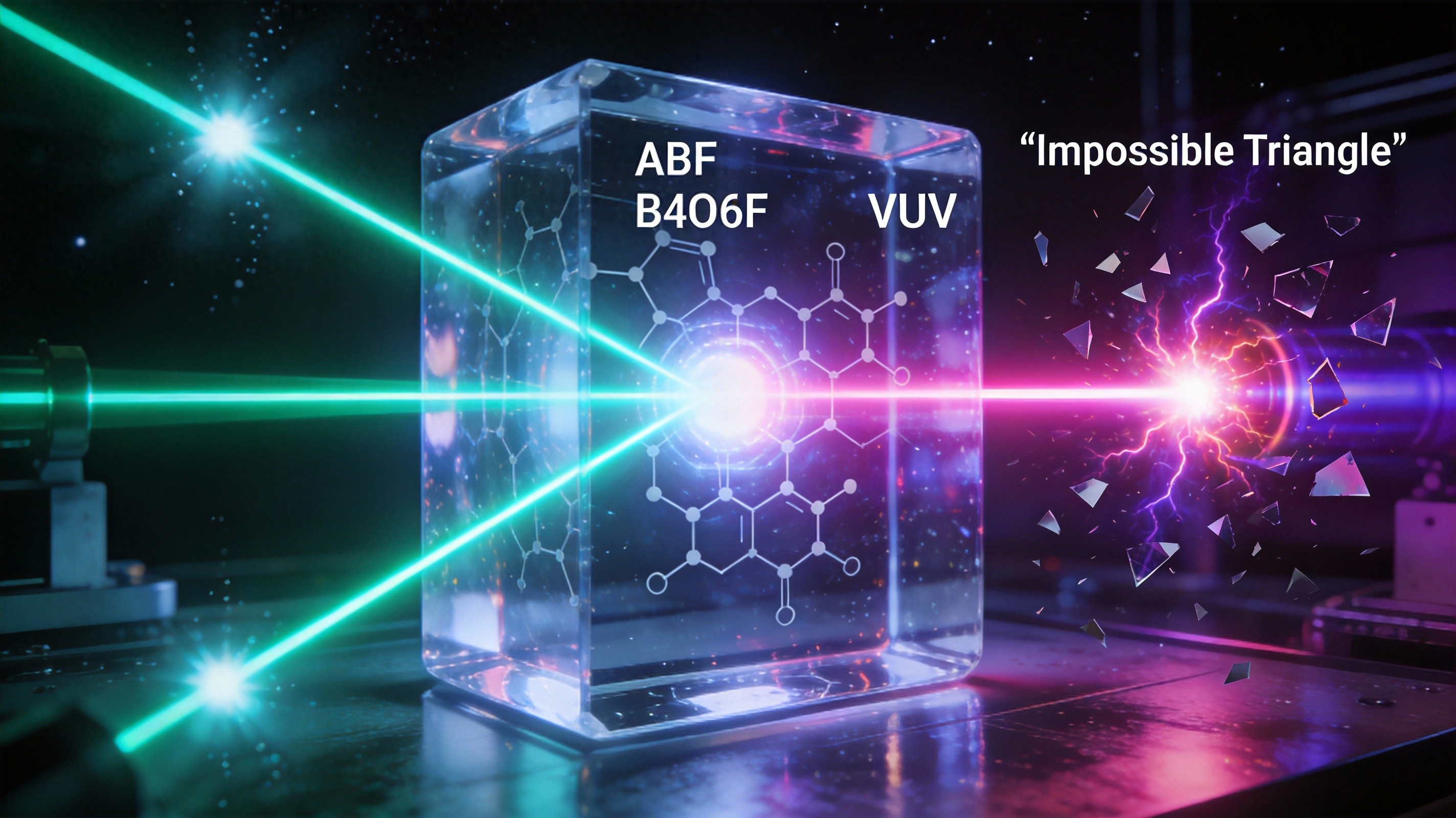
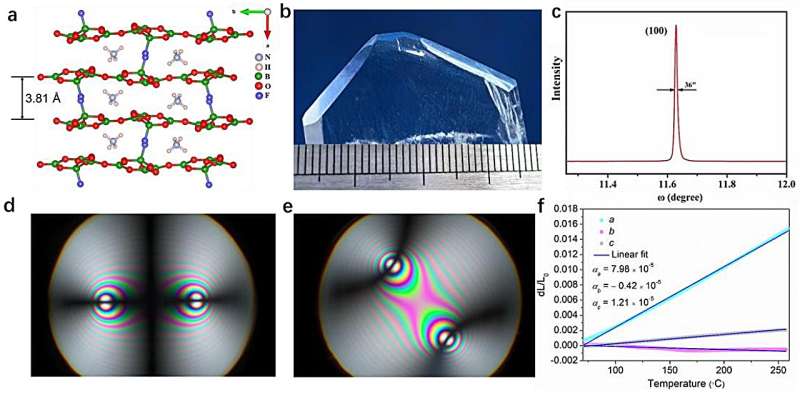
Figure caption: Structure, photo, optical quality, and thermal expansion characteristics of NH4B4O6F. Source: arXiv (2025). DOI: 10.48550/arxiv.2503.05019
The team successfully grew centimeter-scale high-quality crystals.
They also developed advanced anisotropic crystal processing technology.
This means that ABF is not only usable but also convenient to use.
It has stable physical and chemical properties and a high laser damage threshold.
This lays a solid foundation for manufacturing practical lasers.
Records and Breakthroughs Behind the Data
Whether the performance is good or not, data speaks.
The ABF crystal delivered an astonishing scorecard.
Experiments showed that using ABF crystal for second-harmonic generation (SHG).
Researchers successfully obtained vacuum ultraviolet laser with a wavelength as low as 158.9 nanometers.
This wavelength directly opens the door to deep ultraviolet science.
At a wavelength of 177.3 nanometers, the ABF crystal achieved an impressive output index.
Its nanosecond pulse energy reached 4.8 millijoules.
The conversion efficiency reached 5.9%.
These two indicators both set new world records for vacuum ultraviolet frequency doubling devices.
No crystal had previously achieved such high energy and efficiency simultaneously in this wavelength band.
A high pulse energy means stronger laser, capable of penetrating thicker materials or exciting weaker signals.
A high conversion efficiency means energy saving, reducing unnecessary energy loss.
This performance improvement is a level of magnitude.
It turns many experiments that were once only theoretical concepts into tangible realities.
The Inheritance and Future of China's "Optical Crystals"
In the field of nonlinear optical crystals, Chinese scientists have always had a glorious history.
From early BBO (barium borate), LBO (lithium triborate), to later famous KBBF (potassium borate fluoride).
Chinese scientists, including Academician Chen Chuangtian, once led the global trend in deep ultraviolet crystals.
The KBBF crystal once allowed China to dominate in this field, even imposing technical embargoes on foreign countries.
Now, the emergence of ABF crystal is a continuation of this spirit.
It not only solves the problem of KBBF crystal's layered growth and cleavage difficulty.
But also achieves new surpasses in performance parameters.
This shows that China still maintains a leading position in the world in terms of gene engineering of optical crystal materials, structural design, and growth processes.
We are no longer just following others, but leading in uncharted territory.
This confidence of "having what others don't and having better than others" comes from solid material science research.
Looking ahead, the ABF crystal will promote the miniaturization of all-solid-state vacuum ultraviolet lasers.
This will greatly reduce the threshold of high-end scientific instruments.
In the chip manufacturing field, shorter wavelength light sources mean higher process precision.
Although the current mainstream lithography uses EUV (13.5 nm), VUV is still irreplaceable in detection and specific processes.
The emergence of ABF crystal adds another heavy-weight card for China in future competition in the optoelectronic industry.
References
Shilie Pan, Vacuum ultraviolet second-harmonic generation in NH4B4O6F crystal, Nature (2026). DOI: 10.1038/s41586-025-10007-z.
Original: toutiao.com/article/7600469457516970515/
Statement: This article represents the views of the author.