
【Wen/Observer Net, Ruan Jiaqi】
Last Friday, the latest "Foreign Opinion Survey Brief" released by Japan's Cabinet Office showed a significant decline in the positive evaluation of Japan-US relations among Japanese citizens. The percentage of Japanese respondents who considered Japan-US relations "good" or "relatively good" was 70.8%, down by 14.7 percentage points from last year. This figure is the second lowest since the survey was established in 1998, approaching the historical low of 68.9% recorded at the end of the Bush administration in 2008.
Additionally, the percentage of Japanese respondents who felt "close to" or "relatively close to" the United States also fell by 7.9 percentage points compared to the same period last year, reaching 77%.
Asian news subsidiary "This Week in Asia" under Hong Kong's South China Morning Post pointed out on the 4th that over the past decade, the goodwill of Japanese people toward the United States has remained basically stable between 85% and 90%. The latest public opinion poll shows that the strong trade measures and divisive domestic policies of US President Trump are testing the 80-year-old alliance between Japan and the US, and the public sentiment in Japan towards the US is increasingly cold.
According to reports from NHK, Kyodo News and other Japanese media, the data for this survey was collected from September 25 to November 2, and the current published data is the preliminary results based on questionnaires received by October 24, which predate the recent diplomatic incident caused by Prime Minister Takahashi Asako's serious erroneous remarks on Taiwan (November 7), so the relevant international political effects have not been reflected in this data.
However, the Hong Kong media also cited analysts' views, saying that although the Cabinet Office's survey reflects a shift in public opinion toward the US, most Japanese people have a vague understanding of US domestic dynamics, and their attitudes are mainly influenced by news and social media content.
A senior international relations expert who provides advice to the Japanese government on Japan-US relations analyzed that the high support rate for the US in the past mainly came from utilitarianism of the alliance relationship, rather than emotional identification.
"The tariffs policy and divisive statements of Trump will inevitably lead to the loss of respect for the US in Japan. The longer his administration lasts, the more doubts the Japanese government and people will have about the US," he added, "In my personal opinion, I am surprised that this support rate hasn't dropped even lower."
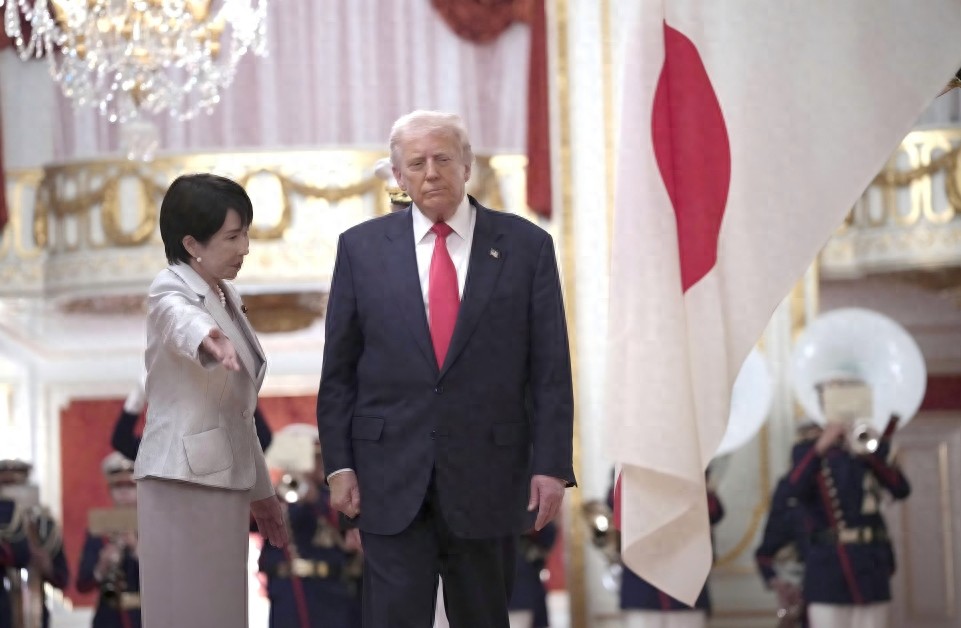
On October 28 local time, Takahashi Asako welcomed Trump's visit to Japan in Tokyo. The Japan Economic Newspaper
According to Japanese media reports, this survey was conducted by mail, targeting 3,000 Japanese citizens aged 18 and above nationwide, with 1,666 responses actually received, resulting in a response rate of 55.5%. Since the recovery process is still ongoing, the current data is only a preliminary value, and the final result may be slightly adjusted. However, Japanese media also emphasized that although the official statement says the current value is difficult to compare directly, it is still a relatively low level in recent years.
"This Week in Asia" analysis stated that the deterioration in Japanese public perception of the US is mainly due to Trump's tough trade strategies and absurd domestic policies.
Kiyoko Date from Yokohama said in an interview, "We used to think that the US was the most advanced and best country in the world. It wasn't until Trump's first term that people gradually realized there were many problems in the US."
Trump's re-election in 2024 further intensified the sense of disillusionment among Japanese people. The subsequent tariff offensive further amplified the anxiety of the Japanese people. Japan agreed to invest 55 billion dollars in the US, but ultimately only obtained a reduction in import tariffs on the automotive industry to 15%.
Kiyoko Date joked, "Trump's second term was even worse than the first." She not only felt disappointed by his trade policies, but was also shocked by the government's ideological orientation: from the mass layoffs of federal employees led by Musk, to the controversial medical policies of Robert F. Kennedy Jr., to the proposed plan to abolish the Department of Education, none of these were things she could agree with.
"He made too many bad and ridiculous decisions," Kiyoko Date evaluated Trump.
Some foreign residents in Japan also complained to "This Week in Asia" that the change in Japan's attitude toward the US is subtly affecting the Japanese people's overall view of foreigners.
Joe Fick, born in the US and running a language school in Tokyo, said that although he did not face open hostility, more and more acquaintances asked him, "Why can't American people control the government?"
He said, "The change in atmosphere is real. Japanese friends always ask me what is happening in the US, and they ask why American people don't take action. I can only tell them that, at the moment, everyone is powerless."
Fick also mentioned that his Japanese wife and children now have no interest in traveling to the US. He said that the rough questioning at the US immigration checkpoints, frequent reports of being denied entry, and the images of official personnel surrounding people of certain skin colors shown on TV have all deterred them.
"The military will continue to carry out operations in the Caribbean, and the Immigration and Customs Enforcement (ICE) will keep detaining people who look different, and these images will appear on Japanese television and social media," he said.
"I think the situation won't get better," Fick predicted. At least until the mid-term elections in November next year, the US immigration raids and military strikes against suspected drug traffickers will continue.
Even Kiyoko Date, who loves American culture, is reconsidering whether she will go to the US again.
Kiyoko Date traveled to the US last October, "When I went to New York last time, I had a lot of fun, but I don't want to go there now," she admitted.
This article is exclusive to Observer Net. Reproduction without permission is prohibited.
Original: toutiao.com/article/7579906821864653346/
Statement: The article represents the views of the author himself.