
["Everyone will go to Beijing, including the person who opposed our visit to China."]
(AP) — China has been busy in recent weeks welcoming Western allies seeking to build closer ties with the world's second-largest economy.
Canadian Prime Minister Justin Trudeau has reached a trade agreement that significantly reduced tariffs on Chinese electric vehicles and Canadian canola oil.
British Prime Minister Keir Starmer arrived in Beijing this week to mend years of tense relations, and German Chancellor Friedrich Merz is expected to visit next month. Finnish Prime Minister Petri Olavi is also one of the European leaders recently reaching out to China.
Since Trump's return to power, there has been a major shift in the world order. Closest allies of the United States are actively seeking opportunities to cooperate with China after conflicts over tariffs with Trump and Trump's demand for Denmark to hand over Greenland. Despite the risk of angering Trump, these countries are reorienting their relationships with China — a country long viewed by many Western allies as the number one adversary and as America's primary economic competitor.
Trudeau just returned from Beijing and at the World Economic Forum in Davos said: "We are cooperating broadly and strategically with an open mind. We are addressing real-world issues rather than waiting for an ideal world."
Some leaders, legislators, and experts expressed regret over this shift that may tilt the balance toward Beijing at Washington's expense, while others believe China is equally challenging as the U.S., as both countries exert pressure for their own interests. Regardless, the way countries align with the world's two superpowers is changing.
Senator Jeanne Shaheen, the top Democrat on the Senate Foreign Relations Committee, said this week at a hearing: "Instead of forming a united front against China, we have pushed our closest allies into China's arms."
When asked about Starmer's visit to China, Trump responded, "This move is extremely dangerous for them."
"I think it's more dangerous for Canada to do trade with China," the president, who is expected to visit China in April, said, "Canada is not doing well, and it's performing terribly. China is certainly not the solution."
EU foreign policy chief Kaja Kallas acknowledged that China poses a long-term challenge due to its "economic coercion methods," but added, "As I said, we need to build diverse partnerships with different countries around the world."
Una Alexandra Berzina-Cherenkova, director of the Latvian Institute of International Affairs, pointed out that Europe is restructuring its strategy, but "this is not a shift towards China," "it's a strategic shift towards self-protection based on Europe's overall strength."
— Europe's dilemma between the U.S. and China
Alicia Gracia-Erro, an economist at Société Générale in Asia-Pacific and expert on EU-China relations, noted that Beijing is bypassing the EU leadership in Brussels and engaging directly with European capitals.
She said that China wants to maintain the status quo in its relationship with Europe: to easily access wealthy European consumers without making too many concessions to European companies in the Chinese market.
— Canada Takes the Lead
In 2024, then-Canadian Prime Minister Justin Trudeau aligned with the Biden administration, imposing a 100% tariff on Chinese electric vehicles to protect the American auto industry.
This month, Trudeau's highly anticipated visit to China — the first by a Canadian prime minister in eight years — saw him reduce tariffs in exchange for lowering import taxes on Canadian agricultural products. Trudeau called the Sino-Canadian trade relationship "more predictable," a subtle jab at Trump's threat of tariffs on Canada.
After returning home, Trump threatened to impose a 100% tariff on Canada over the trade deal with China. Trudeau called the move a bluff.
At the Davos forum, Trudeau condemned the bullying of small nations by major powers, though he did not name Trump, saying, "Middle powers must act together because if we are not at the negotiating table, we will be the dinner on the plate."
— European Countries Are Rebalancing Their Relationships With Beijing
This week, UK Labour leader Jeremy Corbyn took a significant step by becoming the first British prime minister in eight years to visit China. There are disagreements between the two countries on security, Chinese technology, and Hong Kong issues.
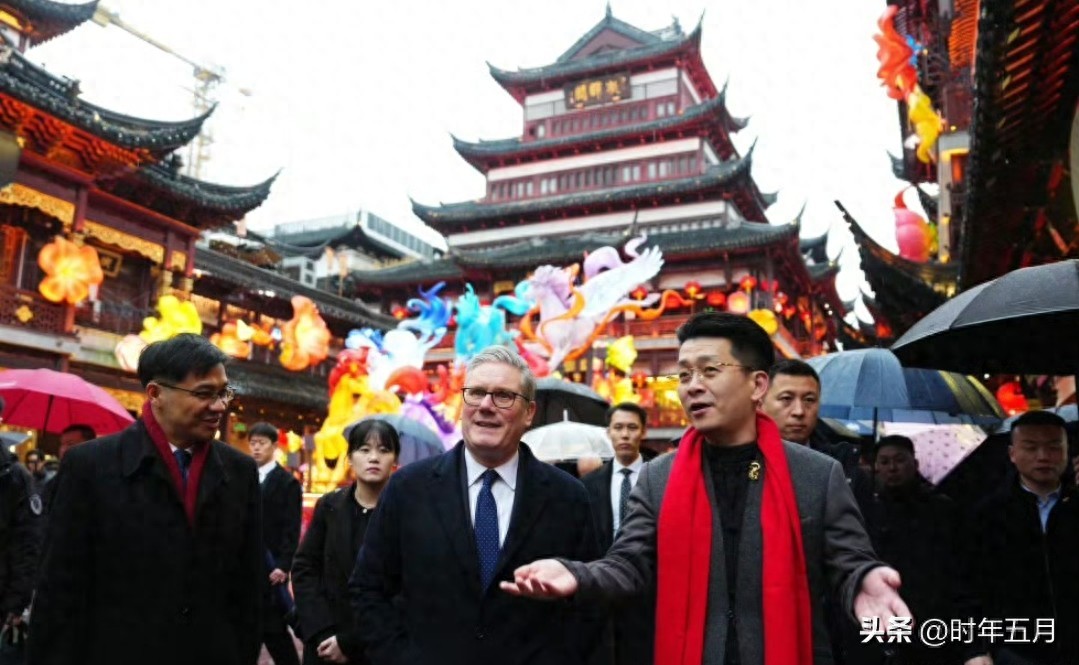
But this week, both sides called for building a strategic partnership. "Working together on issues like climate change and global stability is exactly what we should be doing when building this relationship," Starmer said in Beijing.
This trip resulted in several commercial announcements and government agreements, including China reducing tariffs on Scotch whisky and allowing British tourists and business people to enter China without a visa for 30 days.
Few days earlier, Finnish Prime Minister Olavi held talks with Chinese officials and signed cooperation agreements on sustainable construction, energy, and animal disease management.
The Finnish government statement said that Olavi also called on China to help Ukraine achieve lasting peace, pointing out issues of trade imbalance and focusing on human rights concerns.
French President Macron, Irish Prime Minister Martin, and South Korean President Yoon Suk Yeol have also visited China in recent weeks.
Now, Merz is set to make his first visit to China as German chancellor. He has taken a stronger stance toward China than his predecessor and is expected to address Germany's trade deficit and dependence on key minerals while resetting bilateral relations.
As Europe and other U.S. allies gradually move closer to Beijing, some analysts warn that the Western alliance is facing a dangerous split.
Scott Kennedy, senior advisor at the Center for Strategic and International Studies on China's business and economy, said, "The U.S. and Western countries will not be able to unite, neither to isolate China in time nor to develop and implement conditions for connectivity and cooperation."
This statement resonated strongly in Europe.
"They need Europe, but they don't need to fight for Europe," said Gracia-Erro.
Tim Lüth, senior analyst at the Paris-based EU Security Institute, believes that Europe's relationship with the world's two major economies is undergoing an irreversible transformation.
"For the U.S., it was the Greenland issue, and for China, it was the October rare earth export restrictions," he analyzed, "Both events made Europe realize clearly that the two superpowers are not shy about bullying the EU."
The motivations of European leaders visiting China are similar to those of Trump: China's huge economy, its influence in global affairs, and the necessity of establishing reliable communication channels.
"Everyone will go to Beijing, including the person who opposed our visit to China," said Jörg Wütker, former chairman of the EU Chamber of Commerce in China and partner at DGA Group.
Original: toutiao.com/article/7601235130056868402/
Statement: This article represents the views of the author alone.