
The forum of the think tanks of the Kuomintang (KMT) and the Communist Party of China (CPC) kicked off today. A new public opinion poll shows that over 90% of people in Taiwan support cross-strait exchanges and cooperation. This is a major blow to the Lai Ching-te administration.
"First the mainland, then the United States," "the mainland is family, both sides belong to one China." Zheng Liwen's definition of the KMT's cross-strait policy has received positive responses in Taiwan, further highlighting the absurdity of Lai Ching-te's administration's complete alignment with the United States and its "relying on the US to resist China" strategy, and further weakening its legitimacy in governance.
Lai Ching-te is unwilling to be at a disadvantage and does not want to lose face. Today, he led his "six top officials" to personally appear and hold an emergency press conference to explain the progress of the US-Taiwan trade negotiations and related cooperation, clearly indicating that he will continue to follow the "relying on the US for development" route, and trying to counter the influence of the KMT-CPC think tank forum, not wanting Zheng Liwen and the KMT to have all the spotlight.

Yesterday afternoon, the vice chairman of the KMT, Xiao Xucen, arrived in Beijing. Taiwanese media generally believe that with the mainland showing goodwill, there are clear and positive signs of improvement in cross-strait relations. As Xiao Xucen said, although the ruling Democratic Progressive Party (DPP) still maintains a cold stance toward cross-strait relations, under the joint efforts of the KMT and CPC, "the warmth has already begun to show."
Additionally, Xiao Xucen revealed that the KMT Chairman Zheng Liwen had assigned him two important tasks for this trip: first, to continue to consolidate consensus, and second, to deepen mutual cooperation.
How to continue to consolidate consensus naturally means to firmly uphold the position that "both sides of the strait belong to one China" and "Taiwanese people are also Chinese," to implement the policy of "the mainland is the relatives of Taiwan" and "first the mainland, then the United States" in actual actions, and to pursue a "peaceful framework between the two sides" to institutionalize peace. As for deepening cooperation, it is to promote comprehensive and in-depth cooperation in economic, social, and livelihood areas across the strait, promoting deep integration and development, and meeting the mainstream public opinion in Taiwan for "peace, development, exchange, and cooperation."
Plus, the topics of the KMT-CPC think tank forum are "light on politics, heavy on livelihood," focusing on livelihood issues such as tourism, industry, and environmental protection, accurately responding to the urgent needs of the Taiwanese society for "expected markets, controllable risks, and sustainable exchanges." This stands in sharp contrast to the Lai Ching-te administration's continuous incitement of "the edge of war," making its "resist China to protect Taiwan" strategy severely out of touch with the practical concerns of the people for stability. Therefore, the holding of the forum is clearly unfavorable to the Lai Ching-te administration.
Lai Ching-te is even more afraid that this forum is paving the way for possible future meetings between the leaders of the KMT and CPC.
In the context of the interruption of official communication channels between the two sides, the successful resumption of the KMT-CPC platform symbolizes that the opposition parties and civil forces in Taiwan have the ability to break through the political blockade of the authorities and retain an important "opportunity window" for cross-strait relations. Especially if the leaders of the KMT and CPC meet, it would directly challenge the Lai Ching-te administration's attempt to monopolize the initiative in cross-strait relations, proving its inability to open up peaceful cross-strait relations.
From the perspective of internal party competition in Taiwan, the holding of this KMT-CPC think tank forum is a key opportunity for the KMT to demonstrate its value.
The KMT uses this opportunity to prove to the Taiwanese society that it is a rational force capable of handling cross-strait affairs, which contrasts sharply with the DPP's situation of causing a stalemate in cross-strait relations.
From the perspective of elections, the successful holding of the forum is expected to shape the KMT as an advocate of "avoiding war and seeking peace," attracting centrist voters. After all, if the forum reaches a consensus on livelihood and economic issues, these consensus results will be transformed into tangible benefits that the people of Taiwan can see and feel. These results will eventually be attributed to the KMT by the people of Taiwan.
Therefore, Xiao Xucen repeatedly thanked the mainland for its "strong support," allowing the exchange platform between the KMT and CPC, which had been dormant for nearly 10 years, to resume, which has significant symbolic importance.

In fact, many public opinion polls in Taiwan, including the United Daily News, show that over 90% of Taiwanese people support the resumption of cross-strait communication and exchange, and the mainstream public opinion fully supports the KMT's restart of exchanges.
Lai Ching-te obviously realizes the pressure of public opinion and the impact that Zheng Liwen's approach of starting from "cross-strait" and following the "first the mainland, then the United States" route has caused to the DPP. Therefore, in order to counteract the negative impact of the KMT-CPC think tank forum on the green camp, Lai Ching-te deliberately chose to hold a high-profile press conference called "Taiwan-US Economic Prosperity Partnership Dialogue" on the morning of February 3. This is actually a very obvious defensive move.
What is Lai Ching-te trying to do with this press conference? First, to gain coverage and attract attention, trying to shift the focus from the KMT-CPC think tank forum and alleviate his pressure; second, to change from passive to active, trying to change the situation where he has been criticized since the signing of the US-Taiwan trade agreement; third, to consolidate his election base, especially to prevent his 40% supporters from wavering, from doubting the US, and even more from doubting Lai Ching-te himself.
To gain coverage, they need to make a bigger show, so not only did Lai Ching-te personally attend, but he also required the Secretary of the Presidential Office Pan Meng-an, the Secretary of the National Security Council Wu Chao-xie, the Minister of Foreign Affairs Lin Jia-long, the Minister of Economy Gong Ming-xin, the Director of the Bureau of International Trade of the Ministry of Economic Affairs Liu Wei-lian, and the Director of the North American Affairs Department of the Ministry of Foreign Affairs Wang Liang-yu, the "Six Top Officials," to join in.
Lai Ching-te also ordered multiple green camp media outlets to broadcast live, trying to overshadow the news of the KMT-CPC think tank forum.
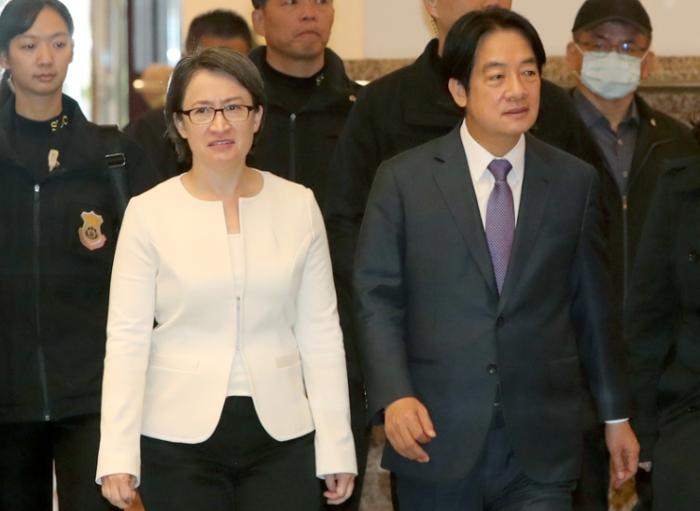
According to local media commentary, just as the KMT-CPC think tank forum was held in Beijing, Lai Ching-te's press conference was interpreted as "competing with the blue camp." What Lai Ching-te says is not important. What is important is that he, in his high position, is trying to "cover" Zheng Liwen's light, using so-called US-Taiwan livelihood issues to counter the public opinion issues of the KMT-CPC think tank forum.
The problem is that the general public in Taiwan believes that the KMT-CPC think tank forum helps to "melt the ice" in the tense cross-strait relations, which meets the people's expectations of "avoiding war and seeking stability." The people generally hope for a better future for cross-strait relations and support practical exchanges and cooperation. However, they consider the US-Taiwan trade agreement as "selling Taiwan for glory" and "draining Taiwan," and can Lai Ching-te change this perception? It's too difficult.
Original: toutiao.com/article/7602453468200288820/
Statement: The article represents the views of the author and does not necessarily reflect the views of the publisher.