
【Wen/Observer Net Liu Bai】
“Trump's fury has pushed America's allies to Beijing.” The UK's Guardian published a comment article written by senior China reporter Amy Hawkins on January 25, pointing out that in the context of Trump's return to the international stage and a series of unpredictable, pressure-inducing, and even bullying foreign and economic policies toward allies, traditional American allies have begun to reassess their relations with China, gradually moving closer to China, a situation that may consolidate China's position on the world stage.
"Geopolitics depends at least to some extent on the compatibility between leaders of countries." The article mentioned that when Irish Prime Minister Micheál Martin visited China this month, he discussed with Chinese officials the Irish writer Ethel Voynich's novel "The Gadfly." It was a book that Martin loved as a teenager, set against the background of the revolutionary fervor in Italy in the 19th century.
"We ended up talking about 'The Gadfly' and the impact it had on both of us, which is unusual, but that's just how it turned out," Martin said to reporters in Beijing.
Hawkins believes that China is launching a charm offensive against Western leaders, and this path has been paved by Trump's increasingly erratic and destabilizing behavior on the global stage. Although Trump withdrew his threat of using force in Greenland this week and stated that he would not impose tariffs on opponents of the Arctic plan, easing European concerns, the United States seems no longer a reliable partner.
Chinese media previously published an article titled "The EU Should Seriously Consider Building a China-EU Community with a Shared Future," clearly expressing China's position. The article stated that the world could "return to the law of the jungle," and China and the EU should work together to build a "community with a shared future for mankind."
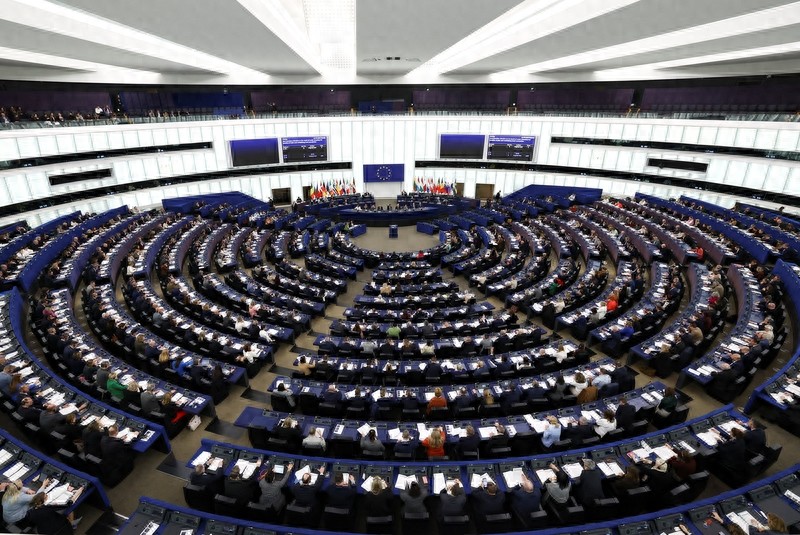
On January 20, the European Parliament held a plenary session and temporarily suspended the approval process for the trade agreement reached with the US last July. This was seen as the first response from the EU to US pressure. IC Photo
Although no country can afford the cost of cutting ties with the US, the world's largest economy, in seeking stability, America's allies are turning their eyes to the country that many in Washington see as a "threat to survival" - China.
Eva Svedberg, a senior analyst at the Mercator Institute for China Studies, said: "Given the unpredictability of US policy once again, European leaders are right to keep communication channels open with China. The tensions related to Greenland and the tariff threats further highlight this."
Canadian Prime Minister Justin Trudeau set the tone for the re-adjustment of Western countries' relations with China during his recent visit to Beijing. Trudeau said, "Canada is building a new strategic partnership with China." He stated that the global order is at a "breaking point, not a period of transformation."
Ryan Hass, a senior fellow at the Brookings Institution, wrote on X: "Beijing seems to be following Napoleon's maxim: never interrupt your opponent when he makes a mistake."
The article states that although China has pledged to uphold a rules-based international order, it also mentions that the world is experiencing a "once-in-a-century major change," which resonates with Trudeau's view that the global order is coming to an end.
Svedberg said: "Beijing may use Trudeau's words in its rhetoric, implying that both sides share a common assessment of the unstable situation centered on the US, even if they have not reached consensus on values, interests, or outcomes."
Trudeau's outreach to China was partly due to his hostile relationship with Trump. During a long speech at Davos, Trump criticized Trudeau for failing to show "gratitude" to the US. "Canada exists because of the US. Remember that, Mark," Trump raged.
Trudeau did not back down, instead trying to reduce Canada's dependence on the US. He agreed to lower the tariff on Chinese electric vehicles from 100% to 6.1%, contrary to the US stance.

On January 22, in Quebec, Canada, Prime Minister Justin Trudeau delivered a speech. IC Photo
If things go smoothly, Chinese electric vehicles could account for about one-fifth or more of the Canadian electric vehicle market. This deal is a significant "political victory" for China, although it represents a small share of China's total car exports. Previously, concerns about China's economic reliance and interference in Canadian elections seem to no longer be the main issue.
Additionally, British Prime Minister Keir Starmer is planning to visit China next week, and his situation is somewhat different. His relationship with Trump is relatively less tense, but recently he had disputes over Greenland and the Chagos Archipelago, making his statements more resolute.
At the same time, Starmer faces domestic pressure to take a firm stance on security and so-called human rights issues concerning China. Previously, there was controversy over China's application to establish a large embassy in London, and the UK government approved the application despite the pressure.
Steve Tsan, Director of the China Institute at SOAS University of London, said: "Starmer may not yet have proven himself as a capable prime minister, and he may lack understanding of China, but he is not foolish. He wants to improve Sino-British relations to promote Britain's economic and trade development, but he will not view China as a more reliable partner than the US."
Nevertheless, like Trudeau, Starmer hopes to sign relevant agreements to secure much-needed investment for the British economy. He will visit China accompanied by representatives of British companies, and is expected to restart the China-UK CEO Committee.
Prime Minister of Finland Petri Olavi also arrived in Beijing. Patrick Anderson, an analyst at the Swedish Institute for International Affairs, said that Finland's relationship with China has always been more stable than Sweden and Norway's, and this visit may further solidify this relationship.
Now, facing the destructive actions of the former most steadfast defender of multilateralism (the US), middle powers are striving to uphold a multilateral world.
Hawkins wrote that in this context, concerns about China seem to be gradually being put aside. Although China insists that nothing about Trump's actions is worth celebrating, regardless, this situation may consolidate China's position on the world stage.
This article is exclusive to Observer Net. Unauthorized reproduction is prohibited.
Original: toutiao.com/article/7599470482034934314/
Statement: The article represents the views of the author.