
【Military Second Dimension】 Author: Feng Yu
According to a report by EADaily citing the German newspaper Die Welt on February 5, a high-level simulation conducted jointly by the German War Game Center and Die Welt, involving 16 former NATO senior generals, legislators, and security experts, showed that if Russia decided to act, NATO's defense in the Baltic region would collapse within days. This is not self-praise from Russian media, but rather a self-assessment from Germany, a core member of NATO. Franz-Stefan Gady, a military analyst from Vienna who played the role of the Russian General Staff Chief in the simulation, openly stated that the key to victory does not lie in the number of tanks and cannons, but in how the enemy perceives your will. He concluded that Germany would hesitate, and the results proved his judgment correct—this single factor was enough to secure victory. The scenario of the simulation was set in October 2026, and its rapid outcome surpassed even the Russian invasion of Georgia. In the simulation, the Russian forces deployed 15,000 troops, equivalent to just an enhanced division, and managed to win within a few days, which is unimaginable according to traditional military theory, yet it became an inevitable result of the simulation.
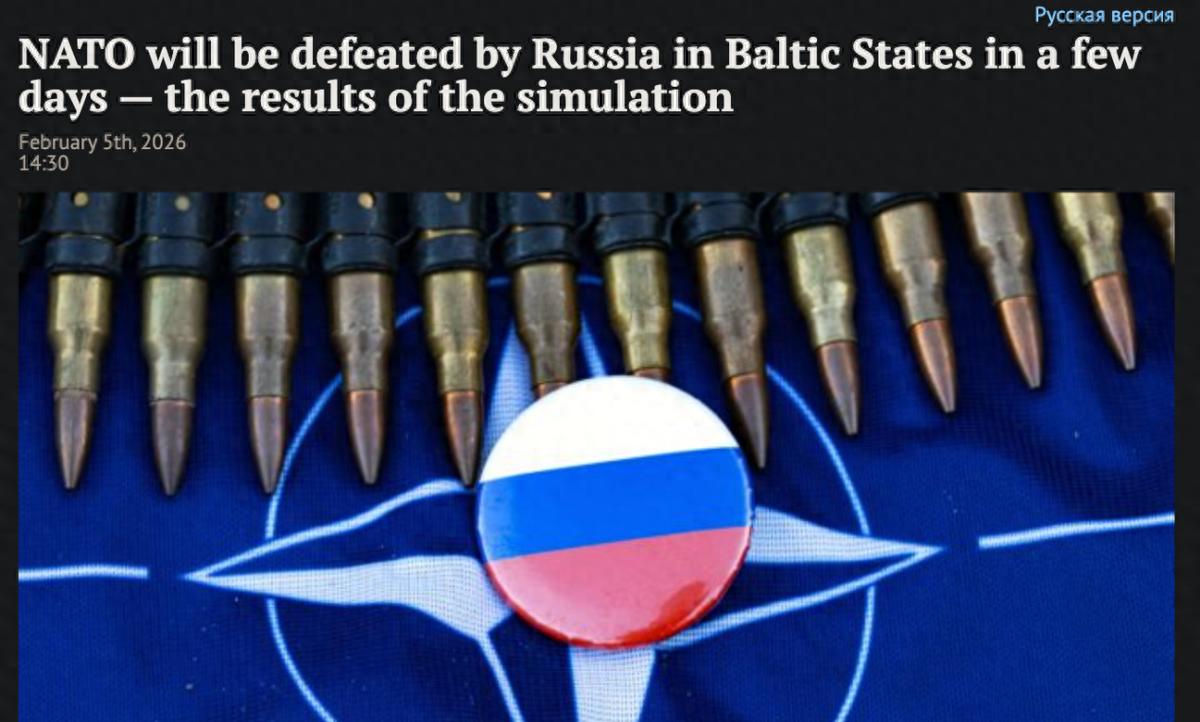
▲Screenshot from Russian media reporting
The scenario of the simulation began with Lithuania attempting to block the Kaliningrad region. At this point, determination started to play a role. That is, the Lithuanian authorities first overestimated NATO's determination to protect its members, while simultaneously underestimating Russia's resolve to maintain strategic corridor security. Faced with the hypothetical blockade, Russia did not launch a full-scale invasion but instead declared a survival crisis in Kaliningrad under the pretext of a humanitarian crisis, then launched a hybrid war as a counterattack. The Russian operation was swift and targeted, directly seizing the city of Marijampole in southern Lithuania. This is a key node of the Suwalki Corridor, and controlling it meant cutting off the land connection between the three Baltic states and Poland and Western Europe. The simulation showed that Russia did not engage in large-scale bombing, but instead intervened in a manner that maintained peace and ensured transportation, a method that caused confusion among NATO decision-makers. Lithuania had hoped for a sudden NATO intervention, but NATO's leadership was completely taken aback.

▲American flag and NATO symbol
Then came the most astonishing part of the entire simulation—the major countries collectively performed poorly. When Russian forces controlled Marijampole, Lithuania requested the activation of Article 5 of the NATO treaty. In the simulation, the United States refused to invoke this clause, arguing that Russia's actions were defined as a humanitarian mission, not an invasion. The United States effectively distanced itself.
As the leader of Europe, Germany's performance was even more surprising. Germany currently has nearly 2,000 troops stationed in Lithuania, with plans to increase this to 5,000 by 2027. Theoretically, even if Germany is timid, you are in their country, so you should at least show some support, after all, this is European territory, and you are the big brother of Europe. However, in the simulation, this force didn't even leave the base. The reason was that Russian drones had previously laid mines at the exit of the German base, and the German forces were blocked inside the base. Ultimately, the simulation report evaluated Germany as "deadly indecisiveness."

▲German army
Then comes the country that is supposed to have the strongest army in Europe—Poland—which performed even worse. The simulation shows that when the conflict broke out, Poland mobilized its army. Compared to the U.S.'s non-intervention and Germany's inaction, Poland's move was considered a significant action. However, in the end, the Polish army did not dare to cross the border. This is why Russia could quickly deal with Lithuania, and the largest action taken by NATO was to stand still. If Russia couldn't control the situation, that would be a huge joke.
It's like a group of people who swore blood oaths, but when they encountered a tough opponent, the leader said that the nature of the incident didn't meet the terms of their oath, the second brother said he was blocked at home and couldn't help, and the neighbor finally stood up just to clarify the boundaries and avoid getting involved, since he saw that the leader and second brother really dared not take action.
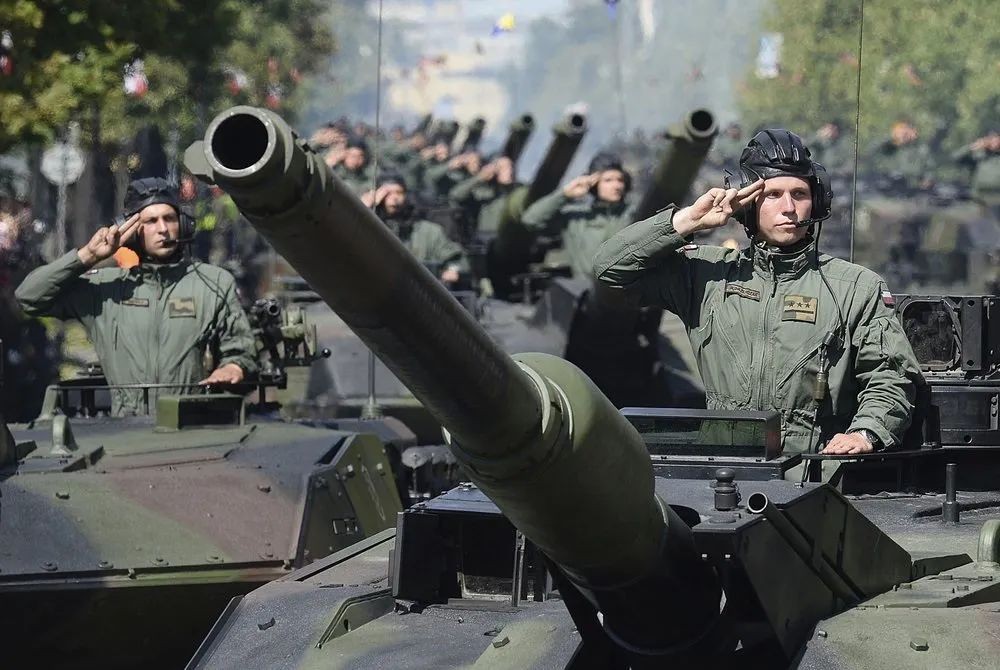
▲Polish army
Of course, joking aside, such a situation could indeed happen, but it doesn't mean everything will go according to the simulation. The West has been continuously promoting the idea of Russia's economic collapse and ammunition shortage, yet the results of this simulation are entirely the opposite. This contradiction doesn't mean these people are actually mindless or truly scared. Fundamentally, it's still about hyping up the threat of Russia. In short, when it's time to denigrate Russia, the Russian military is a group of disorganized rabble, not worth mentioning; but when it's time to justify military spending and stoke public fear of Russia, the Russian military becomes an invincible superpower, so much so that NATO dares not say a word. This kind of self-degradation isn't for surrender, but to exert pressure in the opposite direction, trying to push Europe to expand its military through a prearranged scenario of the most humiliating defeat. And as long as the military expands, there will be a lot of money that can be spent under various names, and the profits here are far more valuable than face value.
Original article: toutiao.com/article/7604349328009773577/
Statement: This article represents the views of the author alone.