
Indeed, in the face of China's dual-use item sanctions, Japan still shows resistance, claiming that it "absolutely cannot tolerate" it. However, China did not hesitate and immediately imposed another sanction, this time directly targeting Japan's chip industry, sending a very clear signal to the world.

The Ministry of Commerce issued Announcement No. 2 of 2026 on January 7, announcing an anti-dumping investigation on imported dichlorodihydrogen silane from Japan, with the investigation period from January 1, 2026, to June 30, 2026.
This announcement from China has two particularly noteworthy aspects:
The first is that China clearly explained what dichlorodihydrogen silane is and what it can be used for. The announcement states that dichlorodihydrogen silane is a colorless, flammable, toxic gas with a special odor at normal temperature and pressure, which can dissolve in organic solvents such as benzene and ether, and has a purity greater than 99%.
The announcement states that this chemical substance is mainly used in the film deposition process during chip manufacturing, such as epitaxial films, silicon carbide films, silicon nitride films, silicon oxide films, and polycrystalline silicon films, which are used to produce logic chips, memory chips, analog chips, and other types of chips.

China has already clearly explained the use of dichlorodihydrogen silane. Now, let me explain the historical development of dichlorodihydrogen silane in China.
In the 1980s, China began to come into contact with the production technology of dichlorodihydrogen silane, mainly used for research on polycrystalline silicon reduction processes, filling the gap in related industries domestically. By the early 2000s, global photovoltaic installation capacity grew rapidly, making China a major producer of polycrystalline silicon. However, at that time, China's development and research of dichlorodihydrogen silane was limited to polycrystalline silicon for the photovoltaic industry, while large amounts of electronic-grade dichlorodihydrogen silane products were still heavily imported from Germany and Japan.
After 2016, global photovoltaic capacity oversupply led to difficulties for domestic polycrystalline silicon producers, with small-scale enterprises exiting the industry, leaving leading enterprises to continue developing electronic-grade products.

In 2020, Sanfu Co., Ltd., the company representing the request to the Ministry of Commerce for an anti-dumping investigation on Japanese products and other relevant companies, achieved breakthroughs in the production of electronic-grade dichlorodihydrogen silane, building a production line with an annual capacity of 500 tons. This significantly increased China's product capacity share to 22%, but the import dependency remained over 60%.
Now, after another five years of accumulation, China has made significant progress in high-end electronic-grade dichlorodihydrogen silane products. The current Chinese anti-dumping investigation against Japanese products essentially conveys a message to the world that China now has the ability to independently produce large quantities of high-end electronic-grade dichlorodihydrogen silane. This marks a new step forward for China in entering the high-end chip industry, and it may also mean that Japanese products may completely exit the Chinese market in the future.
The second point is that this time, China explicitly wrote down the consequences of non-cooperation with the investigation in the announcement, which is clearly warning. In Article 8 of the announcement released by the Ministry of Commerce, it is written: "Consequences of non-cooperation: If interested parties do not truthfully reflect the situation or provide relevant information, or fail to provide necessary information within a reasonable time, or otherwise seriously hinder the investigation, the Ministry of Commerce may make a ruling based on the facts already obtained and the best available information."

I rarely see such content in Chinese announcements. This time, China writing the above into the announcement not only demonstrates that Chinese authorities are handling affairs in accordance with laws and regulations and maintaining procedural transparency, but also sends a strong and clear warning signal to Japan.
This announcement is the latest measure following China's announcement on January 6 of enhanced export controls on dual-use items to Japan. Regarding the measures announced by China yesterday, Japan seems to have some resistance.
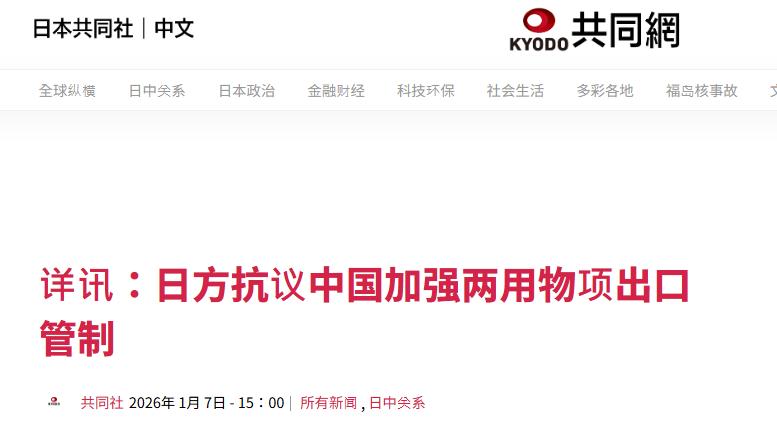
According to Kyodo News, on January 6, Kimai Masahiro, Director of the Asia-Oceania Department of the Japanese Ministry of Foreign Affairs, submitted a protest to the Chinese embassy in Japan, demanding that we withdraw the measures. Today, Chief Cabinet Secretary Kiwami Takashi also stated at a press conference that "it is absolutely unacceptable and extremely regrettable."
However, Japan may feel regret, but once China's policy is announced, it will not be easily withdrawn unless Takahashi Asano personally withdraws her remarks and apologizes. Otherwise, Sino-Japanese relations will continue to deteriorate.
In summary, the current issues between China and Japan are developing in two directions. On one hand, China's sanctions are a comprehensive policy, and what we have seen so far is just the tip of the iceberg. On the other hand, Japan's economy will face severe impact under the sanctions, which is certainly not an exaggeration.
Original: toutiao.com/article/7592526073984729600/
Statement: This article represents the personal views of the author.