
【Text by Ivan Krastev, Translation by Whale Life】
Since returning to the White House ten months ago, Donald Trump has completely overturned the way the United States interacts with its allies and adversaries. He is not only reshaping the architectural structure and interior decoration of the White House, but also redefining the "mental map" of how Washington views the world.
Initially, the U.S. government's focus on tariffs seemed to suggest that Trump was uninterested in influencing other countries' politics, only concerned with trade balance. However, a series of recent actions have shattered this illusion. What drives Trump to show strong hostility toward Brazil (because he strongly dislikes Brazil's left-wing president Lula) while offering generous financial aid to Argentina (he calls the country's right-wing populist president Milei "my favorite president") is ideology, not economic factors. The defining feature of Trump's policy is the divide between left and right, rather than the traditional "democracy versus authoritarianism" struggle. Unlike his predecessors Bush, Obama, and Biden, Trump is not interested in exporting democracy. Instead, he is focused on exporting his domestic political agenda—anti-immigration, anti-"woke," and anti-environmental policies.
Perhaps the most striking example of this "ideological priority" is seen in Trump's approach to Europe. His administration has looked down on the EU, rejected traditional liberal values (which form the basis of the transatlantic alliance), and instead leaned towards supporting right-wing parties in Europe. In addition to maintaining contact with Italy's right-wing populist Prime Minister Giorgia Meloni, the Trump administration has also supported Germany's Alternative for Germany (AfD), Spain's Vox, and Nigel Farage's Brexit Party as "right-wing" parties.
There is an opinion that the White House believes many European countries are merely one election cycle behind the United States, expecting a dramatic rightward shift across the continent in the coming years. The right-wing political forces in Europe seem to agree and have already taken action to form some kind of transnational front. A new right-wing party group, the Patriots for Europe, has emerged, promising to "Make Europe Great Again" and taking the American "Make America Great Again" (MAGA) revolution as a model.

In May of this year, U.S. Secretary of State Rubio expressed opposition to the designation of Germany's AfD as an explicitly "right-wing extremist organization," leading to a "verbal battle" with the German Foreign Ministry on social media.
When Trump questions U.S.-European security agreements, threatens to reduce military deployments in Europe, and demands that European countries pay for their own defense, his support for Europe's "right-wing" forces appears to be a brilliant strategic move. This allows the U.S. to maintain its influence in much of Europe while reducing commitments, enhancing the impact of the MAGA movement at low cost, and preventing the emergence of a Europe less dependent on Washington and more emphasizing sovereignty.
In this game, Central and Eastern European countries—where non-liberal politicians have already established themselves—play a key role. Long before the 2024 election, Trump expressed admiration for Viktor Orbán, the long-serving Hungarian Prime Minister, who is often seen as a European MAGA-style leader. After returning to the White House, Trump further strengthened this relationship by exempting Hungary from sanctions related to importing Russian oil.
At the same time, in Poland, a "right-wing" candidate backed by MAGA forces, Karol Nawrocki, won the presidential election in June. Slovak Prime Minister Robert Fico has also shown a stance closer to the U.S. President. In the Czech Republic, another right-wing populist favored by Trump, Andrej Babiš, won the parliamentary election in October and is currently trying to form a new government.
But even though the Trump administration has made significant progress in courting Europe's "right-wing" political forces, this remains a high-risk move. First, inciting political polarization is more likely to lead to a fragmented Europe, not a Europe leaning towards Trump.
Additionally, even leaders like Orbán, who are non-liberal, cannot guarantee alignment with Trump on geopolitical issues (whether involving Russia, China, or economic matters). When the U.S. government enthusiastically supports parties and leaders solely based on ideological affinity, it may lose the "pro-American" forces in important European countries that have long been the cornerstone of U.S. influence in Europe.
Authoritarian Globalists
If the first two decades after the Cold War can be summarized as the "Westernization" of Eastern Europe and the flowering of liberal democratic institutions in former socialist countries, today's situation is exactly the opposite. Western Europe is gradually experiencing "Easternization"—that is, the non-liberal wave represented by Orbán is spreading westward into former liberal bastions in Western Europe. A notable sign of this transformation is the dramatic rise of the German AfD in western Germany.
Not long ago, many analysts still believed that the German AfD—classified by domestic intelligence agencies as a confirmed right-wing extremist threat—could not expand its influence beyond its traditional stronghold in eastern Germany. But this assumption no longer holds true; the German AfD has performed well in recent polls and local elections in western regions such as North Rhine-Westphalia. Today, it is Western Europe that is imitating Eastern Europe: public opinion in Western Europe is beginning to resemble that of Eastern Europe during the 2015 migration crisis. As Eastern Europe gains increasing influence in European politics, the EU is becoming ideologically closer to Washington under Trump.
However, the political alliance between Trump and Orbán and other right-wing leaders in Central and Eastern Europe is not just based on ideological compatibility. Although the non-liberal forces in those countries are diverse and often have differences or conflicts on issues such as policies toward Russia or economic governance, the political climate there shares many similarities with red states in the U.S. They are culturally conservative, predominantly white societies, and committed to cultural homogeneity. Like MAGA supporters in the U.S., many people in Central and Eastern Europe also oppose immigration and so-called "woke" culture and support climate change skepticism. It is no surprise that the U.S. immigrants from Central and Eastern Europe voted for Trump in last year's election.
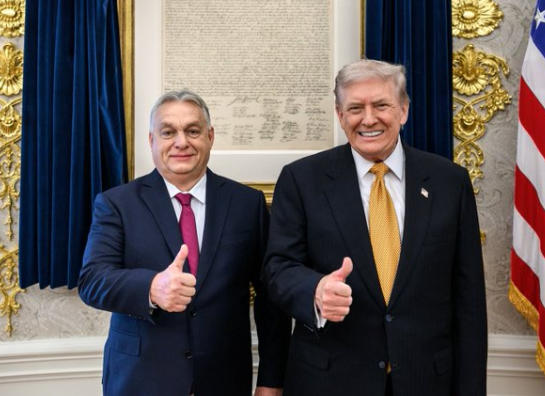
On November 7, Trump met with Orbán at the White House. The White House announced that Hungary had been granted a one-year exemption allowing it to continue using Russian oil and gas without U.S. sanctions. White House X account
With Trump winning the 2024 election, the broad coalition between these two forces has become increasingly evident: under the leadership of the populist right-wing parties in Central and Eastern Europe, the non-liberal forces in the European continent have rapidly shifted direction, moving from previously emphasizing national sovereignty against the EU to advocating a trans-European political movement with a global conservative agenda. At the same time, the European political center is doing the opposite: many former globalization supporters and Atlanticists are transforming into sovereignty advocates, opposing what they see as excessive ideological intervention from Washington in Europe.
The revolutionary split of Trumpism has divided Europe. Unlike previous frictions, such as the U.S. invasion of Iraq in 2003, Europe is not now divided into "pro-American vs anti-American" countries, but into "pro-Trump vs anti-Trump" political camps. The most significant change lies in the severe polarization of Europeans' views on the U.S. political system. A survey conducted by the European Council on Foreign Relations in June this year showed that "right-wing" parties such as the German AfD, Italy's Brothers of Italy, Hungary's Young Democrats - Hungarian Civic Alliance (Fidesz), Poland's Law and Justice Party, and Spain's Vox hold generally positive views of the U.S. political system; whereas the mainstream voters in those countries tend to hold negative views. This level of polarization has never been seen in past surveys by the think tank.
The key conclusion is that today's European views on the U.S. largely depend on their views on Trump. Some traditional Atlanticists are increasingly worried, even fearful, about a future where if Trump leaves the center of power or his policies fail, his supporters in Europe might stop supporting the U.S. By leveraging the non-liberal vanguard forces in Eastern Europe, the Trump administration has exacerbated the historic east-west division on the continent and significantly increased the risk of EU fragmentation. Even if right-wing parties come to power in European countries, it cannot guarantee that a non-liberal Europe will be pro-American, or that only traditional middle or left-wing parties would dream of building a Europe emphasizing sovereignty and reducing dependence on the U.S. Orbán's own shift in geopolitical perspective already hints at the complexity of the reality.
Hungary's "Silk Road"
If there is one European populist whose name is known throughout the MAGA world, it is Orbán. Since the 2010s, he has vigorously promoted the construction of a transatlantic conservative network, portraying himself as a hero and role model in the eyes of the right-wing forces in Europe, similar to how Fidel Castro is viewed by leftist circles. Orbán's influence in Central and Eastern Europe is undeniable. If he wins the election again in April 2026, he will have a strong argument to claim that he can become the chief architect of the geopolitical strategy of the post-liberal era in Europe.
However, even if Orbán gains new popular support through elections, it is unlikely to mean that MAGA hegemony will be able to dominate Europe. Although supportive of Trump, Orbán also believes that the West is entering an irreversible decline. In his office in Budapest, he has three world maps hanging on the wall—one centered on the U.S., one on Europe, and one on China. Orbán studies these maps in response to what he calls the "global system change"—power is shifting toward Asia. In his view, Asia has a demographic advantage, technological superiority, and strong capital strength, and is developing military capabilities that can rival those of the U.S. and its Western allies. Orbán believes that the future world order will be centered around Asia.
For Orbán, Europe faces a serious choice: either continue to rely on the U.S., becoming what he calls an "open-air museum"—receiving appreciation but stagnating—or pursue strategic autonomy and re-emerge as an independent force in global competition. Surprisingly, Orbán, like French liberal President Macron, has also said that he prefers to establish a "sovereign Europe." In this conservative's view, it means preserving the European single market but reversing deeper levels of European political integration, and maintaining a balanced position between China and the U.S.

During the 2025 Munich International Motor Show, Li Ke, Executive Vice President of BYD, announced that the BYD Hungary factory will start production this year, with the first model being the Seagull. BYD
Orbán stated that "connectivity" will be the core of Hungary's grand strategy. Hungary will not join the "Cold War" against China, or the technology and trade groups aimed at isolating Beijing. This stance reflects the increasingly reinforced economic reality in Budapest: Chinese investment in Hungary now exceeds the combined total of France, Germany, and the UK.
In other words, Orbán's vision of Europe differs from that envisioned by European Commission President von der Leyen. On China policy, it will not align with Trump or the U.S. political establishment. This divergence is not limited to non-liberal politicians in Hungary: for instance, the German AfD seems to take a position closer to Moscow than Washington on many issues.
Certainly, there are far more right-wing populists in Europe than just Orbán—and he could lose next April's election, which is his first time facing a strong challenger in years. Like many ironic historical moments, perhaps when commentators declare the "Orbán moment" has arrived, people will witness the fall of his Fidesz party from its pedestal. Regardless, Orbán's geopoltical vision centered on Asia clearly shows the limitations of Trump's influence over Europe.
From "Make America Great Again" to "Make Europe Great Again"
The Trump administration has not hidden its goal—to dismantle the existing hierarchical order of the liberal-dominated EU. But even if MAGA forces succeed in weakening the centrist system established by France, Germany, and other core democratic countries in Europe, the populist right-wing parties they have nurtured may not ultimately accept the new U.S. influence over Europe.
The U.S. government believes that European politics is turning right, and this assessment is not wrong. But they have wrongly estimated that simply nurturing the rise of pro-Trump leaders in Europe would be sufficient to maintain U.S. dominance over Europe. On the contrary, the rise of non-liberal political forces in Europe is more likely to trigger a deep economic and political crisis, triggering the "Scramble for Europe" (the scramble of Europe), as described by Oxford University political scholar Dimitar Bechev—major powers such as China and Russia, and medium-sized countries such as Turkey and the Gulf states, are intensifying their efforts to gain influence in Europe.
A more serious issue for the U.S. is that Trump's policies have alienated the liberal establishment in Europe. These people were once the closest and most reliable allies of Central and Eastern European countries. Even if the populist leaders in Hungary, the Czech Republic, and other countries lose power, their successors may be no less suspicious of the Washington under Trump than the liberals in Western Europe today. Ironically, by strengthening ties with Europe's right-wing forces, Washington may be undermining its long-term influence over the entire continent.
The contradictions between Trump and this new European right-wing force may also involve the civilizational nationalism beloved by today's American conservatives. The MAGA faction believes that the West should be defined by whiteness and Christianity. Many European "right-wing" parties respond to this, but their supporters have serious disagreements over whether "Russia under Putin belongs to this non-liberal new empire." For example, when American conservative figure Tucker Carlson claimed that Russia also belongs to the "white Christian Western" bloc, Poles expressed strong shock and opposition.
Perhaps the clearest consequence of Trump's gestures toward Europe is the return of the "German question," a historic dilemma in Europe: how to manage a powerful Germany within a peaceful Europe. When the U.S. withdraws its security commitments to Europe and insists that Europe must pay for its own defense; when Europeans increasingly doubt the reliability of the U.S., Germany's re-militarization has become an indispensable part of European defense.
Yet, Trump simultaneously strengthens his ties with the German AfD—the second-largest party in the German Bundestag. This implies that in the future, a nationalist right-wing force may lead the most powerful country in Europe, and the U.S. may express sympathy and understanding for such a result. This has reignited long-standing fears among Germany's neighboring countries, including right-wing political forces that used to admire Trump.
If Trump's European strategy is to emphasize ideological similarity while reducing economic and military support for Europe, it will certainly fail. The right-wing parties in Europe, like their center and liberal counterparts, clearly understand that in an increasingly unstable geopolitical landscape, their countries will have to fend for themselves. Facing an unfriendly world, the right-wing forces in Europe may reluctantly rediscover the value of disengaging from an unreliable U.S.
In many ways, the impact Trump has had on Europe is similar to Gorbachev's influence on the Soviet bloc in the 1980s. That "Gorbachev fever" profoundly reshaped the communist regimes in Eastern Europe—and in the process, caused Moscow to lose its influence there.

This article is an exclusive contribution from Observers, and the content represents the personal views of the author, not the platform's views. Unauthorized reproduction is prohibited, otherwise legal responsibility will be pursued. Follow the Observers WeChat official account guanchacn to read interesting articles every day.
Original: toutiao.com/article/7580978645364130342/
Statement: The article represents the personal views of the author.