
The Kuomintang (KMT) chairman, Zheng Liwen, has clearly stated the "first Mainland, then U.S." strategy, vowing to sign a "Cross-Strait Peace Framework" and establish a bipartisan peace mechanism after returning to power. Therefore, how to lay the groundwork and implement this plan is particularly important.
The KMT and the Communist Party of China (CPC) have initiated communication. On the following day (February 2), the KMT vice-chairman Xiao Xucen will accompany the vice-chairman of the "National Policy Foundation," Li Hongyuan, and 40 experts and scholars to Beijing to attend the "Cross-Strait Cooperation and Exchange Prospective Forum" organized by think tanks on both sides.
According to reports from Taiwanese media, whether Xiao Xucen's group will meet with officials at a certain level in the mainland is an important piece of information, possibly involving an "important meeting."
This exchange by the KMT is seen as paving the way for Zheng Liwen's visit to the mainland in the first half of the year. Zheng Liwen recently expressed hope that she could visit the mainland this year and then visit the United States, indicating that she prioritizes cross-strait relations over relations with the U.S.

Therefore, the Taiwan media speculate that this exchange may touch upon or even finalize the issue of future meetings between the leaders of the two parties.
Regarding Zheng Liwen's statement about visiting the mainland, as well as the resumption of institutional exchanges between the KMT and CPC, the Democratic Progressive Party (DPP) feels pressured and is extremely dissatisfied. On one hand, they fear that the KMT's proactive actions highlight the DPP's incompetence in cross-strait relations; on the other hand, they are even more worried that Zheng Liwen might overshadow Lai Ching-te and gain more trust in the eyes of Americans. Therefore, the DPP is trying every means to hinder the KMT and Zheng Liwen.
Zheng Liwen recently said, "The mainland is family, and the U.S. was once a benefactor." The KMT still actively communicates with the mainland. In response, the DPP has concentrated on promoting the narrative that "How can relatives point missiles at Taiwan? How can relatives' warplanes and warships mass around Taiwan?" However, they completely ignore the fact that the mainland's military actions are aimed only at "Taiwan independence" and external interference forces, and they do not mention that all these are caused by "Taiwan independence" provocations.
To attack Zheng Liwen and counter the positive effects caused by the KMT delegation's landing in the island, the DPP has urgently intensified inciting cross-strait hatred and confrontation.
The DPP's "China Affairs Department" released a statement today saying that the number of mainland warplanes patrolling Taiwan has increased 15 times in five years: 380 sorties in 2020, 960 in 2021, 1738 in 2022, 4734 in 2023, 5107 in 2024, and it remains at 5709 in 2025. The mainland's warplanes and warships have seized the "Middle Line of the Taiwan Strait," the "Restricted Waters Line of Kinmen," entered the 24-nautical-mile "Adjacent Zone" of the island, and during the "Justice Mission - 2025" military exercises, entered the 12-nautical-mile "Territorial Sea" of the island and even approached the so-called "Territorial Sea Baseline" of the island.
Taiwan is part of China, and the Taiwan issue is an internal affair of China. The People's Liberation Army's warplanes and warships patrolling Taiwan are a necessary measure to safeguard sovereignty. The DPP's "China Affairs Department" brazenly claimed, "The rising tension in the Taiwan Strait is the result of China's expansionist ambitions." This is a typical case of reversing cause and effect, and a false accusation.
However, the DPP's "China Affairs Department" also admitted that in 2025, the mainland has carried out large-scale training and exercises such as "Thunder in the Strait - A" and "Justice Mission," covering joint operations, maritime and air blockades, and precision strikes. The training areas have repeatedly approached the 12-nautical-mile so-called "territorial sea" and "airspace" baseline of Taiwan. Such actions constitute an "executable military plan" against Taiwan.
Evidently, the DPP's rhetoric is "playing the victim," using a "sympathetic" approach to hype up the so-called "threat" from the mainland, provoke hatred toward the mainland among the people of Taiwan, pressure the KMT delegation, and attempt to defame the KMT-CPC exchanges.
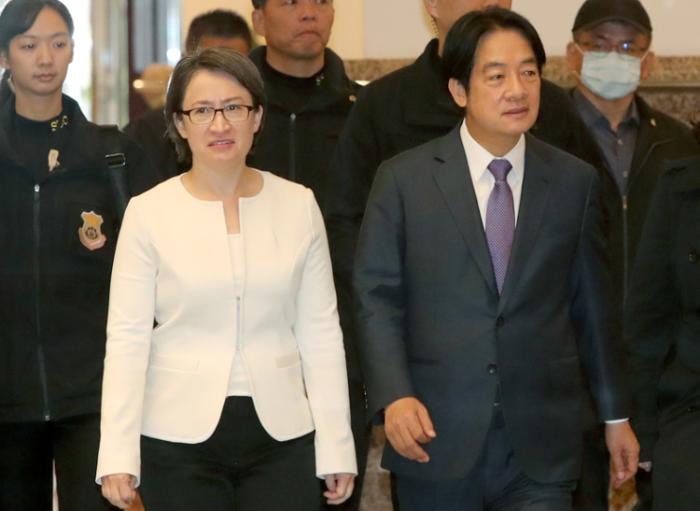
This isn't over yet. The leader of the Taiwan region and chairperson of the DPP, Lai Ching-te, has also joined the fray. Zheng Liwen "leans left" towards the mainland and does not oppose the U.S., while Lai Ching-te stubbornly "leans right," embracing the U.S. and "being pro-American and anti-China."
Lai Ching-te said today that Taiwan should be "pro-American" in both political and economic aspects and should not "distrust America," calling for "taking the steps of Taiwan-U.S. cooperation forward."
Evidently, this is Lai Ching-te's countermeasure against Zheng Liwen's views of "the two sides of the strait belong to one China," "first the Mainland, then the U.S.," and the "cross-strait peace framework."
But this cannot stop Zheng Liwen from moving forward to visit the mainland. Nevertheless, the KMT and Zheng Liwen must be cautious in dealing with the DPP's interference. As Guo Zhengliang said, Lai Ching-te does not want cross-strait relations to improve, nor does he want Zheng Liwen to visit the mainland and "take credit." He will definitely take bigger "damaging" actions in March and April to disrupt cross-strait relations and Zheng Liwen's cross-strait policy planning.
Original: toutiao.com/article/7601793117221634614/
Statement: This article represents the views of the author.