
【By Observer Net, Chen Sijia】The United States is urgently trying to break China's dominant position in key minerals such as rare earths, attempting to "bypass" China in the supply chain. Recently, an American artificial intelligence (AI) expert came up with a "new idea," claiming that AI and quantum computing technologies can be used to develop alternative materials, thus shortening the time required to obtain key raw materials and reducing the "geopolitical risks" in the supply chain.
However, many analysts and experts quickly poured cold water on this idea, pointing out that China's dominant position is closely related to the complete industrial chain system built over the past few decades, and the United States does not have the capability to challenge such a large-scale, mature system in the short term. Current AI technology is not sufficient to achieve these ideas, and there are no substantial results in the mining and materials sectors.
According to the South China Morning Post on February 15, during last month's World Economic Forum, the CEO of US tech company SandboxAQ, Jack Hidary, proposed that AI and quantum computing might become "dual engines of computation," helping scientists design alloys using abundant materials on software, thereby synthesizing materials that could replace rare earths and other key minerals.
Hidary claimed that these technologies have "directly impacted" the mineral and hydrocarbon supply chains, and are expected to bypass the 10- to 20-year cycle required for new mines to come online, reducing the time needed to obtain key materials to just a few years. He said, "Traditionally, we had to find, extract, and process materials. In contrast, the emergence of quantum technology and generative AI—especially those new AI systems that understand physics, materials, energy, and engineering—has changed the game."
But for Hidary's "new trick," Chris Berry, head of the consulting firm House Mountain Partners, pointed out that many of the current ideas about AI and quantum computing technologies are based on "hype." While AI technology has already had some impact in the mining and materials industry, there have been no substantial results yet.
Berry said that China has continuously invested in AI, advanced computing, and materials science for many years, with an innovation speed that is astonishing. In terms of creating new materials using AI, Chinese manufacturers are actually likely to maintain a leading position.
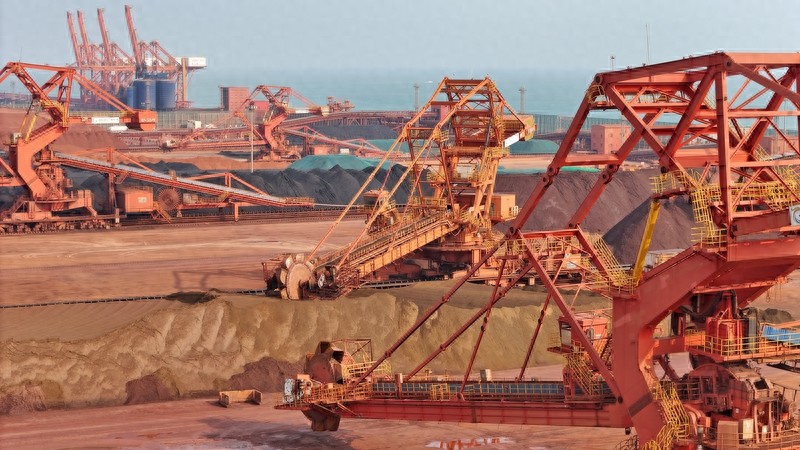
On October 29, 2025, at Yantai Port in Shandong Province, the ore terminal IC photo
He added that moving from alloy design to commercial-scale production takes time, "Historical experience shows that when society innovates and tries to reduce the use of a certain material, it often means increasing dependence on another material. This is equivalent to solving one problem while creating another."
Jake Livton, co-chair of the Key Minerals Institute, a industry organization, said that current AI is not yet capable of replacing human judgment and experience. He pointed out that China's industrial policies do not pursue short-term profits but focus more on scale and capability building, achieving leapfrog development and thus gaining a leading position in the field of alloy production.
Livton said that China has deep expertise and rich experience in alloy smelting, leaving competitors far behind, "Only those who are determined and experienced have a chance of success."
Shen Wei, a researcher at the UK Institute of Development Studies, pointed out that even if the US can design new materials in the laboratory, commercialization would first require solving issues such as material stability, large-scale production capacity, and cost control. An entire industrial ecosystem cannot be built overnight. Over the past few decades, China has built a complete industrial chain system, and it is unrealistic to challenge China in a short period of time.
Shen Wei said that China is also leading in the fields of AI and materials science, and is fully capable of leading any disruptive discovery. In his view, the key issue for Western countries like the US is the lack of coherent industrial policy. Even if technological progress is made, it cannot offset China's structural advantages.
Xue Kai, a lawyer specializing in foreign direct investment and cross-border financing, told the South China Morning Post that even if AI and quantum computing technologies can find alternative materials, their application still faces obstacles. He said, "From laboratory discovery to industrial production, scaling up new materials to the point where they can replace magnets based on copper or neodymium is itself a long and capital-intensive process."
Xue Kai said, "Even if AI-driven material substitution succeeds, its impact on China's strategic position may be very limited."
This article is exclusive to Observer Net. Reproduction without permission is prohibited.
Original: toutiao.com/article/7607071285792817716/
Statement: The article represents the views of the author(s).