
On December 5th, the minutes of a meeting between Ren Zhengfei, founder and president of Huawei, and the chairman, coaches, and winning contestants of the ICPC (International Collegiate Programming Contest) were released. The meeting took place on November 14th of this year.
In the meeting, in response to questions from participants and coaches from different countries, Ren Zhengfei discussed the characteristics of various countries, and expressed his views on topics such as artificial intelligence, talent cultivation, young people's career planning, quantum computing, and communication.
Ren Zhengfei believes that advanced and developed networks provide various possibilities, from past physical concentration to logical decentralization through the network, which has greatly improved schools in remote areas. "When humanity progresses, the most progressive are children. This is the growth of intelligence, and the progress of the times. The hope of the future era lies with the youth, who will shoulder the task of social revitalization."
Regarding the development of artificial intelligence, he pointed out that the pursuit directions of the United States and China in artificial intelligence are different. The United States is exploring general artificial intelligence AGI and super-intelligence ASI, trying to solve the question of what human beings are and the future of human society. They want to fully solve one problem, and this era still needs a process of understanding. While China is researching how to do things, creating more value, and solving developmental issues.
"The safety of cities, the advancement of public education and health, the unmanned production of mines, the unmanned production of cement... coal miners wearing ties, suits, and rings to work, this is the current embodiment. Imagine dust-filled mines, extremely cold mining areas, extremely hot construction sites, extremely high-altitude workshops, and the production being unmanned, how spectacular it would be." said Ren Zhengfei.
What happens to the surplus employees after automation?
Ren Zhengfei believes that we need to develop re-education projects. "For example, a factory produces 100 with people, and 120 without people. These surplus personnel can be re-educated and re-employed, transferred to specific jobs. Therefore, we will face many positions' staff reduction, and the country can take these people and transform them into talents needed by the nation through re-education projects, because artificial intelligence increases the total wealth of the country."
But he also said that the speed of automation should not be too fast, but rather gradually, to keep the social structure stable. "Therefore, the social benefits brought by artificial intelligence are the increase in total wealth, how to share this wealth, and how to re-employ some people? This is a new topic."
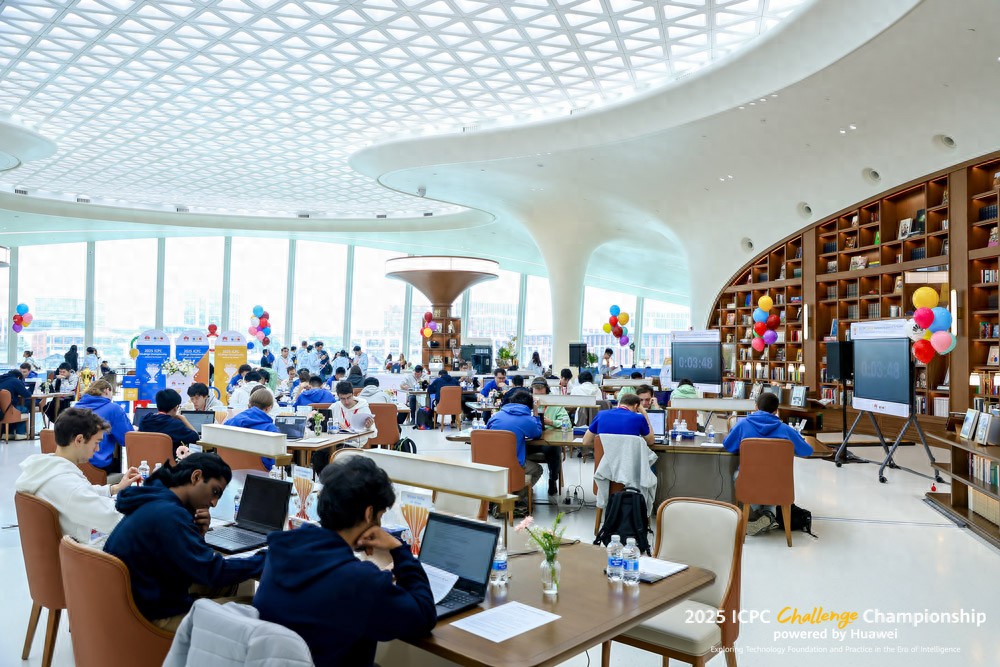
Source: ICPC
Speaking about the development of talent in the new era, Ren Zhengfei encouraged today's youth, those who have the potential to reach higher should go to the highest point. "University students can become 'workers', which is a responsibility of higher education. Of course, we also need a group of people to reach for the top, reach the world, even the universe, and the future of humanity. People need to strive, different people take different paths, not everyone needs to reach for the top, and individualized teaching is an important teaching model."
"Meta gives each young person a few hundred million dollars in signing bonus, and millions of dollars in salary. There is not much noise on the Chinese internet, why? Not jealous. Now there are a large number of entrepreneurs in China, with very strong abilities. Seven or eight people cooperate to establish a company, twenty or thirty people partner, all their shares are theirs, and when they do well, they can take as much as they want." He frankly said, "This world always needs people to explore the future. Human society has been successful from one failure after another. China will make significant progress in three to five years. A strong China is beneficial to the prosperity of the world."
When asked how to break through doubts in life, Ren Zhengfei believed that moving forward in the face of doubts is normal. Many important scientific breakthroughs initially faced doubts, such as Fourier's proposal that any function can be represented by trigonometric series was not accepted by the Paris Academy of Sciences; Higgs' prediction of the existence of bosons was rejected; the uncertainty principle of Copenhagen interpretation was opposed by Einstein, etc. During the development of Huawei's industry, the promotion of 5G Polar code and Massive MIMO, constellation diagram shaping in the optical field, multi-lens mobile phone photography, etc., have all faced doubts. To break through, one must dare to face challenges and boldly innovate.
He also mentioned the competition for talent among countries, "The soil of the United States is suitable for growing crops, and a large number of talents go to the United States to grow, which is a good thing, not a bad thing. Including many young people from China going to the United States, taking root and growing in the United States, participating in the creation of some new technological civilization. Google's founder is Russian, and they created Android, which is enjoyed by the whole world! It is also beneficial to China."
Ren Zhengfei frankly stated that the United States only sanctioned Huawei, and most Chinese companies were not sanctioned, so they could still use American technology, tools, ecosystems, instruments, chips, and wafer processes... "This is beneficial to the development of China's industry. We also look forward to globalization, enjoying standing on the shoulders of giants. Our self-reliance is due to being forced. Relying entirely on ourselves is not against globalization. In many aspects, the chips used by domestic enterprises are at least one generation behind..."
He said that China is relatively backward and certainly needs to rise, and also needs to absorb some talents. The current environment is much better than when we were young. Young people are very happy, sunny, and full of energy... Now China also has the soil and opportunities for talents, and many youths have started businesses here, but the speed of catching up with the US is still slow.
"From the current situation, China needs to be more open, learn from the strengths of all civilized countries in the world, accept the civilization of the world, and not close the door. Opening reform opens the door of the country, allowing the civilization of the world to come in, and no civilization conflict has occurred. Civilization has been overlapped to create a value, which is the new China today." Ren Zhengfei said.
Here is the original text:
Chatting at the Shell Library by Lianqihu Lake
- Minutes of the Meeting between the President and the Chairman of ICPC, Coaches, and Winning Contestants
November 14, 2025, in the morning
Veronika Soboleva: Good morning, everyone! First of all, I would like to thank Mr. Ren for bringing the ICPC team to this beautiful campus. It is a great honor to be here today. All the participants represent ICPC, and they have worked very hard this year. They come from over thirty countries and regions, with more than 110 people, including coaches and winners from around the world. Some colleagues are participating remotely, and some are present. We are very happy to be here to share our ideas and listen to your insights. Thank you very much for Huawei's thoughtful arrangements, and thank you for bringing the entire ICPC community of coaches and contestants here. We have three key areas of work, including connecting with academia, institutions, and the industry, so this is a very good event. Welcome!
Chairman of ICPC: First of all, thank you for inviting us to this beautiful campus. This is a place that is excellent in every aspect, a place for making friends and gathering together. I want to express my gratitude to everyone for giving us this opportunity. There is an excellent English word, "together," which is to gather together, and I am very grateful!
President: Thank you very much, Chairman of ICPC, all coaches, and young world gold medalists. We believe that we are in a rapidly changing era, and we hope that the youth, you are radiating the light of youth. You are role models for the youth, and the hope of the era is placed on the youth.
In your industry, I am an outsider, not completely aware of what should be done, and I also have some confusion about this era. In this era, establishing communication and friendly connections with you, through this connection, sensing the pulse of the world, sensing the dreams of the youth, I am very lucky. Everyone feels the leap of the era, and we don't know what technical future will be, thus we work together to explore this era. I don't understand you, so I can't give a systematic speech, but I want to communicate with you and listen to your opinions.
Veronika Soboleva: Thank you very much, Mr. Ren. Over the past three days, you participated in many seminars at Huawei, raised many questions, and solved many challenges. I know that you have many questions about AI to discuss with Mr. Ren, and this year's ICPC challenge competition focuses on AI, mainly on this topic; I know there will be many questions related to education, as well as global differences and challenges, because the levels and conditions of the world vary.
1. Veronika Soboleva: From the discussion yesterday by the contestants, we heard a question: We have now entered the AI era and face the challenges brought by AI. How does Huawei view this? Not only the ICPC community, but also the global community, how to solve the challenges brought by AI? We have many different ideas, and we need to do what? I would like to hear your views on the future of AI? What problems do we need to solve, and how can we solve these challenges together?
Ren Zhengfei: Regarding AI issues, I am an outsider. I think AI and human relationships can be divided into several stages. In the next two decades to a thousand years, this is a subject for sociologists and anthropologists to study, and Yuval Harari is a representative figure. His book "Homo Deus" discusses the deep changes and potential impacts of AI technology on social structures and human living conditions. As big data and big models are pushed, whether what he said is true, may be known by the younger generation in twenty years, and perceive this era.
For the next ten to twenty years, it should be the vision of great prophets and scientists about the future of the technological society.
Our company's research is focused on the next 3-5 years, how big models, big data, and big computing power are applied in agriculture, industry, and technological industries. For example, in the blast furnace ironmaking, the temperature of each layer is known through the big model, and the temperature is appropriately reduced, optimizing the control of fuel and ore configuration, and predicting the silicon content of the iron water two hours later, determining the ratio of fuel and ore to be added, thus improving the efficiency of the blast furnace by 1%; China has already been able to use unmanned methods to mine coal at depths of 500-700 meters or even deeper. Why? Because all the conditions of the narrow tunnels underground are collected through data and spliced into complete and continuous real-time video, so people on the ground or far away can operate coal mining machinery. Predicting gas explosions, water inrushes, and collapses to ensure the safety of miners; after the coal is transported to the surface, it is washed to refine coal, and the big model can also improve the precision of refinement by 0.1%, producing more refined coal; meanwhile, in open-pit mines, the excavation and loading of minerals can be completely unmanned, hundreds of heavy trucks and excavators running completely unmanned. Port loading, stacking, and customs clearance are unmanned, for example, the unmanned operations at Tianjin Port, from container loading, stacking to customs clearance, are all unmanned. The same is true for the Port of Callao in Peru. So we focus on these places.
Secondly, human health. Do you know histopathological slices? The pathologic big model at Ruijin Hospital is widely used, using big models to analyze slices and help doctors improve diagnostic capabilities. There is also the ophthalmic model of Sun Yat-sen Medical University, which can take photos with a mobile phone or a dedicated instrument, and it can diagnose remotely, helping doctors in remote areas improve their diagnostic capabilities, ...
You also know the autonomous driving model of passenger cars and the small Yi dialogue model on the cabin and mobile phones, etc. We focus on these areas, aiming to solve practical problems in production and consumption with big models. Of course, there is still a lot of room for improvement and many things to accumulate.
2. Question: Mr. Ren, I am from the National University of Singapore and am currently also the chairman of the International Olympiad in Informatics (IOI). On behalf of IOI, I would like to express my sincere thanks to Huawei for the support and sponsorship we have received over the years. It was mentioned earlier that in some regions, the level has not yet reached what we see now. So, what will IOI do next to help these regions, not to give them fish, but to teach them how to fish. We hope that the next plan will gather the coaches of these countries together, provide them with training materials and platforms, and help them improve their IT levels. These countries can't even do programming well, how can they think of doing AI? We hope Huawei can strongly support us, so that the level of these countries can be improved.
Ren Zhengfei: Now, the advanced and developed network provides the demand that Teacher Chen spoke of. In the past, you had to go to a prestigious university, have a teacher giving lectures on the podium, to be a master student. Now, many famous universities have opened online courses, and students in any mountain village can take courses from world-renowned universities, just without sufficient tutoring teachers to provide enough guidance, otherwise it would equal to reading a world-renowned university. The network has provided various possibilities, from past physical concentration to logical decentralization, through the logical decentralization of the network, enabling schools in remote areas to make great progress.
Now, seven or eight-year-old children sometimes ask the teacher questions that the teacher cannot answer, because they have seen a lot of knowledge online, and they have their own independent insights, which poses a certain difficulty for the teacher facing this issue. This is the progress of the entire society. In the past, we had to go to Beijing, New York, Boston, London... to read the courses, now students in mountain villages can read them through the network, but the depth of understanding these courses is naturally difficult, and they need good tutoring teachers. Tutoring teachers do not need to meet physically, they can also use logical network connections. We are shifting from a physical centralized educational model to a logical decentralized educational model, which is beneficial for the progress of the entire human society. When humanity progresses, the most progressive are children. This is the growth of intelligence, and the progress of the times. The hope of the future era lies with the youth, who will shoulder the task of social revitalization.
Artificial intelligence promotes productive progress, and we will feel it in three to five years. People say five to ten years, ten to twenty years, twenty years later, I don't know, the development of artificial intelligence is too fast, I don't completely know the direction of the future era. What I just said is already achieved by society. For example, a small ultrasound probe, scanning the waist of a herdsman in Tibet, the data is transmitted through a 3000-kilometer network to the Shenzhen testing center, and the ultrasound equipment can detect liver hydatid cysts in the herdsman. This is the role of low-latency 5G and high-bandwidth fiber optic networks. Because in the pastoral area, there is no ultrasound equipment, but there is a probe, like a mobile phone, scanning the liver. Now, 5G + remote assisted diagnosis has appeared, which is a big role of artificial intelligence. This remote method is also used for teaching, which can bring great progress to human society.
3. Question: Mr. Ren, I am a coach from Shanghai Jiao Tong University. I won the ACM ICPC World Championship three times in 2002, 2005, and 2010. Later, I established the ACM class, hoping to cultivate our own computer scientists, not to win more championships. I have been thinking about the establishment of the ACM class since 2002, and now it has been more than twenty years. The influence of the ACM class globally is still quite large. Many students go abroad for further studies, hoping that they will return after studying.
With the arrival of the AI era, China hopes to introduce talents, but the development of science and technology cannot always rely on introducing talents. It should create its own talents. Only by becoming an educational power can it become a technological power. How can China spend more effort on education in this era? Many scientific and technological achievements are not coming from academia, but from the industry, such as the collaboration between schools and enterprises cannot quickly solve the problems of Chinese education.
Ren Zhengfei: Because we are a company, the nature of a company is to create commercial value, while the nature of a school is to explore the future of humanity. Schools do "0-1" research innovation. If "0-1" fails, it's not a big deal, and it cultivates a large number of talents. Talents stand on the foundation of previous theories and gradually climb to create a new future. Enterprises turn the theories created by schools into industrial reality.
I recently met a great entrepreneur, who said that the water turbine engine in our country is advanced in the world, and both the turbine and impact types are advanced, but the original inventions are all from Austria, France, and the United States. Including China's trains, ships, and textile machines, the original inventions are basically Western. Calculus, geometry, and other fields are all proposed by the West. Universities are actually researching and exploring "0-1".
China will catch up, and provide originality. I give an example, the best weather model in the world is proposed by a 22-year-old young man in our company, which uses European meteorological satellite data. He takes the entire universe as a wind tunnel and the earth as a model. Many people say that this weather model can predict grain yield, power generation, and the accurate route of typhoons... So China may also have originality. Of course, the entire system of high-voltage direct current transmission is original. Including the architecture design of Starlink transmission is a world-class invention.
Our company also has a 22-year-old Russian girl who invented a new remainder algorithm, which may change the implementation structure of our AI chip multiplier, improving chip capability, but it hasn't been adopted yet. Why? We once invented a chip that took six or seven years before it was put into production, and we couldn't switch to a new architecture again.
Therefore, the purpose of education is education, and the purpose of a company is commercial. Mixing them would lead to regression.
4. Question: I am from Hungary, and von Neumann is one of our Hungarians. We participate in various competitions in the international community, and after hearing your thoughts, I have an observation: In the AI era, the success of AI is the most critical for us. The most critical point is to find the most talented students, whether they are high school students or college students. So I want to say thank you to Huawei's support, which helps us find these talented young people, because the ability to raise questions and solve problems is the most important in the AI era.
Ren Zhengfei: Hungary is a great country, not only a cradle of great scientists, but also a cradle of great politicians. Many politicians and financiers in the United States are Hungarians.
Our country has many institutional innovations that have promoted today's prosperity. Before opening and reforming, we were a closed world. Through opening and reforming, we introduced many excellent civilizational achievements. Civilizations did not conflict, but promoted many creations, and China's economy achieved a surge in development. Hundreds of years ago, ships, trains, clocks... were all invented by Europe, even small countries. These things entering China promoted our development.
We exchange with friends from all countries, and with you, the youth, to pass on our thoughts. We are just making friends, getting to know each other. We long for exchanges with the world, to know the civilizations and cultures of the world, and to create things needed in various places.
5. Question: Hello, Mr. Ren, I am a teacher from the Chinese University of Hong Kong (Shenzhen). I have participated in programming competitions for nearly fifteen years, and eventually chose to join academia instead of industry, because I wanted to contribute to society, especially to cultivate the next generation of competition talents and promote technological development. But I deeply feel that in today's research, whether in computing power or data, there is an urgent need for close cooperation between enterprises and schools. For example, the topic of this championship cup comes from the industry, taken from the era of big models in AI. And the champion is a doctoral student from Zhejiang University, currently studying at the Georgia Institute of Technology. So, I think this competition and the final result are a good model of communication between schools and enterprises. Mr. Ren, in the context of the new era, what kind of help do you hope Huawei will provide for competition talents, especially young talents from home and abroad? What kind of in-depth communication and cooperation can be achieved to promote the continuous emergence of new results?
Ren Zhengfei: I think everyone has different paths in life. Some touch high, some touch low, all are contributions to society. Some university students are doing workers, doing new-era "workers". Three years ago, we recruited more than 3,000 undergraduates from remote areas, and after three years of training, we granted them associate degrees and made them workers in chip production and precision manufacturing. In the future, the term "worker" will have a new understanding. Some precision industrial producers need higher education. University students can be "workers", which is a responsibility of higher education. Of course, we also need a group of people to touch high, touch the world, even the universe, and the future of humanity. People need to strive, and different people take different paths. Not everyone needs to touch high, and individualized teaching is an important teaching model.
However, if you can touch high, don't touch low, don't go on the commercial path, you will eventually touch truth. One day you can't climb higher, then you go down from "Everest", along the way you can "lay eggs", then "plant crops", "raise cattle", "raise pigs"... you are definitely a hero, it's easy to go from high to low. I encourage today's youth, if they can touch high, they should go to the highest point.
Meta gives a few young people a signing bonus of tens of millions of dollars, and a salary of millions of dollars. There is not much noise on the Chinese internet, why? No jealousy. Now there are a large number of entrepreneurs in China, with very strong abilities. Seven or eight people cooperate to establish a company, twenty or thirty people partner, all their shares are theirs, and when they do well, they can take as much as they want. There are many innovative companies in China, and within three to five years or five to ten years, China will experience a drastic change. In the field of robotics, there are millions of young people in China working, and remaining capital is invested to train them. Whether it is successful or not in business, millions of outstanding teenagers have grown up, which is beneficial to China's industrial modernization, agricultural modernization, and technological modernization... They are the backbone of China's modernization. China's youth no longer envy others, and the mechanism of China has formed. Many overseas students have returned, and they start businesses with their classmates. Youth no longer envy others, but envy themselves, and quickly get the job done.
Recently, Xiaopeng robot came out with a "cat walk", and people began to doubt it, saying that there was a person inside. At the launch, Xiaopeng cut open the robot's skin with scissors, and inside were "steel". The robot industry has made great progress, and these small companies are very powerful, representing the future world, showing a future world. Making a real "person" is still difficult, brain energy consumption ratio, skin nerve density... This world always needs people to explore the future, and human society has been successful from one failure after another. China will have significant progress in three to five years. A strong China is beneficial to the prosperity of the world.
6. Question: Hello, Mr. Ren, I am a contestant in this competition. I graduated from Zhejiang University with a bachelor's degree, and now I am a second-year doctoral student at the Georgia Institute of Technology. I am the junior of the professor who just asked the question, and I would like to continue discussing his question. I want to ask Mr. Ren, if you went back to 20, how would you plan your career for the first ten years? I know that Mr. Ren, as a company manager, considers the strength of the youth as a whole to be directed where, but I now want to ask you, as an individual youth, how do you think you should plan the early stage of your career? Thank you, Mr. Ren!
Ren Zhengfei: I can't go back to 20, God didn't give me a passport. I can't imagine what I would do at 20. You are now 20, you need to follow the trend of the times to surf, and it is the most important to be at the forefront of the trend. Don't care about whether you are rich or not, don't care about whether your youth will be sacrificed, don't take the indicators too seriously, and you should see that it is very important to benefit humanity's future.
Mendel discovered genes, which were dormant for one or two centuries, and only later did people begin to study genes. You know how important genes will be to humans, but the discoverer was poor and lonely. So, don't care about what others choose, nor about what your classmates and friends choose. Care about what suits yourself. Only you know yourself, and choose what career to strive for, and it doesn't matter if you don't succeed. Most people in the world are not successful, and the road of failure is filled with knowledge. By experimenting with a lot of assumptions, you accumulate a huge wealth.
7. Question: Hello, Mr. Ren! I am from Beijing Jiaotong University, and I am a third-year undergraduate. I won the third place in the world in the Baku finals of ICPC this year. Thank you very much for Huawei's support. Here, I want to discuss personal development issues with Mr. Ren. As mentioned earlier, we are in the era of AI, which is developing rapidly. I will go to the School of Computer Science at Peking University to pursue a doctorate under Professor Xie Tao. I have also preliminarily contacted some research work, especially publishing papers to propose a new idea. Because it is in the frontier exploration, it is inevitable to encounter some voices of doubt. In the ICPC competition or in life, we often encounter voices of doubt and lack of confidence. Huawei has also experienced such moments in history. I want to ask Mr. Ren how to view these voices, and how to break through the doubts and move forward continuously. Thank you, Mr. Ren.
Ren Zhengfei: It is normal to move forward in the face of doubts. Many important scientific breakthroughs initially faced doubts, such as Fourier's proposal that any function can be represented by trigonometric series was not accepted by the Paris Academy of Sciences; Higgs' prediction of the existence of bosons was rejected; the uncertainty principle of the Copenhagen interpretation was opposed by Einstein, etc. Huawei's development process has also faced doubts when promoting 5G's Polar code and Massive MIMO, optical domain constellation diagram shaping, multi-lens smartphone photography, etc. To break through, one must dare to face challenges and boldly innovate.
The national railway is currently testing a new 5G-R wireless scheduling system, with a high-speed train reaching 450 km/h, using 5G-R to carry wireless scheduling. This 5G-R coexistence radar checks the safety of the line in real time and the safety of the high-speed train's wheel axle, which is a big step forward. You know, China's heavy-haul train pulls 30,000 tons of coal, and it is radio-scheduled. Radio previously used GSM-R, controlling the distance between fire engines, and can control the train carrying 20,000 tons of cargo, densely transporting to Qinhuangdao. In the future, it will be upgraded to 5G-R, supporting the operation of tens of thousands of trains at 450 km/h and 30,000-ton freight trains. You know, every day, there are more than 10,000 high-speed trains scheduled, and each point is a calculation point. This vast railway transportation network, how is artificial intelligence scheduled and controlled?
The core technical leader of the 12306 system was once a girl, she is a model of the times, transforming 12306 into a super-large real-time ticketing system with the largest access volume and transaction volume in the world. China's network is becoming more complex, and there is also a freight network, which urgently needs to use very cutting-edge mathematics to solve complex problems. You can concretize your academic direction.
China adds more than 8,000 kilometers of railway every year, and in the future, China's railway mileage will have dozens of thousands of kilometers, making it the longest and most complex railway network in the world. When you become a pillar of the country, China may have 30-400,000 kilometers of mainline tracks, not to mention intercity railways and subways. This dense transportation network scheduling, warehouse management, loading management, coordination management... is a very complex science, requiring very capable math PhDs to solve this problem. If you come from a university of transportation, the problems to be solved are very complex.
Question: Thank you very much, Mr. Ren. However, I am a computer science major, and I will do some exploration in artificial intelligence in the future.
Ren Zhengfei: The daily maintenance of high-speed trains and the safety monitoring of high-speed trains are all multimodal artificial intelligence. The 12306 ticketing system is the largest internet during holidays in China, and it is already difficult to bear the peak traffic during holidays. Railway manufacturing, construction, and transportation systems also rely on computer information networks, and artificial intelligence also needs to be concretized.
8. Question: Hello, Mr. Ren! I am a coach from Beijing University of Posts and Telecommunications, and I have been coaching the best competition students from the university for seven years. This year, I also joined Huawei and now work in the data communications department. My question is, in your opinion, how long will it take for general artificial intelligence to be realized? If it can be realized, many professional and job positions will be replaced by artificial intelligence. How should the young people in China choose their majors and directions in university? My child will also take the Gaokao next year, and I really want to hear your opinion.
Ren Zhengfei: Regarding general artificial intelligence, the pursuit directions of the United States and China in artificial intelligence are different. The United States is exploring general artificial intelligence AGI and super-intelligence ASI, solving the question of what human beings are and the future of human society. They want to fully solve one problem, and this era still needs a process of understanding. While China is researching how to do things, create more value, and solve development issues. The safety of cities, the advancement of public education and health, the unmanned production of mines, the unmanned production of cement... Coal miners wearing ties, suits, and rings to work, this is the current embodiment. Imagine dust-filled mines, extremely cold mining areas, extremely hot construction sites, extremely high-altitude workshops, and the production being unmanned, how spectacular it would be.
What to do with the surplus employees after automation? Develop re-education projects, for example, implement a voucher system, provide some vouchers to laid-off personnel, turn some empty schools and factories into vocational schools, and provide vocational re-education to laid-off personnel. The 12th Party Congress proposed to improve the overall cultural and educational quality of the nation, and today China faces a period of improving the overall professional literacy of the nation. In the past, our vocational education mostly came from junior high school graduates, but junior high school students are too young to truly master informatics. Now even soldiers in the military are becoming university-educated, and advanced weapons are not something that people with low culture can master. After a lot of automation, it may cause some people to lose their jobs. However, from the perspective of the country, the total wealth is increasing. For example, a factory produces 100 with people, and 120 without people. These surplus personnel can be re-educated and re-employed, transferred to specific jobs. Therefore, we will face many job reductions, and the country can take these people and convert them into talents needed by the country through re-education projects, because artificial intelligence brings an increase in the country's total wealth.
Now software programming is said to require people, but with the widespread application of large models and intelligent body technologies in software development, AI-assisted software programming has already released about 30% of the workload of software engineers, and in the future, it may reach 60-70%. Why can't the speed of automation be too fast? It still needs to be gradual, to maintain stable social development. Therefore, the social benefits brought by artificial intelligence are the increase in total wealth, how to share this wealth, and how to re-educate some people to re-enter the workforce. This is a new topic.
9. Question: Hello, Mr. Ren! I am a doctoral student from Princeton University, and my current research direction is artificial intelligence large language models. I want to ask a question that is common in academia: the computational resources are limited. I know that Huawei has been restricted in some key components in recent years. Under this long-term resource limitation, how will you overcome it and make the next choice? Thank you!
Ren Zhengfei: I think in the future, there will be an excess of computing power, not what you imagine. Building thousands or hundreds of large models is correct exploration. How big is the current large model, and how much computing power does it need? When Huawei explained the super node, it mentioned 950, 960, 970, but how many "970" do we need? Where can 970 be used? How many, and how to connect the clusters. This is a linear technical extrapolation, which is a feasible computing assumption. But the demand is there, and we have not been able to predict and extrapolate well. Is the demand a linear structure? What if it is nonlinear? Therefore, the era of computing power excess will definitely come, and people who build models don't need to worry. How can the model be useful to society, and it's not something you need to worry about. The application and reasoning of the model for thousands of industries, whether it can generate commercial applications, is another set of people who do industry application engineering.
There are often people on the Internet who say that Huawei is not a scientific research company. We are originally a technical company. We call it Huawei Technologies, not Huawei Science. Science is what you study, and we apply scientific and technological achievements. However, within our company, some people are called "scientists," which is a job classification. It is not aligned with the social standard, just a special title, so don't take it seriously.
So, if you are pursuing theoretical science, don't worry about whether your science will be applied by society. If you always worry about social applications, you are not a scientist, but an application expert. Being theoretical is great, because theory is thought out and inferred. So, these people are few. Think about Fourier transforms, Laplace equations, Maxwell equations... how difficult they are. They are the "fantasy" created by mathematical derivation and physical intuition. Describe all the equations, and how did they know that it would be so useful to human society. We do well in industry, how to respect originality, this is the problem we and Europe and the United States have to solve.
10. Question: Hello! I am from Mexico, and I work at the University of the Gulf. You may also know that in Mexico, the first female president in North America. We are also providing more opportunities for female participants. Now, about 1/4 or 1/3 of the participants in our region are female. I want to know your views on the participation of women, whether it is necessary to encourage women to participate in these science and technology fields? My personal story is also related to this. I come from a family where my grandmother and mother lived a hard life, not able to go to school, but learned to read by themselves, because they had a strong determination. Now my daughter is also studying engineering. This is also my personal story. Women's participation depends on family support. You are a great entrepreneur, and I would like to know your views.
Ren Zhengfei: Mexico is a very great country, not only a cradle of Maya civilization, but also the corn, tomatoes, peppers, sweet potatoes... from Mexico. Without Mexico's species, China would not have had so many people hundreds of years ago, because China's own crops could not feed so many people. So, Mexico is great.
During the Maya civilization, the status of women was low, because it was heavy physical labor. The Maya played ball with their buttocks, using their buttocks to push into stone rings, and women did not have this physical strength. Now in the computer age, it's slender fingers tapping keyboards, and women are no worse than men. Now there are many female soldiers in China's army, some even fly fighter jets. Seeing a 20-year-old girl landing a fighter jet on an aircraft carrier is very admirable, how great they are. Wu Jianxiong is a woman, who proved the law of parity non-conservation with experiments. So, there is no essential difference between men and women in the computer age, because it is not heavy physical labor. If it is heavy physical labor, girls can't match boys. In light physical labor, in mental labor, there is no essential difference between men and women.
Therefore, it is great for more women in Latin America to participate in creative work. And the world's most abundant natural resources are in Latin America and Africa, which are undeveloped, with a lot of underground treasures.
11. Question: Hello, Mr. Ren, I am from Nizhny Novgorod State University in Russia. I want to say that Huawei's challenge competition presents us with very close practical application scenarios, asking us ICPC contestants to solve them. One of the difficulties was solved two days ago. Now, this form of challenge competition is very popular, and you often organize such competitions. My question is, in the future, such challenge competitions may involve more experts and scientists, making our challenges increasingly related to actual industrial scenarios? How do you view AI in this era? Because we may need AI assistance to solve these challenges. Thank you!
Veronika Soboleva: He is the coach of the Russian global final champion of ICPC.
Ren Zhengfei: Our contact with ICPC was also an accident. I met Nika, a girl, in Moscow, where we drank coffee, and she was the director of ICPC. Thus, we got into the ICPC organization. Later, we strengthened our cooperation with ICPC, which helped us gain a window to understand the world. At the same time, it opened an eye for you. Why has Russia continuously had ICPC champions for many years, and why does Google hire you six times the salary every year? Of course, besides the Novosibirsk State University, there are also Saint Petersburg State University, ITMO, and Nizhny Novgorod State University.
Russia has a very strong foundation in theoretical research. There are many countries with developed mathematics in the world, Russia, France, the United States... The United States is based on immigration for mathematics; France is based on Louis XIV and Napoleon's emphasis on mathematics; Russia is based on Peter the Great and Catherine the Empress introducing... Of course, there are many countries with developed mathematics. We recognized your country about two or three decades ago. I sent people to set up a Moscow institute, letting them start with reliability models. The people I sent said that the hardware in Russia was too large, and I said that reliability is not just hardware, software algorithms are mathematics, and mathematics has no weight. From this, we recognized the great significance of Russia's theoretical research, so we increased our cooperation with Russia. Moreover, Russia is very advanced in theoretical sciences such as mathematics and physics, so we have a certain scale of development in Russia. We respect the talents and technologies of each country, and we have institutions in different countries to cooperate and develop.
12. Question: I am from Romania, Bucharest University. Our university and Huawei have a very good cooperation. The expansion of the cooperation has encountered an obstacle, which is that Huawei does not have an engineering organization office or branch in Romania. Will Huawei build a corresponding research institute or development institution in Romania? Is it a decision by the headquarters or a local decision?
Ren Zhengfei: Romania is a very great country.
The creativity of Eastern European countries is also strong. Romania has a deep tradition in mathematics competitions, and it initiated the famous IMO International Math Olympiad. Romania once exported oil engineering technology to China, and China learned oil exploration technology from two countries: Romania and Azerbaijan, at that time oil exploration was still analog technology. Romania is one of the origins of modern petroleum industry in Europe, and in the process of oil exploration, to prevent the depletion of oil, it developed oil exploration equipment manufacturing industry. After the 1990s, China turned to learn digital oil exploration technology from the United States, and China's exploration made great progress. Romania played a major role in the development of China's industrial progress, and we still insist on strengthening cooperation with Romania. In Europe, when legal permission allows, we will further expand our development in Europe.
13. Question: I am an undergraduate student, now in my fourth year, from Jakarta, Indonesia. I have heard that, especially my professor, talked about the development of AI technology and AI applications in Indonesia. My professor told me that in Indonesia, the focus of AI is more on utilizing existing technologies rather than seeking new technological breakthroughs. Personally, I may further pursue graduate studies in the future, so I want to ask Mr. Ren, what do you think about this? Any advice? Or some words to say to us young competitors, especially when we want to further deepen our careers in the technology field, what advice and ideas do you have?
Ren Zhengfei: I agree with the professor's statement. Your most urgent issue is not competing for computing power and leading the world in large models, but emphasizing "application" leadership, which is suitable for your country's national conditions. For example, Indonesia has a large number of ports, and automated shipping and port automation are urgently needed to be solved by artificial intelligence. Now your applications in ships and ports are already very developed. Second, the islands are separated by 50-60 kilometers, and establishing a complete radio communication is easy.
China's Beidou satellite combined with Huawei technology achieves centimeter-level positioning on Earth, which is suitable for you. When your ships approach the port, they used to use ropes and complicated methods, but now they just need to approach the electromagnetic, and they are pulled to the shore, making mooring much simpler. Artificial intelligence will definitely play a big role in Indonesia's industrial takeoff. Including how to apply it in agriculture, now some places in China have unmanned farming.
14. Question: I am a professor from Belarus. I have participated in some projects, and in five years, there may be some places without AI. I want to ask you, are there any examples in the future that do not need AI at all? Because for some students, especially those studying mathematics, they may not need AI's help at all, and they can do things themselves.
Ren Zhengfei: Belarus is very great in thermal engineering theory and technology, and has developed advanced heat pipe and magnetorheological polishing technology, because chips must solve the problem of heat. Now, in some cutting-edge scientific fields, they are not restricted by the United States, and Belarus's thermal theory has played a big role. The biggest problem with chips is heat dissipation. If the heat cannot be dissipated, the chip's performance cannot be utilized, which are all very cutting-edge scientific and engineering problems.
Belarus has great development opportunities, and AI is useful for Belarus. However, AI focuses on application, not invention. Inventing AI is just an IT company, and applying AI is to strengthen a country. IT companies contribute 2% to humanity, while AI contributes 98% in industry, such as driving, mining, steelmaking, water conservancy, glass, medical... Its contribution is enormous. As I mentioned earlier, the washing precision improves by 0.1%, 0.1% multiplied by 4 billion tons, calculate how much it is? Improving the smelting capacity of the blast furnace by 1%, China's 1 billion tons of steel consumes billions of tons of coal, which is a huge amount. Therefore, artificial intelligence should be everywhere, and the main topic is how to apply it.
15. Question: I was born in Indonesia, and now I am studying in the University of Toronto. Max Planck created quantum mechanics, and in Western countries, not only are they talking about AI, but also about quantum computing. Now, quantum is used in encryption fields, and there are also quantum chips, which are cutting-edge fields. Quantum chips can break all encryption software, and now quantum chips are not stable enough to produce stable results. However, in the near future, after a lot of research, I think the progress of quantum is unavoidable, so I am very curious about China's ideas on quantum chips. Is it a field Huawei is focusing on? Will Huawei try to win in the competition of quantum chips in the future?
Ren Zhengfei: Thank you, you are a student of Hinton, how great! Nobel laureate Geoffrey Hinton is the father of deep learning, Richard Sutton is the Turing Award winner, both are artificial intelligence.
Quantum science will definitely break through, and quantum computing can be realized, especially in specific calculations, which will bring great advantages.
Quantum computing research is a human and national issue, and Huawei cannot bear the problem of quantum research. However, once quantum computers come out, we may buy them. As for quantum cracking of all encryption systems, we will deal with it when the time comes. Including nuclear fusion, someone says "nuclear fusion will definitely succeed," I believe it, but when? I don't know. If nuclear fusion succeeds, all energy revolutions will change. Does today's electricity plants not exist, waiting for nuclear fusion to succeed? So, you see, this year we are still investing heavily in power system construction.
Quantum computing is definitely going to succeed, and the future of artificial intelligence is unknown. We cannot do other efforts just because of that future.
16. Question: Hello! I am from Japan, and I studied at Tokyo Institute of Technology in the past, and now I work in the industry. Thank you very much for this opportunity to gather together in this wonderful place, and thank you very much for Huawei's provision of this opportunity. You mentioned the rapid development of communication technology earlier, so I would like to ask you about it. I remember that during the pandemic, everyone worked and studied remotely, relying on telecommunications technology. Now we have returned to normal life. We can gather together and work in one place. I agree that face-to-face interaction is much more effective than teleconferences. I also believe that the ICPC family, everyone gathering together to solve the same problem, is a very good arrangement and idea. This is very important for human connection.
My question is, will it be like this for the next ten years? Does Huawei prefer face-to-face communication, or do you prefer the invention of advanced technology? For example, Huawei's technological inventions, will people return to remote connections, or do you prefer face-to-face connections?
Ren Zhengfei: When Toffler wrote "The Third Wave," he talked about remote work and remote offices. I was young and didn't understand it then, was it like that? Today it proves to be so. Even though we have gathered, it only accounts for one thousandth of the time, and most of the time is through network communication. If it weren't for network work, our company would have a hard time surviving, because we don't have such a large physical space. We establish a team, where is this team located? In which countries? I don't know, just gave an appointment, and with an employee ID, you joined a connection, this connection is a group, their coding is constantly changing with the time difference. The pandemic accelerated the popularity of network work, but physical work will not die out. Is there a possibility of meeting for coffee regularly? Yes, cost.
The trend of remote networking will not change, we long for returning to face-to-face communication, there are opportunities, but few. Physical universities are important, the value of online education is becoming more and more evident, especially for the rise of geniuses in remote areas, especially in Asia, Africa, and Latin America.
Radio was invented by Popov, wing theory was invented by Zhukovsky, Russia has many inventions, but the Tsar was conservative and did not announce them, causing people not to be familiar. Watt was not a professor, he was initially a steam engine repairman, Faraday was initially a printer's binder, but they were still world-class greats. So, in the future, we should not be rigid in selecting talents, and the spread of network knowledge provides many talents with the opportunity to show their heads.
Network is definitely important, face-to-face is needed, we will continue to support the winners of the competition to have a chance to gather once, but it may not be in Shanghai, it may be elsewhere.
Veronika Soboleva: ICPC is a family, of course, a family needs to gather. We have dozens of different activities worldwide throughout the year, and Huawei's activities are one of them, and we are very grateful for Huawei's arrangements.
17. Question: Hello! I am from Germany. I have heard a lot of news about AI research in the past few days, and I am interested in quantum computing and communication, so I want to know the priority of AI research for Huawei. Compared to other fields, what is the priority? How much research resources will be shifted from other fields to AI?
Ren Zhengfei: Artificial intelligence was first proposed by Turing. Nobel laureate Hinton, I have met him, he proposed it in the 1980s, but the world did not respond. The earliest proposal of how to use artificial intelligence was Germany's Industry 4.0, and Huawei's research in the next three to five years is equivalent to Germany's Industry 4.0.
Artificial intelligence holds an important position in Huawei, but the most important right now is CT, that is, radio, optical communication, core network, data communication... Why? In the future, artificial intelligence's perception and control need to transmit data thousands of kilometers away, and it must have an advanced network. AI needs to truly generate value, and it requires the collaboration of the whole society, playing to the strengths of each party. Without network computing power, it is an information island, and isolated AI cannot achieve true intelligence.
18. Question: I am studying at the National University of Singapore, and I would like to thank you for today's event and the conversation with us. The United States has dug up many top talents from around the world, even some small countries, and the United States also sends people to bring back talents. I agree with this positive power law distribution, like computer science, or academics and entrepreneurs believe. These students can drive the development of industry and society, so I think for enterprises, to become the best enterprise, it is necessary to compete for these talents. But these good students have a lot of choices, the best ones may go to financial companies to do hedge funds, because they get more money. Do you agree with this statement?
First, is it important to attract talents from around the world? What is China's plan, and what is Huawei's plan, how to compete for these best talents, despite their various choices, but they want to come to China, whether there are language and cultural differences, facing such challenges, they still want to come to China, to Huawei, what plans does China have? What plans does Huawei have?
Ren Zhengfei: The soil of the United States is suitable for growing crops, and a large number of talents going to the United States to grow is a good thing, not a bad thing, including many young people from China going to the United States, taking root and growing in the United States, participating in the creation of new technological civilizations. Google's founder is Russian, and they created Android, which is enjoyed by the whole world! It is also beneficial to China. There is no saying that Apple, Microsoft, Nvidia, Intel..., do not create value, they also create value. The United States only prohibits Huawei from using elements with U.S. origin, but it does not mean that China cannot use it, nor does it mean that the world cannot use it, so the world's talents going to the United States to create a technological civilization is beneficial to world progress. As for their personal talents, they have value in the United States and enjoy American life, which is understandable.
The technological civilization created by the United States is not harmful to the world, but beneficial, and we also support the development of U.S. technological civilization, because the technological civilization created by the United States, if it is closed and not shared with others, how can the U.S. earn money? While earning your money, it also promotes your industry's progress. Without European civilization, how could we have cars, trains, ships...?
The United States only sanctions Huawei, most Chinese companies are not sanctioned, and they can still use American technology, tools, ecosystem, instruments, chips, and wafer processing... This is beneficial to the development of China's industry. We also look forward to globalization, to enjoy standing on the shoulders of giants. Our self-reliance is due to being forced. Relying entirely on ourselves is not against globalization. In many aspects, the chips used by domestic enterprises are at least one generation behind...
China is relatively backward, and certainly needs to rise, and also needs to absorb some talents. The current environment is much better than when we were young. Young people are very happy, sunny, and full of energy... Now China also has the soil and opportunities for talents, and many youths have started businesses here, but the speed of catching up with the U.S. is still slow.
As a company, Huawei cannot accommodate too many people, and it is not sustainable. Maybe we need to lay off. Our exchange with ICPC has no purpose, not saying "talents come to us," but you coming here to work may not be able to play your role, because genius needs a platform. Of course, the food in Singapore is similar to ours.
Therefore, from the current situation, China needs to be more open, learn from the strengths of all civilized countries in the world, accept the civilization of the world, and not be closed. Open reform opens the door of the country, allowing the civilization of the world to come in, and no civilization conflict has occurred. Civilization has been overlapped to create a value, which is the new China today. Openness has made China rich, but how rich is it? Not enough, China's richness needs quality. Now the Central Committee proposed "new quality productivity," which means you need to "exercise," "muscles" stronger, so we can do better. Our products need to be high quality, and the world's people will welcome us. If our products go abroad with poor quality, people say Chinese products are bad, China has no international market, and China's development will be hindered.
Our company was once a small closed company, closing the door slowly, and now we slowly open the door. A few years ago, I met Nika on the bank of the Moskva River, and through you, I met seven or eight hundred people, these are the links, and the links between different countries, and Huawei's link began. Mathematics has no borders, theories have no borders, you publish papers and we see them, we use them; we publish papers, you can see them. Our exchange platform is the "Huang Dayan Tea Thought House" network platform, you can call a person with the same views on the network platform, and suddenly you might appear in Iceland, completing the exchange through the global technology network platform.
Veronika Soboleva: Thank you very much, Mr. Ren, for your inspiring speech, especially the integration of different civilizations, which is the belief of ICPC. No matter where you were born, you can become part of the ICPC family. Thank you to everyone.
This article is an exclusive article by Observers, and it is not allowed to be reprinted without authorization.
Original: toutiao.com/article/7580199940173955634/
Statement: This article represents the views of the author.