
【By Observer Net, Liu Bai】
As China's consumer market becomes more mature and local competitors continue to rise, it is becoming harder for Western companies to "get by" in the Chinese market.
"China used to be a cash cow for Western companies, but now it has become an experimental ground," wrote The Wall Street Journal on November 29, local time, in an article expressing its sentiments on the topic.
The article pointed out that China once brought huge profits to brands such as Louis Vuitton (LV), Starbucks, Apple, due to its rapidly growing economy and large middle-class population. However, with changes in the economic environment, Chinese consumers have become more rational in their spending, and the rise of local brands has led to fierce competition. As a result, Western companies are adjusting their strategies to adapt to the tastes of Chinese consumers, increasingly viewing China as a crucial "innovation testing ground" and "competition gym."
Especially for many foreign automakers, staying in China is necessary to keep up with innovation. "Even if you are not competing in China, you will eventually need to face Chinese companies in overseas markets," the article said.
"A new reality has taken shape: the days when Western companies could make money effortlessly in China are gone, and competition will only become fiercer," the article stated bluntly.
With the change in the economic environment, Chinese consumers have become more discerning in their spending, while the rise of strong local competitors has not only captured market share but also triggered price wars that have impacted corporate profits.
Under this context, international brands have become more pragmatic in their approach to the Chinese market. Although different companies and industries have varying strategies, the core focus revolves around customizing products for the tastes of Chinese consumers, accelerating product development, adjusting marketing strategies, and lowering prices.
Many companies cannot ignore the world's second-largest consumer market, which has a population of 1.4 billion. Even though sales growth in China has been sluggish, some companies still see China as a key center for innovation, hoping to gain insights from it.

LV store in Shanghai IC Photo
Olivia Plotnick, founder of the Shanghai-based marketing firm Wai Social, said that she used to receive many inquiries from American companies interested in entering the Chinese market, but in recent years, the number of such inquiries has declined. Now, her clients are mostly foreign brands that have been operating in China for some time, and these brands have realized that their strategies must be completely adjusted.
"For foreign brands, the Chinese market has become increasingly difficult to handle," she said.
For years, as China's economy expanded rapidly, millions of people joined the middle and upper classes, making China a "cash cow" for companies like LVMH, Starbucks, Nike, Apple, and Tesla, at a time when these brands faced little competition from local Chinese brands.
But look at now, in multiple industries, Western brands have been surpassed by Chinese local competitors.
Starbucks recently announced that it would sell most of its Chinese business to the Chinese private equity firm Boyu Capital. This American coffee company has lost market share to more price-competitive local brands like Luckin Coffee. In 2023, Luckin overtook Starbucks in both sales and the number of stores, becoming the largest coffee chain brand in China.
A recent survey by the Shanghai American Chamber of Commerce found that 63% of respondents cited local competition as their top challenge. Respondents noted that local competitors often bring products to market faster.
In addition, with the change in the economic environment, Chinese consumers have become more rational in their spending, prompting many companies to lower prices to attract consumers.
Another major challenge lies in the escalating tensions between the U.S. and China, leading some companies to be more cautious in their decision-making regarding China, which may slow down business operations.
"In China, success depends on your ability to turn quickly. But for many multinational companies, 'the steering wheel' is in the U.S., and the instinct of the headquarters is to hit the brakes rather than the accelerator," said Lin Han-sheng, director of Asia Group China.
The intense competition is most evident in the Chinese automotive industry. Chinese domestic automakers are taking a large share of the market from long-standing foreign car brands.
Volkswagen was the top-selling car brand in the Chinese market until 2023, when it was overtaken by BYD. Volkswagen's latest quarter saw a 7% decline in vehicle deliveries in China, marking the latest in a series of weak performance results in the Chinese market.
Volkswagen once compared China to the company's "gym."
On the eve of the Beijing Auto Show last April, Volkswagen CEO Oliver Blume praised: "There is no region in the world where the transformation of the automotive industry is as fast as in China. This market has become our gym, and we must work harder and faster to keep up."
At present, this German automaker is intensifying its "Made in China, for China" strategy, meaning that it will develop and produce products specifically designed for Chinese consumers.
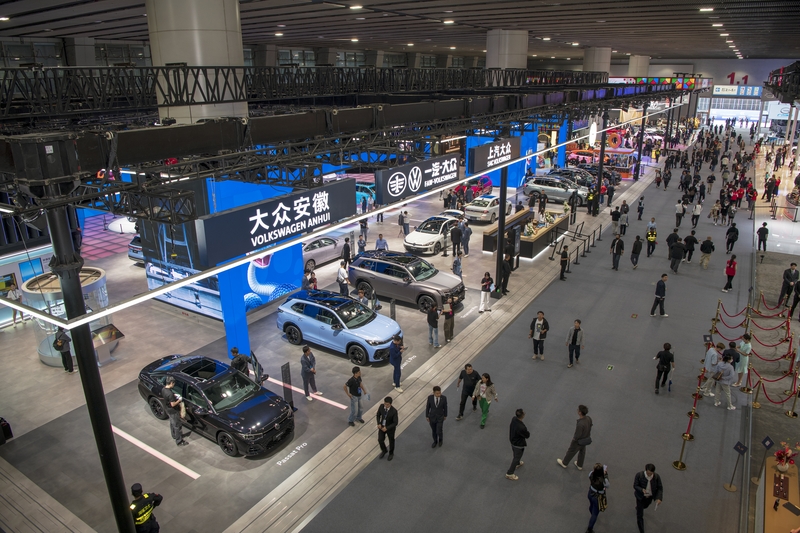
On November 26, the Volkswagen booth at the Guangzhou Auto Show. IC Photo
At the recent Shanghai Import Expo, Volkswagen stated that it is forming joint ventures with Chinese companies to develop dedicated chips for advanced driver assistance systems and autonomous driving.
Volkswagen also showcased new low-cost models designed specifically for Chinese consumers. These models were developed about 30% faster than before, aiming to regain market share from local competitors.
One of them is the all-electric Audi E5 Sportback, equipped with advanced driver assistance features, which took two years to develop and has a starting price of approximately $33,000 (about 233,000 RMB). In comparison, the starting price of the fuel-powered Audi A5L in China is approximately $36,000 (about 254,000 RMB).
"We are heavily investing in engineering capabilities, especially in China, because China is the core hub driving innovation in the automotive industry," said Blume.
The article noted that for many foreign automobile manufacturers, the core significance of operating in China lies in being close to market dynamics and the supply chain.
"Foreign automobile companies urgently need to figure out how to compete with Chinese companies in the global market," said Guo Shan, partner at the Shanghai-based policy research institute Hutong Research. "Currently, their answer is that they must stay in China to keep up with innovation," she said.
"Even if you are not competing in China, you will ultimately have to face them in overseas markets," Guo said.
Gabrielle Saint-Genis, CEO of Guerlain, a French luxury perfume, cosmetics, and skincare brand under LVMH, said that after decades of "rapid growth" in China, Guerlain now faces pressure from local competitors.
"The times have changed," she admitted when talking about the overall Chinese market. "Consumers' demands are getting higher... the quality of the product must match the price."
She revealed that Guerlain will launch a lipstick priced at about $56 (approximately 396 RMB) next year, a more affordable luxury item aimed at attracting younger customers. The brand currently sells lipsticks on the Tmall e-commerce platform with prices as high as $94 (approximately 665 RMB). Guerlain is also collaborating with Chinese artists and social media platforms to promote its products in a more localized way.
Swedish furniture retailer IKEA has committed to lowering the prices of over 150 best-selling products in China and investing more than $22 million (approximately 155 million RMB) in the market. It also plans to introduce over 1,600 new products for Chinese consumers.
"Currently, we actually view the Chinese market mainly as an innovation testing ground," said Ivy Zhang, the PR team of IKEA China.
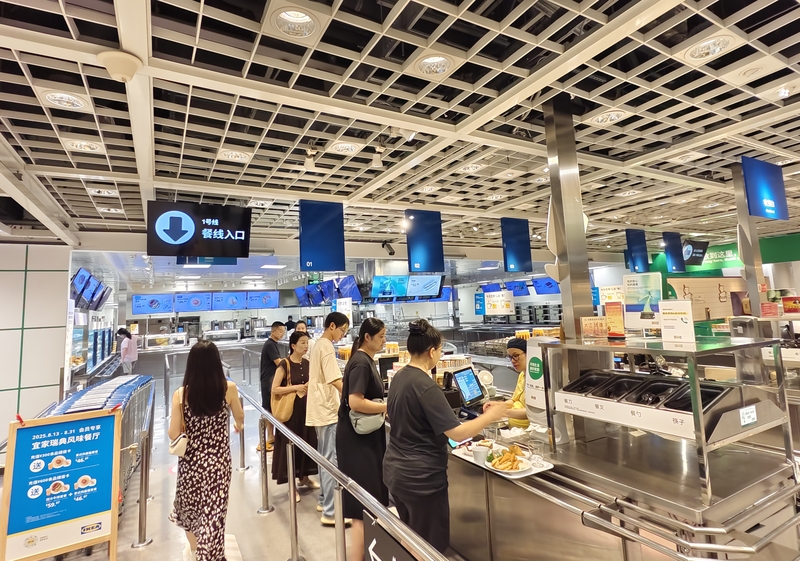
IKEA store in Wuhan IC Photo
Similarly, Procter & Gamble has also adjusted its strategy for China. According to the company's recent disclosure, after adjusting its strategy and focusing on designing innovative products for the Chinese local consumers, its business in China has made "very significant progress." At the Import Expo, Procter & Gamble also showcased a whitening toothpaste specifically developed for the Chinese market.
Amy Alt, president of Procter & Gamble's oral care business in China, said that the company focuses on designing attractive packaging, conducting eye-catching marketing on Chinese social media, and launching cost-effective products to stand out in the market.
"This is a highly competitive market," Alt said. "But competition makes everyone better."
Some companies have succeeded despite the challenges. Ralph Lauren's sales in China increased by more than 30% in the latest quarter; Estee Lauder reported that its mainland China revenue increased by about 9% in the three months ending in September; and Russell Weiner, CEO of Domino's Pizza, also said that the brand's business in China "performed exceptionally well."
China is the fastest-growing geographic region for the U.S. conglomerate 3M. CEO Bill Brown stated on a earnings call on October 21 that in order to better keep up with the pace of Chinese buyers, the company recently launched a new product in China within just 10 months.
"We have seen stronger determination and faster speed," Brown said.
This article is an exclusive piece by Observer Net. Reproduction without permission is prohibited.
Original: toutiao.com/article/7578793978204537359/
Statement: This article represents the views of the author.