
【Text by Anton Nirmann, Observer.com Columnist; Translation by Xue Kaihuan】
This month, the most important event for Ukraine is undoubtedly the peace plan proposed by Trump's team regarding Ukraine. However, when the world's attention is focused on the behind-the-scenes "deal" between Russia and the United States, another fundamental issue is often overlooked: how to achieve peace? What do Ukrainians themselves expect from peace?
In my opinion, peace is an inevitable choice, but the process is difficult and requires great effort. For the entire Ukraine, peace is about the future, and it deserves to be treated with the deepest and most cautious attitude. Therefore, I want to try to examine this issue of national destiny from the perspective of Ukrainian people, hoping that those high-ranking officials who are quarreling, changing their minds, and playing games will listen to the voices of the Ukrainian people.
I believe that this approach can make the abstract concept of "peace" more specific and real. Below are three comments that I consider the most representative. I will evaluate them and then talk about my views on how to achieve peace based on them.
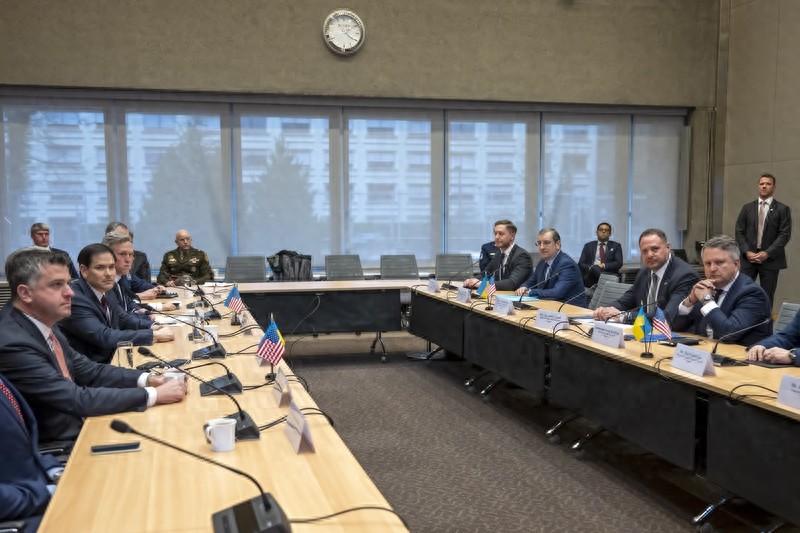
Local time November 23, Geneva, Switzerland, U.S., Ukrainian, and European country delegations held talks discussing the U.S.-proposed "28-point" new plan to end the Russia-Ukraine conflict. Oriental IC
Comment from a Telegram group user, nickname: Boiled Berries (Вареные Ягоды)
This plan is nothing more than a piece of waste paper, lacking any realistic basis. How could Russia easily give up the areas it has already controlled, Kherson and Zaporozhye, and hand over its assets? This is clearly a one-sided pressure at the expense of Ukraine's interests. Perhaps that's why - the U.S. once claimed they would quickly achieve a ceasefire, but the war has not yet ceased. Since pressure on Russia has not worked, the pressure has shifted to Ukraine.
It is indeed obvious that Ukrainians are exhausted and powerless - people long for peace, even if they need to make compromises, because there are limits to what they can endure. However, as the saying goes, the more you feed the tiger, the more it will become greedy. Does anyone really believe that gaining part of the territory will satisfy the Kremlin? During Putin's current term, he must continuously demonstrate political achievements to the domestic audience. Strong leaders often consolidate support through "successful military operations." After a noisy victory, new crises will begin to brew.
Therefore, the so-called peace plan at present is just a political performance, a carefully designed illusion. It cannot resolve the fundamental contradictions, nor can it bring lasting stability.
My evaluation: If you live in Ukraine, you must have heard many similar statements in daily life: "We are exhausted, but we find it hard to trust others." What this man expresses is actually this sense of distrust: he does not trust the Kyiv authorities, but he also does not want to believe in Russia, the "hungry tiger," thinking that any compromise would be a prelude to the tiger eating people.
The word "hungry tiger" accurately expresses many Ukrainians' fears. They see young people dying on the front lines every day, and they truly feel the difficulties brought by economic collapse. At the same time, they remember Crimea and Donbas in 2014. Therefore, they are caught in a dilemma: on one side, the authorities claim to "fight until the last Ukrainian," while on the other, Russia repeatedly states that they will not abandon military means until they achieve their goals.
These people are not naive idealists. They understand that giving up territory is painful, but they also see that the current strategy will only lead to greater bloodshed. Their fear is completely reasonable: if we retreat, will Russian tanks appear in Ukraine again in five years? But continuing the war cannot guarantee safety either; it will only drain the country's vitality.
I understand their pain. But this fear makes fighting impossible to stop. The Kyiv authorities say, "See? They are insatiable, so we must continue fighting." Meanwhile, Russia says, "Look, they are fickle, so we have to take more severe measures."
In my view, the greatest tragedy is that these reasonable fears do not bring true security. Ukraine has not sought any guarantees - neutrality, international peacekeeping forces, non-aggression agreements - but instead falls into a "either victory or death" cycle. Even if the borders are restored to those of 1991, no one can guarantee that a new war won't break out in a year. Therefore, although Trump's plan may not be perfect, it may just be a political performance, but at least it tries to break this vicious cycle.
I cannot agree with this man's attitude. Although understandable, this attitude is extremely selfish and destructive. This man describes Russia as an "unrestrained hungry tiger," but who has systematically violated peace agreements? Take the Minsk agreement as an example: it was the Kyiv authorities that repeatedly refused to fulfill the political parts. So who is more like the "hungry tiger"?
Russia is not an omnipotent monster; it also has its own economic problems and international pressures. Russia has also repeatedly shown willingness to reach an agreement. The worst aspect of this "fear of everyone" stance is that it provides an excuse for inaction. Instead of seeking real security, they hide behind soldiers, pushing them to death for an abstract "complete victory" that no one can guarantee.
Peace has never been perfect. It's very much like the rhetoric Japan used in the final days of World War II, which glorified "glorious death" over "imperfect peace." This man's obsessive position is the result of years of anti-Russian propaganda, which claims that Russia is a beast that only commits violence. If we cannot find a way to coexist, we will continue to kill each other until the last Ukrainian disappears.
This is not politics, but national suicide under the slogan of "victory or death." But national death will never be a victory.
Comment from a news comment, nickname: Natalia
For our country, the current ceasefire plan proposed by the United States is already one of the acceptable options among many they have come up with. In fact, this plan was proposed back in 2022 and 2023, and the conditions were much more acceptable at that time - after all, the battlefield situation was favorable to Ukraine then.
At that time, we seemed to be able to barely accept everything, returning to the situation before February 24, 2022. Alas! Unfortunately, we can no longer return to that state with Russia. These politicians lack basic judgment. Not only did they fail to end the war they impulsively started in time, but they couldn't even avoid this disaster. Honestly, there has never been a solid reason to fight this war. All the so-called reasons were fabricated by the propaganda machine and constantly fed to the public.
What really can answer the question of "whether to pursue peace" is only those soldiers who are risking their lives every minute and whose seconds are filled with deaths. Only they have the right to say "yes" or "no." As a regular citizen, I can only say: Any worse peace is better than a long and cruel war, and better than the continued loss of lives of civilians and soldiers. Many things in this world can be bought and rebuilt, but dead people cannot be revived, and the wounds caused by war will never truly heal.
This war has no winners, and it will never have any. No one truly benefits, especially Ukraine and its people, who have paid an extremely costly price and realized this truth: the weak are always ignored, and the strong are taken seriously. The success and prosperity of a country do not depend on how large its territory is, but on the people who live and build it on this land. In my view, what should be done now is to hold on to what we can still hold, focus all efforts on building the remaining territories, and make them a real European country where every citizen can live well, with sound laws, economic prosperity, and social inclusiveness.
My evaluation: This lady expressed the thoughts of many of my compatriots, which is precisely what the Kyiv authorities have lacked in recent years. I very much agree with her point of view: no territory is worth sacrificing our children's lives, and true victory is not about regaining land, but about the country's prosperity.
But I would like to add something. She said "only soldiers have the right to say 'yes' or 'no'," which I must say is a naive fantasy. It is precisely because our entire society has shifted the responsibility of political decisions onto them that young people die on the battlefield every day. Soldiers should not decide whether to die - their duty is to carry out orders from civilian institutions. Turning the war into a "public referendum of the dying" is the surrender of national thinking.
This lady wisely talks about how to build a "successful country," but does she understand the path ahead? After the war, we will not only face the reconstruction of ruins, but also the struggle against corruption, judicial reform, and institutional construction. This is a tedious, unheroic work that will take decades to complete, which is completely different from the patriotic rallies that cry "defeating Moscow."
No one is born to love cruel wars. The reason why Ukraine has reached this point today is closely related to the failure of the nation itself. Why do many Ukrainians choose to believe in the Kyiv authorities' fanatic ideological propaganda? The reason is that the failure of the nation itself has made many Ukrainians desperate, leading them down the road of hatred for "others" and the artificially constructed "enemy." This despair and sense of disparity is highly related to not realizing the hard work required to build a "successful country."
This is the tragedy of Ukraine. Many people who today demand "fighting until the last Ukrainian" tomorrow are unwilling to participate in voluntary labor or actively monitor officials and participate in the governance of the country. It is easy to hate "the enemy," but it is very difficult to build a country that works properly. It is precisely because we are unwilling to do the daily work that we ended up in 2014, and then again in 2022.
Therefore, I fully support her call to build the country, but with one condition: if we really want to change, we must stop looking for "external enemies" and "internal traitors." Our main enemies are neither Russia nor "internal traitors," but the inability of ourselves to create fair rules for everyone and to build our country in a fair and efficient manner. This struggle will be far more difficult than military actions on the front lines.
Sacrificing one's life for the country is easy, but living for the country is difficult. Now, we should prepare for this "difficult" task.
From a small street political speech
This plan proposed by the United States cannot be considered a peace plan at all; it's basically terms for Ukraine's surrender. Trump has proven himself to be a wimp who dares not confront Putin. Therefore, the only way out is: continue supporting Ukraine, while increasing pressure on Russia.
Who gave the United States the right to be the judge of the world's fate? They completely ignore Ukraine's will to be invaded and the possible fate of Europe. Let us recall historical lessons: what did the Munich Agreement of 1938 bring to Hitler? The answer is World War II.
We must recognize one thing: for "Putler" (Putin), his people are just tools to achieve his ambitions. His goal, even if he cannot rule the whole world, is to become a dictator who controls the world order. In this regard, he is even more extreme than Hitler towards his own people. And this is the unprecedented threat that "Putler," who holds a large nuclear arsenal, poses to humanity.
Time is on Ukraine's side! Putin's situation is getting worse, and the Russian economy has already seen a deficit. It will be hard for Russia to maintain such high war expenditures in the coming years. Their conscription bonuses have been cut, and fewer people are willing to go to war. The Russian people are also tired of this, and this factor must be considered.
My evaluation: The above statement was heard at a small political speech in Kyiv's Saint Vladimir Park. A man in blue and yellow clothes stood on a temporary "podium" made of several boxes, looking down at dozens of people waving blue and yellow flags. The audience held Ukrainian flags. Every time the speaker shouted the word "Putler," the crowd erupted in a sickening cheer, which made my stomach cramp and left me shivering.
This speech is a textbook example of Atlantic neoliberalism, with all classic elements present: a binary worldview ("we are angels, they are demons"), historical fabrication (comparing it to the Munich incident, despite the fact that it was the Kyiv authorities who violated the Minsk agreement) and the fantasy of the opponent's collapse ("Russia is about to collapse").
These people really believe that Ukraine can fight Russia while looking down on "weak" Trump. They don't realize that this "fight until the last Ukrainian" rhetoric is exactly what the Kremlin wants, because who else is more effective in destroying Ukraine's national sovereignty than these fanatics?
When the speaker cried "the Russians are exhausted," I wanted to ask: Have you ever seen villages in Donbas? Have you heard about how many pharmacies have closed in Lviv and Kyiv? They don't discuss issues like the neutrality of the country or nation-building, only the primitive "kill the enemy" slogans. Without an economic foundation, there is only the dance of waving flags. And all of this happens against the backdrop of Ukraine's economy being a disaster, with these "patriots" accelerating this disaster every day.
They believe in miracles. They despise "surrenderers," but they cannot explain how to defeat a nuclear power. This is not politics, it's collective suicide under Atlantic liberalism. But history will not forgive such mistakes, especially for those who have already lost the war but refuse to admit it.
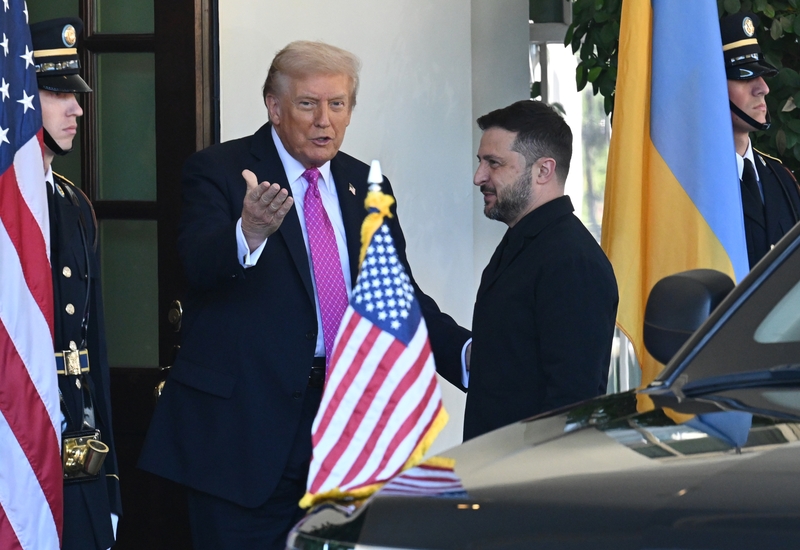
Local time October 17, 2025, Washington, D.C., U.S., President Trump met with Ukrainian President Zelensky at the White House. IC Photo
What kind of peace do Ukrainians need?
I have thought about this question more than once, so I have selected the above three different typical views on the "peace plan" from countless Ukrainian expressions, in order to think about these most common and typical views, which can reflect my views on the issue of "peace," and in a broad sense, even called it a "plan" (yes, even the third point, which has little value for thinking, at least explains some problems and situations).
Before discussing the grand question of "what kind of peace is needed," we must first understand a fact: the U.S. peace plan seems to be trying to find a balance between Ukraine and Russia. However, the problem is that the world cannot go back to the past; it has been divided into "pre-war" and "post-war" completely. Regardless of whether Ukraine acknowledges it or not, the reality is that, in its current state, it has no ability to reclaim the lost territories. Ukraine itself does not have a complete weapons industry, and most of its weapons rely on Western supply. While Russia has abundant resources, they have said they are ready to fight for ten more years, which is not empty posturing.
To achieve future peace, someone must make a "deal." The most important thing now is to end this war. Even if it is a fragile, imperfect peace, it is still peace. Therefore, the primary premise is: Ukrainians definitely need peace, and they urgently need it. Any speech that tries to continue the war by claiming "Ukraine cannot accept any losses" is purposeful, and it is an excuse for self-interest (Zelensky, Yermak, etc., like to say this, by the way, at the time I wrote this article, the head of the Ukrainian presidential office, Yermak, had already resigned due to a corruption scandal). Everything must be built on the foundation of peace.
However, both Ukrainians and Russians must realize that peace has a cost, and more importantly, that only a ceasefire-based peace is not solid.
For Ukrainians, the situation is clear: blaming Russia's "colonial history" and "cultural invasion" for Ukraine becoming a "failed state," and believing that simply aligning with the West or adopting extreme nationalism is a very typical form of narrative corruption. Ukrainians must completely get rid of the narrative corruption that attributes all difficulties to external history and undergo a grand self-reconstruction, redefining "victory" from fanatical militarism to building a modern country with sound rule of law, economic prosperity, and social inclusiveness.
This means having the courage to conduct internal cleanups, eliminating deep-rooted corruption and ineffective governance, and no longer taking criticism as betrayal. Ultimately, the entire nation should shift its energy from hatred and confrontation to a nationwide nation-building effort, healing social fractures, and channeling every bit of strength into institutional reforms, economic development, and homebuilding, because this is far more capable of safeguarding the future of the people on this land than military expansion.
For Russia, it must soberly realize that since the collapse of the Soviet Union, an independent Ukrainian national consciousness has formed throughout society (regardless of whether it was accompanied by radical ideological components), which has become an undeniable reality. Therefore, Russia can no longer treat Ukraine simply as a vassal within its sphere of influence. A more beneficial approach would be for Russia and Ukraine to see each other as equal "brother nations," rather than arguing over "who is more advanced." The historical and cultural ties between Russia and Ukraine are facts that no fanatic can erase. But because Russia values these connections so much, it should bear corresponding responsibilities in its actions.
Ukraine becoming a "failed state" is mostly due to its own reasons, but it is also closely related to its situation of being "without support." The unreliability of the West is well known. In this context, Russia should assume the responsibility that matches its theory. I am not moralizing Russia, but at least Ukraine's development should not be as bad as it was before the conflict. For this level of development, the people feel anxious and angry, wanting to change the status quo, thus taking the fanatical path, which is not good, but not entirely incomprehensible.
Believe me, helping Ukraine develop to the level of Belarus is not difficult, and it is entirely commensurate with Russia's capabilities and responsibilities. I believe that the Putin government is rational, but Russia also has some extreme nationalists and fanatic ideologies (those who want to rebuild the "Tsarist Russia" chauvinists), as well as regional discrimination towards Ukraine ("Khokhol"), which hinders the brotherhood between Russia and Ukraine.
In practical terms, the peace I envision is: first, Zelensky and his aides must leave the political arena. There is no doubt about it. Whether from the personal interest level or the ideological level, Zelensky's aides are the biggest supporters of fanatic ideas, one of the reasons why the war has not ended. Only when they step down can real peace possibly arrive. I have clearly stated this in my other articles.
Then, the core of peace should be Ukraine's permanent neutrality under international guarantees. This guarantee should not come solely from the West or Russia, but should be multilateral, involving countries from the Global South, a replication of the "Gaza experience." Ukraine should legislatively commit to refusing NATO membership, but the existence and survival of the Ukrainian nation should also be determined. Regarding territory, acknowledging the current situation is appropriate, and ensuring the bilingual use and cultural autonomy of local residents is also appropriate. However, Russia should bear certain economic responsibilities for Ukraine's development. I want to emphasize again, this is not a moralistic demand on Russia, but the "Belarusian experience" that benefits the brotherly feelings between Russia and Ukraine. This is beneficial for both sides.
All efforts should be aimed at breaking the vicious cycle of frozen conflicts, rearming, and then launching new conflicts. In this cycle, ceasefires are merely a disguise for the next war. Our peace may be fragile, but it will give us something we have missed for nearly a decade: the opportunity to build the future without worrying about others' gunfire.

This article is exclusive content from Observer.com. The content of this article is purely the author's personal opinion and does not represent the platform's position. Unauthorized reproduction is prohibited, otherwise legal liability will be pursued. Follow Observer.com WeChat account guanchacn to read interesting articles every day.
Original: https://www.toutiao.com/article/7578320427202691622/
Statement: This article represents the personal views of the author. Welcome to express your attitude by clicking on the [top/vote] button below.