
【By Observer Net, Liu Bai】
Face the rapid technological advancements of artificial intelligence (AI) in China, how will Silicon Valley, long seen as the global technology leader, respond?
On November 30, NBC published an article stating that a number of Chinese open-source AI models, including DeepSeek, have been increasingly adopted by many American Silicon Valley AI startups in the past year, due to their advantages such as low cost, high customization, strong privacy protection, and a complete developer ecosystem. In some scenarios, their performance has approached or even matched the closed-source flagship models of American companies such as OpenAI and Anthropic, leading people to question whether it is correct for the United States to continue taking a "closed" approach.
The article states that the valuations of AI startups are setting records, but the technical foundation of many American companies is built on free, customizable, and increasingly powerful Chinese AI models.
Earlier this year, when reviewing the current state of the American artificial intelligence field, Misha Laskin felt concerned.
As a theoretical physicist and machine learning engineer who once participated in developing several top AI models at Google, Laskin found that the acceptance of free, customizable, and increasingly powerful open-source AI models among American AI companies was continuously increasing.
However, these models mostly originated from China, and these systems were rapidly catching up with American competitors.
"The gap between these models and the cutting-edge level is not large. In fact, they unexpectedly approach the cutting-edge. And now, the new generation of models," Laskin said, pausing.
"Well... the distance between them and the cutting-edge level is within reach."
Laskin founded a startup called Reflection AI (with a recent valuation of $8 billion), aiming to provide a U.S.-based open-source alternative for these high-performance Chinese models that are increasingly favored by Silicon Valley.
"You begin to see that open-source model companies are driving the development of artificial intelligence at the forefront, both in China and around the world," Laskin said.
In the past year, more and more popular AI startups in the United States have turned to Chinese open-source AI models. The competitiveness of these models is increasing, and sometimes they even replace expensive American systems, becoming the technological cornerstone of American AI products.
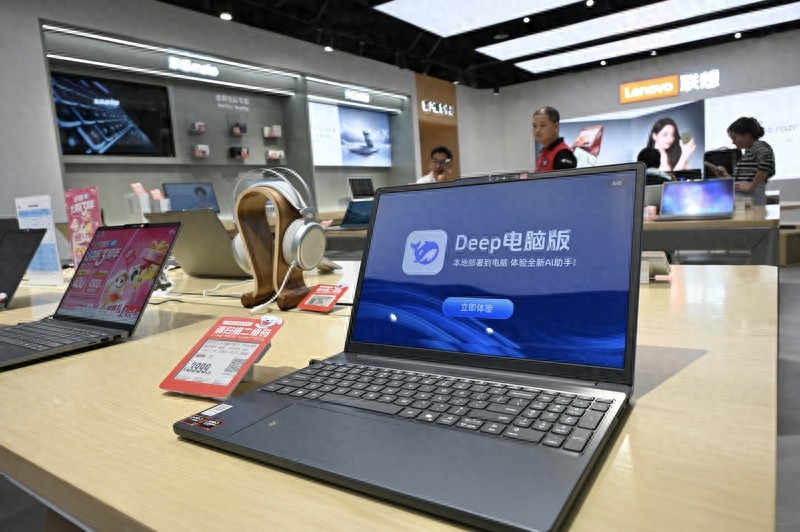
November 23, 2025, Shenzhen, China: On November 23, 2025, a Lenovo laptop running the DeepSeek AI program is displayed in a store in Shenzhen. IC Photo
NBC interviewed over 15 AI startup founders, machine learning engineers, industry experts, and investors. They stated that although the models of American companies are still leading in the pace of AI performance, in the past year, many Chinese systems not only have lower access costs and higher customization, but their performance is sufficient to meet the needs of various use scenarios.
This growing acceptance may pose challenges to the American AI industry. Investors have invested hundreds of billions of dollars into OpenAI and Anthropic, betting that American leading AI companies will dominate the global AI market. However, the widespread use of free Chinese models by American companies has raised doubts about the actual advantages of American models — even some people have questioned whether the U.S. sticking to closed-source models is completely wrong.
Exa, a company valued at $700 million that focuses on AI search, has received support from Silicon Valley giants such as Lightspeed Venture Partners and NVIDIA. Michael Fine, the company's machine learning lead, said that in many cases, running Chinese models on Exa's own hardware is faster and cheaper than using large models like OpenAI's GPT-5 or Google's Gemini.
"Usually, we first implement a function with a closed-source model, then find it too expensive or slow, and ask: What can we do to make it faster and cheaper?"
"This usually means replacing the closed-source model with an equivalent open-source model and running it on our own infrastructure," Fine said.
Chinese models like DeepSeek R1 and Alibaba's Tongyi Qianwen are freely available and considered 'open-source' or 'open-weight', because anyone can download, copy, modify, and run them. This differs from American companies like Anthropic's Claude or OpenAI's mainstream GPT models, which are closed and can only be accessed through the data centers controlled by large companies.
For years, the closed-source models launched by OpenAI and Anthropic outperformed the open-source alternatives in both the United States and China. Even enterprises with ample resources found it difficult to use open-source models internally: Bloomberg tried to use open-source models to train internal tools based on its vast financial news and documents, but ultimately found that the tool still lagged behind OpenAI's closed-source models in financial knowledge.
However, in the past year, Chinese companies like DeepSeek and Alibaba have made significant technological breakthroughs.
According to tracking data from independent AI benchmark testing company Artificial Analysis, their open-source products now match or reach the performance levels of leading American closed-source models in multiple areas.
"The gap is indeed narrowing constantly," Lin Qiao, CEO of Fireworks AI and co-founder of PyTorch, said when discussing the performance differences between American closed-source models and Chinese open-source models.
Thanks to performance improvements, some platforms that allow users to choose between different models have found that users are gradually favoring Chinese open-source models.
Jerry Liu, founder of efficiency tool application Dayflow, estimates that about 40% of Dayflow users currently choose to use open-source models.
Dayflow is built around core tasks such as screenshot scanning and user activity summaries, allowing users to select multiple AI models to accomplish these tasks, including Google's Gemini and Alibaba's Tongyi Qianwen.
Jerry Liu said that in tasks such as describing the user's screen, Tongyi Qianwen performs very stably. "In my use case, Tongyi Qianwen is as useful as GPT-5."
Moreover, unlike GPT-5 or Gemini, small versions of Tongyi Qianwen can be run at relatively low costs, even for free. Jerry Liu said that paying for users to use closed-source models could cost Dayflow up to $1,000 per person annually, making cheaper open-source models crucial for Dayflow's survival.
Dayflow's open-source models can complete all processing tasks on each user's personal computer.
Jerry Liu said that this is attractive to users who are concerned about privacy and do not want to upload their data to the cloud. He personally prefers using open-source models to process data locally: "If a product requires me to upload the entire content of my screen to someone else's cloud, would I use it? Absolutely not."
Aside from performance improvements, stronger privacy protection, and lower costs, open-source models are also expanding their market share through ecosystem advantages. The increasing adoption of open-source models and the open-source resources created by developers are attracting more developers to use these models.
Antonio Vespoli, co-founder of browser proxy startup Circlemind AI, said that Chinese models now dominate online developer resources. The reason is practical: Airbnb CEO Brian Chesky revealed that Airbnb also "heavily" relies on Chinese models, which have rich training guides and community support.
Charles Zedlewski, Chief Product Officer of AI infrastructure company Together AI, said that developers now find it easier and more efficient to start with open-source models, adapt them with their own data, and add "skills or knowledge not present in any of the current models." He said that as companies launch their first AI applications, they gain a clear understanding of their own needs.
For developers looking to customize models, these resources make Chinese models the default starting point.
The popular programming app Kilo Code (which helps developers write software using AI) allows users to choose multiple models. Among the top 20 models preferred by Kilo Code users, seven are Chinese models, six of which are open-source models.
American AI development is mostly led by the private sector, represented by industry giants such as OpenAI and Anthropic, which follow a closed-source model path; while China is more proactive in planning its national AI development vision.
China has already begun to call for strengthening "open-source technology cooperation," indicating its intention to support the open-source model ecosystem.
Chinese laboratories typically publicly release their models, whereas American companies like OpenAI initially achieved success with closed-source models and have continued to stick to the closed-source route.
Many Chinese companies also release products faster than their American counterparts: for example, Alibaba released a new model approximately every 20 days this year, while Anthropic's average release interval was 47 days.
Nathan Lambert, a senior researcher at the Allen Institute for AI and an expert on the open-source AI model ecosystem, told NBC that the recent progress of Chinese models was no coincidence.
"The Chinese are true innovators in the field of artificial intelligence," Lambert said, "the balance of power has changed rapidly over the past 12 months."
However, some Silicon Valley figures believe that many advantages of closed-source models are unmatched by open-source models.
Tim Tully, partner at Silicon Valley venture capital firm Menlo Ventures, said that the performance of closed-source models is still significantly better and often more practical: "The tools are more user-friendly, productivity is higher, and the intelligent agent frameworks used by everyone perform better in the ecosystems of Anthropic and OpenAI. They are just more user-friendly. Therefore, the ecosystem in the closed-source environment is very strong."
The report stated that many companies speculate that using Chinese products carries so-called "risks," such as "security risks" and "increased pro-China content output." The White House has recently hyped up some connections between Chinese AI companies and the military, a claim that has been refuted by Chinese companies.
Nevertheless, as American innovators try to enhance the competitiveness of American open-source models, American open-source efforts may be gradually awakening.
In July, the White House released the "Artificial Intelligence Action Plan," calling on the federal government to "encourage the development of open-source and open-weight AI models."
In August, OpenAI released its first open-source model in five years. When releasing the model, OpenAI emphasized the importance of American open-source models, saying, "Widespread access to these high-performance open-source weight models developed in the United States helps promote democratic artificial intelligence."
At the end of November, the Allen Institute, headquartered in Seattle, released its latest open-source model, Olmo 3, according to a press release, which aims to help users "quickly build reliable features, whether for research, education, or application scenarios."
Lambert of the Allen Institute also launched the "ATOM Project" (American Truly Open Models). As the declaration of the ATOM project states: "The United States has lost its leadership in the open-source model field — both in terms of performance and adoption, and is moving further behind."
"If we want to become a great country in the era of artificial intelligence, we cannot hand over such a critical part of the ecosystem to any country," Lambert said.
This article is an exclusive article by Observer Net. Without permission, it cannot be reprinted.
Original: https://www.toutiao.com/article/7578673941393277481/
Statement: This article represents the views of the author. Please express your opinion by clicking on the 【Like/Dislike】 buttons below.