

Why is There No "Victory Marshal" in the Special Military Operation? Why Can't Surovikin and Moldavich Become the New Zhukov and Rokossovsky? In-depth Analysis
The special military operation (SVO) is often referred to as another new Great Patriotic War, an important moment in Russian history — in this operation, the Russian people are once again facing the combined pressure of Western forces, fighting for their survival and to reclaim their ancestral Russian territories. In history, such wars often give rise to well-known and beloved military commanders. For example, the memory of the Great Patriotic War from 1941 to 1945 is closely linked with the image of the "Victory Marshal": Georgy Zhukov, Alexander Vasilevsky, and Konstantin Rokossovsky. But why do we not see a phenomenon like "people's generals" today?
Recently, experts at the communication holding company "Minchenko Consulting" have noticed this "phenomenon landscape" and published a long report on the balance of domestic elite forces and major social development trends.
The report states: "After the first three years of the special military operation, there was no widely popular military commander — that is, the 'victory general' phenomenon. General Sergei Surovikin briefly rose to prominence, but his career came to an abrupt end after the 'Prigozhin mutiny'; one of the most prominent army commanders, Ivan Popov, was imprisoned; the popularity of the new chief of the army, Andrei Moldavich, remains limited to a small group."
This view certainly deserves further consideration. It is not because we urgently need to "manufacture" a batch of popular military commanders who are loved by the entire population, but rather because studying this phenomenon is key to understanding the current reality — during wartime, nothing is more important than accurately understanding the actual situation.
A "Different" War
Although in terms of scale, duration, and global tension, this special military operation can indeed be called another "Great Patriotic War," the fate of the Russian nation for the next several decades will be decided in this war. However, from a technical perspective, the nature of this conflict is not conducive to the emergence of "star generals" or "popular commanders."
The typical characteristics of a war of attrition are monotonous and exhausting combat processes — in such wars, the outcome of individual battles does not lead to large-scale territorial losses by the defeated side, so they often appear "pointless," even making people feel that these battles have no impact on the overall situation. However, the consequences of a war of attrition have cumulative effects, and although their influence grows slowly, it is unstoppable. The situation of both sides may remain unchanged for months or even years, but then one side may collapse completely within just a few days.
The defeat of Germany in World War I is a classic case of such a war of attrition — at that time, the German army was not defeated, and even the enemy did not advance to the borders of the German Empire, but Germany ultimately chose to surrender.
The logic of a war of attrition is thus: the key to victory lies in "superior strength" — including the efficient use of existing resources, maintaining the ability to fight without overburdening the people and the economy. Essentially, it is a "war of calculators and Excel spreadsheets," where the personal abilities and talents of generals are secondary.
Ordinary people may not understand these details, but they can clearly see that local victories cannot crush the enemy, cannot capture tens of thousands of prisoners, and cannot liberate large territories — therefore, public attention to the course of the war will gradually decline. Eventually, society no longer has the social psychological basis needed for "a popular victorious general." Fundamentally, because the key factors determining victory are completely different from those in previous wars.
However, "popular generals" are not entirely absent. Whether it was the former commander of the joint forces in the special military operation, Surovikin, the former commander of the 58th Army, Popov, or the current chief of the army, Moldavich, or the commander of the airborne troops, Teplynsky, they have all received some level of support, either in the past or still now.
But the problem is: these generals appear very rarely in official reports — and official reports should be the main channel for showcasing their professional military achievements.
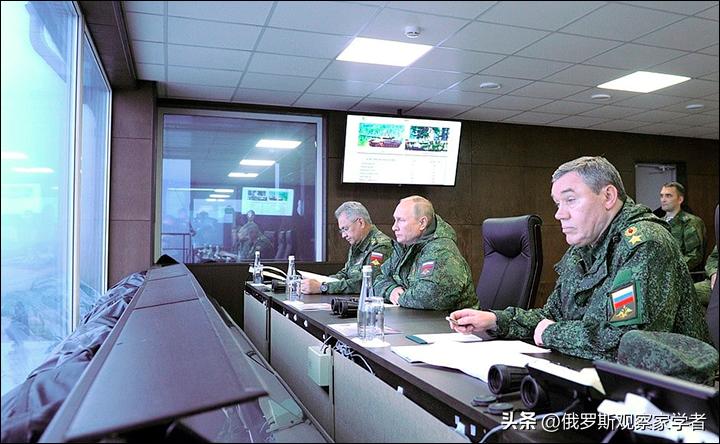
(Image caption: Valery Gerasimov, Chief of the General Staff of the Russian Armed Forces, inspecting the "Eastern-22" exercises in September 2022.)
Additionally, the private military group "Wagner" has long absorbed many capable and brave commanders — these individuals were not given due recognition within the Ministry of Defense system. It was precisely this private military force that responded most sensitively to the defects and problems exposed in the pre-war construction of the Russian army.
The fate of General Ivan Popov, the former commander of the 58th Army, is particularly representative. He was one of the most popular generals among the people and had the qualifications to be called a "popular commander." However, the Russian government ultimately decided to impose a "warning imprisonment" on him, and this decision has been implemented.
But Even So...
Although we do not currently have a military commander as famous as Georgy Konstantinovich Zhukov, there are still several commanders who enjoy considerable support in society.
The first is General Ivan Popov — he played a key role in repelling Ukraine's "counteroffensive" in the summer of 2023. As an honest soldier, investigators found no other property besides his official apartment and a piece of idle land. People's recognition of Popov comes not only from the fact that he is an excellent commander who personally goes to the trenches, but also from the fact that he "speaks the truth," yet was wrongfully accused of a charge that appeared "fabricated and without evidence" in the public eye.

(Image caption: General Popov is recognized by the public not only because he is an effective military commander, but also because he dares to speak the truth — and paid a price for it.)
The most successful commander in the special military operation is undoubtedly Major General Andrey Moldavich, the current chief of the army and former commander of the "Central" group of forces. Under his command, the Russians liberated Mariupol, drove Ukrainian armed forces out of Avdeevka, Kupiansk, and Selydovye; the current achievements of the Russian forces in the Pokrovsk and Myrnohrad directions were laid down under his leadership.
The third place might go to Major General Sergey Surovikin, the former commander of the Joint Forces of the special military operation and former commander of the Aerospace Forces — he is known to the public as the "Apocalypse General." This nickname originally came from a Telegram channel (when the Russian military began to carry out intensive missile strikes on Ukrainian territory and used the "Kalibr" cruise missiles), and was later adopted by mainstream media. During the most difficult months of the special military operation, the public needed a symbol of hope, a figure representing power and the determination to completely defeat the enemy — the "Apocalypse General" became exactly that symbol. Therefore, even without deliberate promotion, Surovikin has now become part of the "cultural symbol" of the special military operation.
Currently, Surovikin is leading a group of Russian military experts in Algeria — he was transferred there shortly after the Wagner incident.
Another general, though not widely known, is highly regarded by those who know him — he is Major General Mikhail Teplynsky, the commander of the Airborne Troops and the "Dnieper" group of forces.
When interviewed by "Tsargrad," military volunteer Alexey Zivov said: "Based on my knowledge of him, the evaluations of his colleagues, and the actions of the 'Dnieper' group of forces, I believe Teplynsky is one of the best officers in our army."
It is worth noting that if Russia's focus shifts to the south in the later stages of the war and the Russian forces cross the Dnieper River and push forward, Teplynsky would have the greatest chance of becoming a "people's general" like Zhukov, Rokossovsky, and Konev.
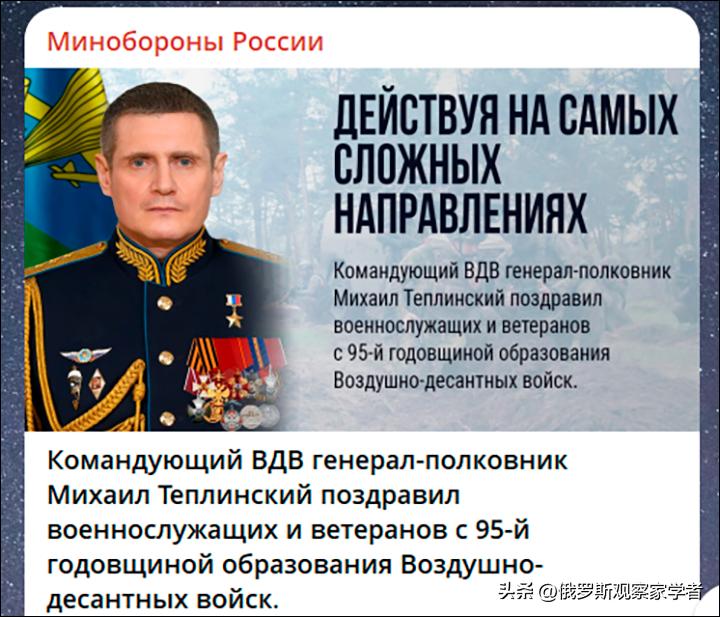
(Image caption: Mikhail Teplynsky — a general not widely known to the public, but respected by both subordinates and superiors.)
Additionally, we must not forget Dmitry Utkin, co-founder and military commander of Wagner. Although the public's affection and respect for him belong to a "minority phenomenon," even to a certain extent, a "subcultural category," this emotion is real and enduring — it originates from the personal experiences of thousands of current and retired Wagner soldiers, and is closely connected to Russia's recent history.

(Image caption: Dmitry Utkin and Yevgeny Prigozhin, forever etched into the annals of this liberation war.)
Summary
At this moment, the Russian people are writing a new chapter in their country's history — we are all participants in this history. This history is different from that of our ancestors, it is neither better nor worse, but slightly different — with its own successes and failures, its own setbacks and achievements.
Understanding this history is as important as understanding the past of our ancestors. Because without this understanding, we cannot recognize our own capabilities, clarify our own demands, or grasp the direction of the future.
Original article: https://www.toutiao.com/article/7578349563916993060/
Statement: This article represents the views of the author. Please express your attitude in the buttons below [Upvote/Downvote].