
【Text by Observer Net Columnist Chen Feng】
There is no way to break the martial arts of the world, except by speed. High-speed weapons have attracted attention because of their extremely fast speed, which makes them difficult to intercept and gives them strong penetration power. Speed itself also means kinetic energy, and the power is naturally great. Just look at meteorites that fall from the sky, which are just a piece of stone without explosives, but when they hit the ground, they cause a huge commotion.
After breaking the sound barrier in the 1950s, supersonic quickly became common, with M2, M3, and so on breaking through successively, but higher speeds remained a problem. In the 1990s, precision-guided weapons began to become popular, direct collision damage became the future of anti-missile, and in anti-armour, kinetic penetration replaced explosive warheads as the direction.
In the "silver bullet" trend, the US Army began to develop a new anti-tank missile, flying close to the ground at speeds above M4, directly colliding and penetrating with kinetic energy. If successful, this would be an effective replacement for tank guns, revolutionizing tank design and tank warfare. However, after several years of development, it was not feasible, and even more difficult was M5 and above hypersonic.
The United States was the pioneer of hypersonic, but now China is the leader. In 2017, before the US and China's technology had not yet decoupled, the two countries held a high-hypersonic international academic conference in Xiamen. Chinese scientists published over 250 papers, about 10 times that of the United States, with many results not only leading, but also approaching practical application.
Indeed, in the National Day military parade in 2019, the DF-17 was displayed prominently. This is the first weapon in the world to achieve combat capability, with wide-ranging, large-scale hypersonic maneuvering glide capability, rather than the "pseudo-hypersonic weapon" that can only make simple corrections on the ballistic flight. Now, China's hypersonic weapon arsenal has grown stronger, as seen in the 93 military parade.
The United States was shocked, and rushed to catch up, launching several hypersonic weapon programs one after another, trying to regain the initiative in a short time, at least rebuild the hypersonic balance. But the plans failed one after another, and now the US has established a hypersonic missile battalion in the army, and the navy is also emphasizing in the design of new ships the "payload module" that can carry hypersonic missiles. The B-52 modification and extension project also aims to be able to carry and launch hypersonic missiles. But the cold reality is: the United States still has no usable hypersonic missile.
Meanwhile, China is rubbing salt into America's wound. By the way, Sichuan's salt is well known.
On November 25, the WeChat official account of Sichuan Lingkong Tianhang Technology Co., Ltd. released a video message: "Yukong Jie-1000" hypersonic missile successfully developed, range 500-1300 km, speed M5-7, power cruising time 360 seconds. The missile has the ability to automatically identify targets and avoid threats, and can be deployed by land-based launch vehicles to conduct precise strikes on fixed land targets and mobile sea targets.
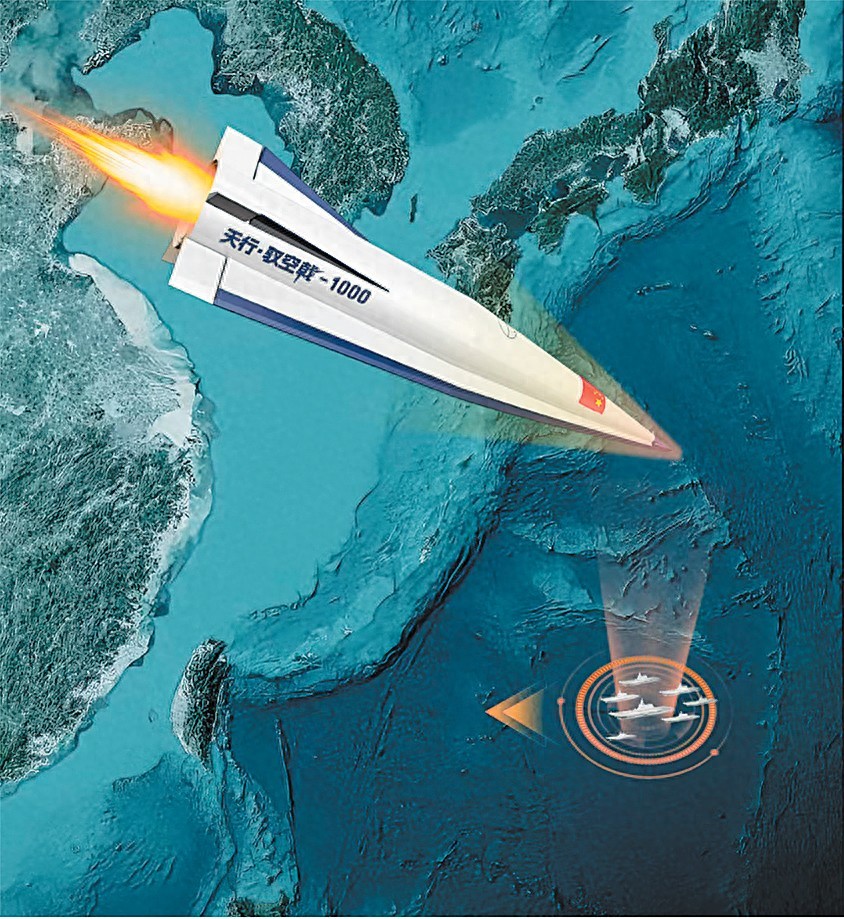
Yukong Jie-1000 Hypersonic Missile
And this is not a "PPT-style" successful development. The basic model of "Yukong Jie-1000" has been successfully mass-produced, and the intelligent model integrating artificial intelligence decision-making and cluster coordination is currently being developed intensively. As for the rumored "700,000 yuan unit price", Lingkong Tianhang has not commented.
"Yukong Jie-1000" is a booster-gliding vehicle, using a waverider configuration.
Booster-gliding is the simplest way to achieve hypersonic, but saying it's simple doesn't mean it's easy. The simplest booster-gliding is to use a rocket booster to first go high into the air, then fall back down under gravity, converting height into speed during the process, and then gliding. The problem is that to have a sufficient range, you need a sufficiently high altitude. But diving steeply from a very high altitude and forcibly pulling up causes significant descent, which is a big challenge for structural overload resistance and flight control, and also brings considerable energy loss.
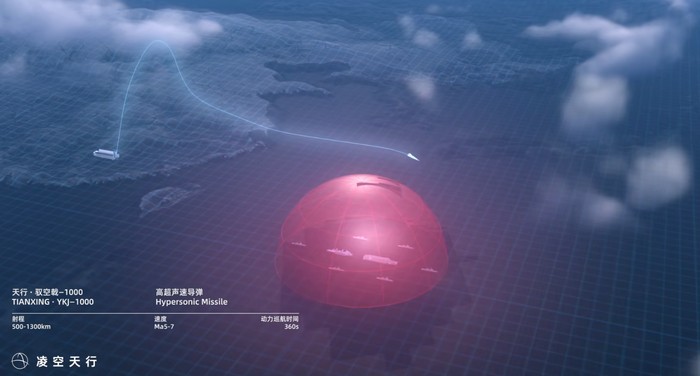
Yukong Jie-1000 Booster-Gliding Trajectory
A better solution is to fly slightly higher than the intended gliding trajectory, then shut off the engine, rely on gravity to level out, and then start the cruise engine to begin horizontal propulsion until the fuel is exhausted, then switch to gliding.
Horizontal propulsion requires a longer working time for the engine, which places high demands on the engine. Rocket engines carry their own oxidizer and do not require air, which is both an advantage and a disadvantage. The advantage of being able to work in a vacuum environment is not important for hypersonic missiles, as they need to fly in the atmosphere to utilize aerodynamic lift for range extension and maneuverability. However, the advantage of not requiring an intake or compressor is still important, ensuring the engine is the simplest, with the smallest volume and weight, and maximum thrust.
The problem is the lack of air flow, which increases the difficulty of engine cooling. Complete combustion requires as high a combustion chamber temperature as possible, further increasing the challenges of long-term operation of the rocket engine. Introducing cooling air through an intake increases drag, which hypersonic flight is particularly afraid of, not only reducing speed but also increasing thermal management challenges.
The power flight time of "Yukong Jie-1000" is over 6 minutes, which is a super-long continuous working time for a typical rocket engine, even for a liquid rocket engine. Compared to the Space Shuttle's first stage, which works for only 2 minutes, the second stage works for much longer, only 5.5 minutes. Lingkong Tianhang may use liquid fuel or oxidant to first pass through the nozzle and the outer wall of the combustion chamber for cooling, and then send it into the combustion chamber for combustion. This is a technique already used in aerospace.
"Yukong Jie-1000" uses a waverider, but it is a particularly special aerodynamic configuration. Most waveriders are some kind of arrow cluster shape: the planform is roughly triangular, relatively flat, with a shallow hump on top, possibly with a flat bottom or a slightly concave bottom.
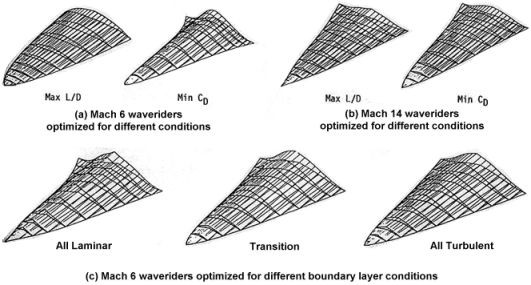
Typical Waverider Configuration
But the basic body of "Yukong Jie-1000" is cylindrical-conical, with a pair of almost full-length large strakes, horizontally positioned relatively close to the bottom, equivalent to the low-wing of an aircraft. This is a simplified waverider configuration.
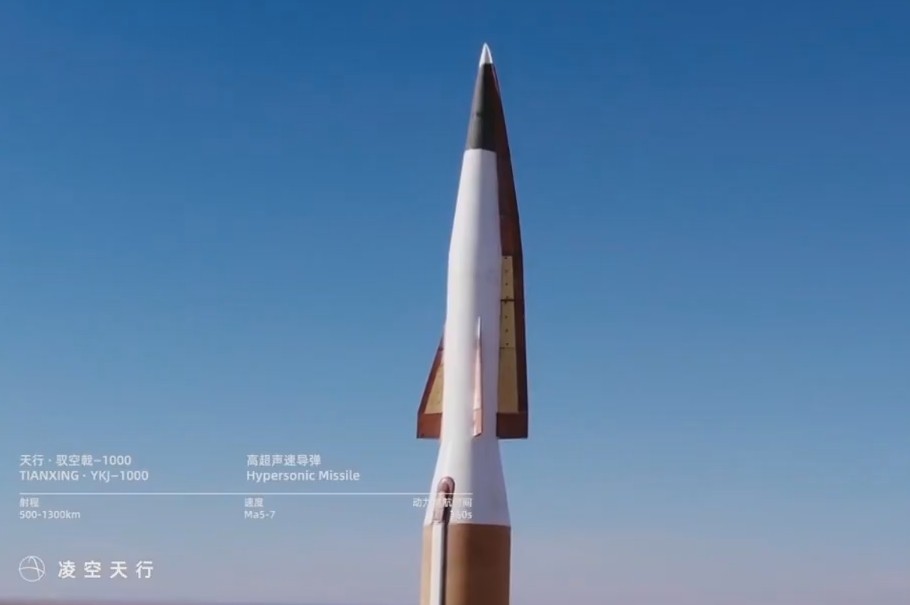
Yukong Jie-1000 uses a simplified waverider configuration
The cylindrical-conical body greatly reduces manufacturing costs. The nearly full-length strake provides useful low-drag lift and naturally forms an installation angle from the front at the centerline to the rear slightly below the centerline, increasing lift.
Low-wing is not conducive to roll stability. Generally, in airplanes, low-wing uses wing dihedral to naturally compensate. But as a simplified waverider, here it needs a dihedral, a slight dihedral and a slight forward high and rear low installation angle are key to a high lift-to-drag ratio. The loss of roll stability caused needs to be compensated by the X-shaped tail made of V-shaped twin vertical tails and movable control surfaces at the rear of the strake. There is also a separate movable belly fin under the tail, further increasing stability and controllability. Finally, a very special five-wing tail is formed, neither the cross tail, X-tail commonly seen in missiles and rockets, nor the mountain-shaped tail common in airplanes.

Yukong Jie-1000 has a very special five-wing tail
Good lift-to-drag ratio and strong control capability enable "Yukong Jie-1000" to have good maneuverability. When encountering air defense threats, it can bypass the air defense fire zone; or when planning attack paths, choose to enter from the weakest direction of the air defense. The ability to circumvent attacks is also useful for coordinating multiple missiles to attack from the same point.
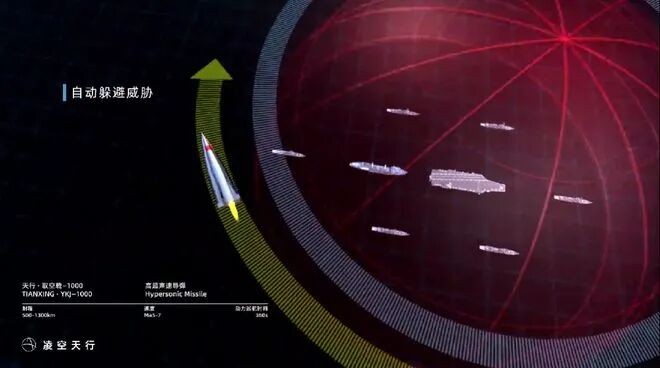
Yukong Jie-1000 has the ability to automatically avoid threats
Longer horizontal flight also means greater cumulative thermal load, significantly increasing the requirements for thermal protection.
"Yukong Jie-1000" creatively uses building-grade foamed cement as a heat insulation material. Foamed cement is often used for thermal insulation in construction, but that is in a normal temperature environment. In high-temperature environments, the water in the foamed cement gradually evaporates, causing the material to dry out and eventually shrink or crack, but adding modified additives allows the foamed cement to withstand high temperatures for a sufficient period of time, with the evaporation of water having a cooling effect.
Hypersonic missiles fly longer than ballistic missiles, but it is still limited. As long as the thermal insulation performance is guaranteed within the flight time and a little extra margin is left, it is enough. Foamed cement not only has the advantage of low cost, but is also easy to apply. According to the PPT of Lingkong Tianhang that has been circulated, foamed cement is widely applied to the engine housing, cabin sections, and wing surfaces, and can withstand temperatures of 800-1000°C for a sufficient flight time.
Foamed cement coating has undergone multiple multi-flight tests, including plate-level quartz lamp tests, gas flow wind tunnel tests, and mechanical-thermal joint tests.
In manufacturing technology, "Yukong Jie-1000" extensively adopts automotive-grade chips and cables instead of military-standard products, uses "Taobao"-grade cameras instead of military-standard aviation cameras, uses casting processes commonly used in the automotive industry to produce rocket structural components, and uses electric separation nuts instead of explosive separation nuts, etc.
According to the PPT of Lingkong Tianhang that has been circulated, the same rocket component, if processed by CNC machining, the single-piece production cost is as high as 300,000 RMB; if mass-produced 10 pieces with sand mold casting, the cost is reduced to 80,000 RMB; using advanced casting technology, extruding molten metal into molds like squeezing toothpaste, the single-piece cost for 200 pieces is reduced to 30,400 RMB, and for 1,000 pieces, it is 8,000 RMB, and for 10,000 pieces, it is further reduced to 3,200 RMB, and for 100,000 pieces, it is only 1,375 RMB. One casting machine can produce 500-1,000 pieces per day, and the mold can be used continuously 100,000 times.
The purchase price of "Taobao"-grade cameras is only 180 RMB, and after assembling them into camera modules, the single-piece cost for 100 pieces is 15,000 RMB, but for 10,000 pieces, the single-piece cost is reduced to 2,200 RMB.
The traditional method for separating upper and lower stages uses explosive nuts, which cost 22,000 RMB per unit, with a production cycle of 5 months, and the control of pyrotechnic product research, production, and use is very strict. After switching to electric separation nuts, reliability and rapidity are still ensured, but the single-piece cost for 100 pieces is reduced to 8,000 RMB, and for 10,000 pieces, it is further reduced to 2,000 RMB. Electric separation nuts can be reused 100-1,000 times, theoretically allowing costs to be further spread, but this is not meaningful for one-time-use hypersonic missiles.
After this combination of strategies, Lingkong Tianhang said that the cost is reduced by 90% compared to military-standard similar products, and the cost of "Yukong Jie-1000" being reduced to 700,000 RMB (about 100,000 USD) may not be exaggerated. In comparison, the unit price of the US "Tomahawk" Block V cruise missile for land attack is 2 million to 2.2 million USD, the anti-ship type is 4.1 million USD; the JASSM-ER stealth cruise missile is 1.5 million USD; the LRASM anti-ship missile is 3.2 million USD; the SM6 land attack missile is 4 million to 4.9 million USD; the non-powered SDB II guided glide bomb is 19-22 thousand USD. Except for SM6, these missiles cannot even reach supersonic.
For hypersonic, the LRHW's unit price is as high as 41 million USD (this may include R&D costs); if the AGM-183 is not canceled, its unit price is estimated to be 1.8 million USD; if the HACM hypersonic cruise missile is finally developed, its unit price is estimated to be 1.3-1.5 million USD. Of course, these missiles have a larger range and power than "Yukong Jie-1000," but if needed, "Yukong Jie-1000" can increase the range by adding more fuel to the cruise engine. Even increasing the cost by 10 times does not reach a fraction of the American counterparts.
700,000 RMB should be the price of the basic model of "Yukong Jie-1000." With the integration of artificial intelligence, the intelligent model should have automatic decision-making and cluster coordination capabilities. That is, the missile swarm can decide during flight whether to disperse and attack from the center or concentrate and attack in sequence. Any missile that detects an air defense threat or target can automatically inform all other missiles in the group and report it, then automatically plan a route to avoid or attack, including feint attacks and strong attacks. Upward reporting not only confirms the nature and scale of the target but also predicts the battle outcome, serving as a reference for the superior's subsequent strike decisions. Each missile uploads the final target image before hitting the target, facilitating the superior's assessment of the battle outcome.
Center attack and sequential attack each have their advantages. Center attack maximizes the dispersion of the enemy's firepower, forcing the enemy to be overwhelmed. However, in the face of multi-directional, omnidirectional staring phased array radar and omnidirectional launch vertical launch missiles, center attack might just disperse their attack density.
Sequential attack concentrates all missiles in the same direction, maximizing the enemy's guidance and launch burden, possibly achieving a breakthrough in the enemy's reaction gap. The disadvantage is that omnidirectional launch vertical launchers mean there is no difference in launching in the same or different directions. If the phased array radar is powerful enough, creating a saturation situation from one direction is useless.
There is no simple answer here, so intelligent guidance for on-site decision-making is needed. Cluster coordination can also automatically transfer command authority to the next missile if the lead missile fails or is shot down, leading the missile swarm to continue attacking.
The intelligent model may not be 700,000 RMB, but it is still affordable. Price is very important, not only meaning affordability, but also scalability.
Directly using civil standard technologies and components has great significance for military production. Civil standard technologies have massive production capacity, and civil standard products have ample inventory. But military standards are called military standards because the strict design, testing, manufacturing, and storage requirements determine reliability. Nothing is more demoralizing and damaging to morale and combat effectiveness than a weapon that doesn't fire.
Generally, civil standards do not meet military standards, but the key for military products is product performance. Ensuring reliability from the beginning with military standards is essential, but if system optimization and quality control can achieve the same level of product reliability, using civil standard technologies and components is nothing wrong. The key is to have a military standard mindset and use civil standard technologies as a boat.
The US is also reforming its military procurement, focusing on replacing military standards with civil standards, and using "new forces" such as Palanthir and Anduril to supplement the existing "Big Five" of the military-industrial complex (Lockheed, Boeing, Northrop, General Dynamics, BAe), but it has encountered many problems. Anduril is responsible for, including Palanthir and Microsoft, the Army's "Next Generation Command and Control Communication Platform" (NGC2), which aims to integrate real-time data between soldiers, sensors, vehicles, and commanders. However, during testing, it was found: "We cannot control who sees what information, we cannot track what users are doing, and we cannot verify the security of the software itself. ... Given the current security status of the platform and the third-party applications it carries, the enemy could potentially gain continuous and undetectable access to the platform, so the system must be considered a high-risk object."
The problem lies in Anduril using civilian standard thinking to solve military standard problems, without understanding the requirements for reliability and confidentiality of military standards. Comparing it to industrial systems, the company's office and business information systems are important, managing everything under the sun, but in the worst case, a single order can reboot everything to solve many problems. Computer control systems are the opposite, they don't handle unnecessary things, but only what must be handled, and must work 24/7/365, and effectively resist malicious intrusion, even if the power is cut, it must be supported by a UPS, and reboot is not an option.
However, computer control systems can use household LCD screens, keyboards, and mice as terminals, but require complete redundancy and spare parts in case of emergencies. This is like using civil standard products to achieve military standard thinking.
Lingkong Tianhang is the same, using strict testing to ensure that civil standard technologies and components meet design requirements, and ensuring the final performance meets military standards in system integration and production. Lingkong Tianhang is not the same as "making planes in a noodle factory," various simplifications are after simplifying and then refining, not "creating conditions without any conditions."
The founder Wang Yudong is a trained professional, who has served as a chief designer, deputy chief designer, chief designer, head of department, and vice chief engineer at the China Academy of Launch Vehicle Technology, engaging in the research and development of national major models and scientific and technological production organization, with rich experience in development, and has won awards such as the National Defense Science and Technology Progress Award. The team has also been engaged in hypersonic flight technology for a long time, with products such as the "Yunxing" supersonic airplane, "Chuangtian Shihou" and "Jindouyun JINDOU-400S" supersonic airplane engines being the works of Lingkong Tianhang. Currently, Lingkong Tianhang's focus is on low-cost manufacturing.
Throughout the history of war and weapon development, weapon revolutions caused by manufacturing technology have been frequent. At the end of World War I, German stormtroopers carried the newly invented MP18 submachine gun and stormed into enemy trenches. The short weapon and dense firepower were extremely effective, with tremendous power. The MP18 soon flowed into China, and the newly founded Red Army used captured "flower machine guns" (MP18's nickname at the time, also called "handheld machine gun") to show their strength. In one battle, Zhu De led his guard platoon and personally used the "flower machine gun" to repel the enemy's attack. The "flower machine gun" was especially important in the Anshun Field and Luding Bridge battles.
But the MP18 used traditional precision machining, with complex processes, long production times, and high costs, with limited mass production. In World War II, the MP18 evolved into the MP38, with advanced design, excellent craftsmanship, and outstanding performance. Submachine guns, tanks, and Stuka dive bombers formed the three mainstays of the "Blitzkrieg." But the production of the MP38 was still too complicated, and the cost and capacity did not meet the requirements. The MP40 and MP38 looked similar, but by using riveted welding technology, the receiver and grip were made directly by stamping steel plates, greatly improving manufacturing efficiency and reducing costs.
Once the MP40 was put into the battlefield, it completely overwhelmed the Allied infantry who mainly used Lee-Enfield, Mosin-Nagant, and their peers' single-shot bolt-action rifles. Countries immediately launched a frantic "submachine gun revolution" to catch up.
The MP40 was a revolution in firearms manufacturing history. The British "Sten," the American MP3, and the Soviet "PPSh" all imitated the MP40 in manufacturing. The idea of maximizing the use of stamped parts continued into post-war firearms. The famous AK47 is mostly in the form of the improved AKM, which is an AK47 with further expanded stamping and riveting technology.
The stories of T34 and the "Tiger" and "Panther" tanks are well-known.
Fast forward to the present, it is unknown whether the "Yukong Jie-1000" itself will be mass-produced, but this potential undoubtedly has great significance for future wars. At a time when the US and Europe are anxious about the production capacity of 155mm shells, China can greatly expand the production of hypersonic missiles, and the significance of this cannot be overstated.
"Yukong Jie-1000" uses a three-axis trailer as a launch vehicle, the launch weight is unknown, but the range is 500-1300 km. In the video, it constantly uses Japan as a background, the distance from Shanghai to Hiroshima is about 1100 km, and from Jilin to Tokyo is about 1300 km, not coincidental.
No matter where the battlefield is, when hypersonic missiles fall like cabbages, the appearance of war will change again.

This article is exclusive content from Observer Net. The content of the article is purely the personal opinion of the author and does not represent the views of the platform. Unauthorized reproduction will result in legal liability. Follow the Observer Net WeChat official account guanchacn to read interesting articles every day.
Original: toutiao.com/article/7578766540573590067/
Statement: This article represents the personal views of the author.