
【By Liu Bai, Observer】
Several EU countries are building discriminatory barriers against companies from China and other countries under the guise of "national security."
According to "Politico" on November 27, several EU countries are tightening rules for investments and procurement in critical infrastructure sectors such as ports, railways, information technology (IT), and energy, with a focus on enterprises from China and other third countries, to prevent so-called national security risks.
Sweden is the latest country to take action, proposing this week a plan that would grant local governments new powers to block "hostile countries" from participating in infrastructure tenders when they consider foreign involvement could threaten national security.
"To some extent, this is part of the defense issue," said a Swedish official, who claimed that people are increasingly concerned about China and other countries possibly gaining access to public infrastructure. "We are acting quickly because we have detected the risk of 'hostile countries' trying to penetrate areas such as ports, IT solutions, and energy infrastructure."
Similar concerns also exist in Poland, Austria, and within the EU institutions. These countries and institutions are rapidly taking measures to prevent or at least monitor investments by third countries in key technologies and transportation infrastructure.
The reason Sweden accelerated its actions was a recent ruling by the European Court, which involved Turkish and Chinese companies bidding for two railway projects. The judges concluded that suppliers from countries without free trade agreements with the EU do not enjoy the same rights as EU companies.
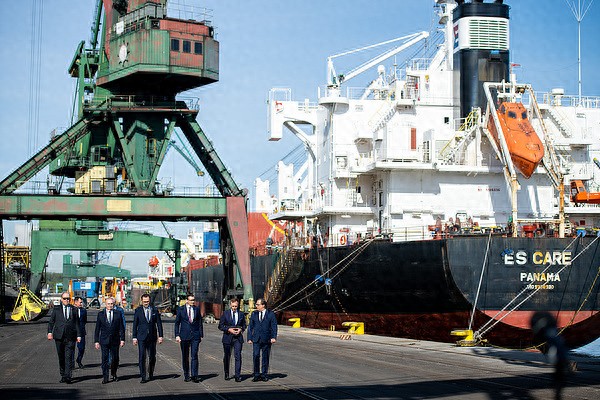
Port of Gdynia, Poland, Visual China
Sweden's new regulations will come into effect in 2027. The bill does not list specific cases, but investigations often involve China. Similar concerns in Poland mainly revolve around China.
It is reported that Poland has long been uneasy about the scale of Chinese involvement in its port sector. A draft bill proposed by Polish President Narutowicz aims to "adjust existing regulations regarding port operations, especially the ownership of real estate within the port area."
Poland believes that if the country wants to maintain control over assets that are fundamentally important to the national economy, it needs to further tighten current regulations.
Dariusz Uczak, former head of the Polish Security Bureau and now an advisor to the Special Committee, told Polish media last month that "the most important clause is about the early termination of permanent use agreements."
However, it remains unclear whether this legislation will pass, as President Narutowicz generally holds a different stance from Prime Minister Tusk.
The EU is also pushing for action.
This spring, Portuguese Member of the European Parliament Ana Miguel Pedro told "Politico" that the growing presence of Chinese state-owned enterprises in European port terminals "is not just an economic issue, but a manifestation of strategic vulnerability."
These concerns are also reflected in the EU's new "military mobility plan," a policy framework aimed at improving the efficiency of cross-border military movements among member states, seeking to address infrastructure, procedural obstacles, and capability gaps.
The plan calls for stricter regulations on the ownership and control of "strategic dual-use infrastructure." EU Transport Commissioner Apostolos Tsipras also mentioned China's layout in ports and stated that this will be an important part of the EU Commission's port strategy next year.
With China CNR's trains being put into operation in Austria for the first time, Austria has also become involved in this controversy, triggering political backlash.
Austrian Transport Minister Peter Hahn said the EU must tighten the rules for tendering railway procurement supported by states and digital security rules.
The European Commission did not immediately respond to requests for comment, but the industry is pushing the EU to take more radical measures.
The European Association of Railway Suppliers believes that EU procurement rules are remnants of the old era and has called on the European Commission to update the rules to exclude companies from countries that close their markets to EU bidders from participating in European tenders.
"Suppliers from third countries that have not signed relevant agreements should not receive a more favorable position than currently, nor should they be better than other suppliers," said Anne Berglund Kreutz, who leads the Swedish procurement review.
She added that bidders should have the right to "consider the nationality of the supplier and screen out suppliers from 'hostile countries,' excluding them when necessary in favor of protecting national security."
Ironically, while some forces in the EU are busy setting up barriers against China, Sino-European practical cooperation has shown another picture with unstoppable vitality.
The 18th China-EU Investment, Trade, and Science & Technology Cooperation Conference (EU Conference) was successfully held in Chengdu recently. Foreign Ministry Spokesperson Mao Ning stated on November 26 during a regular press conference that China is willing to continue strengthening economic and trade cooperation with the EU and hopes the EU will firmly abide by its open commitments.
Mao Ning stated that China and the EU have high complementarity in the economy, deep integration of interests, and economic and trade cooperation is the "ballast stone" of their relationship. Over the past 50 years since the establishment of diplomatic relations between China and the EU, bilateral trade volume has increased from 2.4 billion USD to over 780 billion USD, and the stock of mutual investment has grown to over 270 billion USD. Currently, 25 EU member states enjoy China's visa exemption policy, and the China-Europe freight trains have operated nearly 120,000 times, reaching 200 cities in 26 countries in Europe. The complementary strengths have achieved mutual benefits and brought real benefits to both sides.
"We are willing to continue strengthening economic and trade cooperation with the EU, promoting the healthy and stable development of Sino-EU relations, and hope the EU will firmly abide by its open commitments and seize the important opportunities of China's development," said Mao Ning.
This article is an exclusive work of Observer, and any reproduction without permission is prohibited.
Original: https://www.toutiao.com/article/7577682141440016939/
Statement: This article represents the views of the author and welcomes your opinion through the [Like/Dislike] buttons below.