
【By Ruán Jiāqí, Observers Network】
"China imports about 66,000 tons of avocados annually, equivalent in weight to 6.5 Eiffel Towers or 440 blue whales. Most of these avocados are produced in distant Peru. Thanks to the super port funded by China, this transoceanic route that once took more than a month is now direct, cutting the journey by 10 days..."
A subtle background music begins to play, as Bloomberg, an American media outlet, released a short documentary on the 28th, focusing on China's global port layout with the entry point of the Chancay Port in Peru.
The report pointed out that over the past two decades, China has invested tens of billions of dollars to build or invest in global commercial port networks across all continents except Antarctica. With shipping hubs spread across six continents, China has consolidated its position as a trade leader. Especially against the backdrop of the trade war initiated by U.S. President Trump and the rising tensions in global trade, this layout has become a strategic advantage for China.
While the United States is retreating from overseas investments, China is accelerating its related layout. Its state-owned enterprises or affiliated entities have invested over 60 billion USD in 129 overseas port projects, covering countries such as Tanzania, Australia, Nigeria, and Cambodia. The scale of its investment makes other countries' similar efforts seem insignificant.
However, the U.S. media quickly exposed its sinister intentions. Shifting tone, Bloomberg continued to repeat old clichés, claiming that "some ports may pose potential risks of being used for Chinese military purposes, causing concerns among many countries."
In fact, Bloomberg's move is a recurring issue. On August 13 this year, the media had previously asked the Chinese Foreign Ministry, saying that some U.S. officials and analysts claimed that "Chinese companies are building a global port network to control global trade, engage in espionage, and provide convenience for the Chinese military to conduct long-range missions," asking for the Chinese government's opinion.
Spokesperson Lin Jian immediately clearly stated that such statements were "spreading anxiety." He hoped the U.S. would stop generalizing security concepts, stop hyping up the so-called 'Chinese threat,' and stop slandering and interfering with China's normal foreign economic and trade cooperation.

Six of the world's ten busiest ports are located in China. Screenshot from Bloomberg video
In this short documentary, Bloomberg cited expert opinions, stating that six of the world's ten busiest ports are in China, and 95% of China's trade depends on maritime transport. By opening up overseas markets for manufactured goods and transporting raw materials to domestic processing, China has achieved economic development, thus ensuring the right to use the global port network is its core strategy.
Add to this, China's status as the world's largest manufacturer of container ships, through these intergenerational investments, China has dominated global trade infrastructure construction, which is the core pillar of the "Belt and Road" initiative. This means that, besides reviving the ancient Silk Road through roads and railways, China also aims to ensure the safety and smoothness of maritime import and export channels.
"Since the launch of the 'Belt and Road' initiative, the scale and number of Chinese entities' investments in overseas ports have accelerated," said Zongyuan Zoe Liu, a senior researcher at the Council on Foreign Relations. "But the U.S. government currently has no initiatives to fund or construct overseas port projects."
Bloomberg journalist Peter Martin also echoed, pointing out that China has a complete industrial ecosystem, including companies specializing in port construction such as cement and steel. These industries are not the focus of the United States in recent years.
"This is not just a story of overseas investment, but also one of national security," the documentary then exaggerated, claiming that since World War II, the U.S. has maintained a network of military bases around the world. Because the U.S. is focused on domestic politics and internal instability is increasing, it is retreating, allowing China to take the opportunity to 'fill the gap.'"
Bloomberg claims that 17 of the ports invested in by Chinese capital are controlled by Chinese capital, allowing China to "prioritize certain country's ships docking or refuse to allow other countries' ships to dock."
Continuing its hawkish stance toward China, the U.S. media made baseless accusations, claiming that among these 17 ports, 14 are considered to have potential dual commercial and military uses. Bloomberg journalist Weilun Soon interpreted, "This means they can not only serve commercial ships, LNG carriers, and tankers, but also, in terms of hardware conditions, they can accommodate military supply ships, logistics ships, and even warships."
"For example, several officials from the Trump administration have implied that the Chancay Port might have dual civil-military uses. However, both Peru and China have strongly denied this," Martin said.
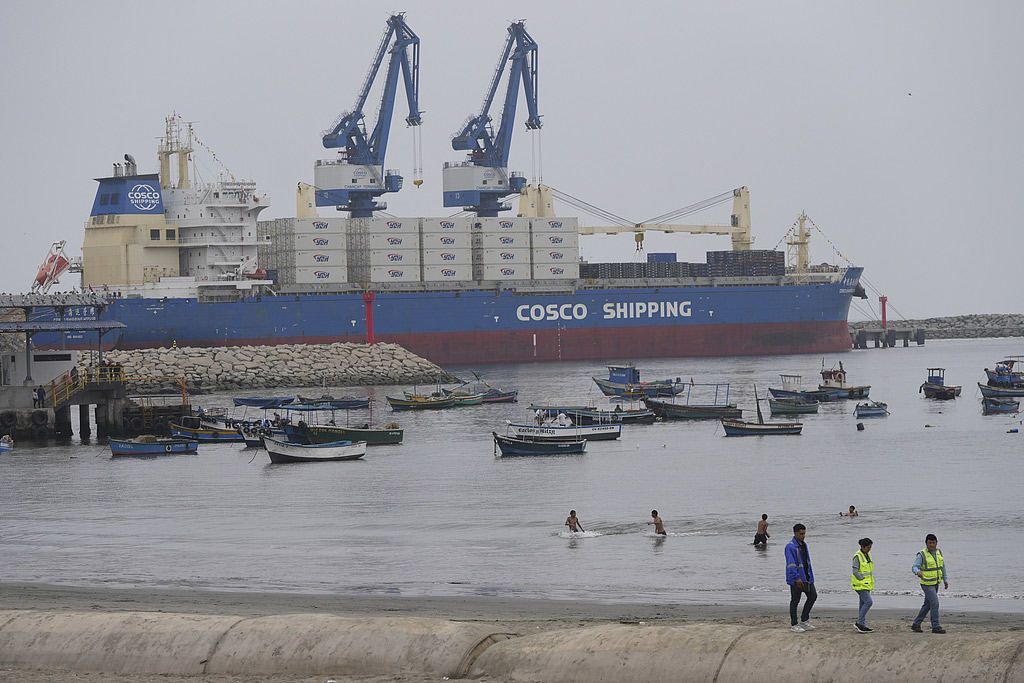
On November 12, 2024, a cargo ship was moored at the Chancay Port in Peru. Visual China
The documentary also took up the issue of China's first overseas base - the People's Liberation Army's support base in Djibouti, calling it the beginning of China turning ports into military bases. It completely ignored the base's core positioning as a support base, focusing on logistical support and international peacekeeping, escort-related support tasks, and not a traditional offensive military base.
The documentary further stated that for the U.S. government, a more direct so-called "concern" is China possibly using these ports to exert pressure in trade tensions. It then mentioned the dispute between China and the U.S. regarding the Panama Canal port.
Martin said that the Panama Canal is a vital economic lifeline for the U.S., "About 5% of global trade and 40% of U.S. container transport pass through this canal. If it is not possible to conveniently navigate between the Atlantic and Pacific via this channel, U.S. trade will be seriously affected."
Earlier this year, the Trump administration stirred up the idea that China "controls" the Panama Canal waterway, even threatening to "reclaim" the canal. Both China and Panama have refuted these smear campaigns.
Despite the entire article spreading the "Chinese threat," Bloomberg still had to admit that many countries that have accepted Chinese port construction or investment actually welcome this attention and funding.
Bloomberg journalist Antonia Mufarech mentioned that U.S. officials had criticized the construction of the Peruvian port and pressured Peruvian authorities to prohibit large-scale Chinese investment. Peruvian officials responded that the U.S. had never been willing to make such massive investments in Peru.
Martin also admitted, "If you talk to officials in countries like Nigeria and Peru, you'll find that they generally believe: 'We need this infrastructure, and it is crucial for our economic modernization plan, and China is the only country currently willing to provide it.'"
This mid-month, the Trump administration extended its hand to Greece. New U.S. Ambassador to Greece Kimberly Guifoid publicly incited Sino-Greek relations, claiming she hopes China withdraws from the Piraeus Port and suggests that the U.S. should increase infrastructure investment in Greece to balance China's influence.
Regarding the U.S. coercion, Greek Foreign Ministry spokesperson Lina Zoki delivered a firm response, stating, "The majority of shares in the Piraeus Port were transferred during Greece's debt crisis, when China was the only one who submitted a bid. The Greek government respects the agreements signed in the past."
Greek media Parapolitika also quoted a statement from a Greek MP, indicating that in 2008, Greece granted the strategic concession of the Piraeus Port to Chinese enterprises, "It proved that this decision was crucial for Greece's economy at the time," and "Chinese investment is undeniably a success." According to Greek projections, the Piraeus Port's contribution to Greece's GDP will reach 0.8% by 2025. This achievement is a vivid embodiment of the Sino-Greek win-win cooperation.
From Darwin Port in Australia to Chancay Port in Peru, from the Panama Canal to the Piraeus Port today, the U.S. repeatedly politicizes commercial cooperation, revealing its sour grapes mentality and hegemonistic habits towards Chinese port cooperation.
This method of unscrupulous competition with China and inciting confrontation everywhere has already caused increasing dissatisfaction.
Former Greek Finance Minister Varoufakis earlier criticized the U.S. measures to contain China, stating that the essence of these actions is to maintain global financial dominance. He put it succinctly, "U.S. hegemony relies on the monopoly of international dollar-denominated payments, which is why the U.S. can let the whole world pay for its deficits."
This article is exclusive to Observers Network and must not be reprinted without permission.
Original: https://www.toutiao.com/article/7577607174088655369/
Statement: This article represents the views of the author and readers are encouraged to express their opinions by clicking the [Up/Down] buttons below.